Kongji and Patji Myth Meaning & Symbolism
A Korean Cinderella tale where a kind-hearted maiden, Kongji, endures cruelty from her stepmother and stepsister, Patji, before a magical intervention leads to her royal destiny.
The Tale of Kongji and Patji
Listen, and let the old story breathe again. In a village nestled between the mountains, where the river sang a constant, patient song, there lived a girl named Kongji. Her world was the color of sun-warmed earth and her mother’s gentle laughter, until the day that laughter turned to silence, and the earth grew cold. Into that silence came a new mother, and with her, a daughter named Patji. Where Kongji’s heart was a deep, clear well, Patji’s was a shallow, grasping stream.
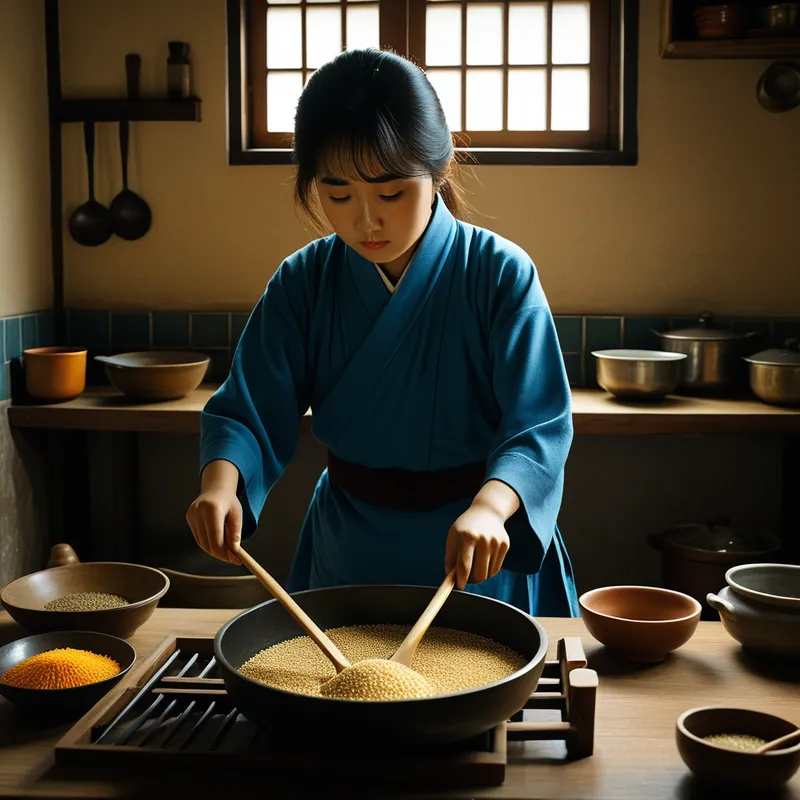
The hearth-fire of the home, once a place of shared stories, became Kongji’s sole domain. Her hands, which once plaited her mother’s hair, now cracked and blistered from endless chores. Patji and her mother wore fine clothes and ate sweet rice cakes, while Kongji’s bowl held only cold scraps. They called her foolish, slow, worthless—and each word was a stone added to the wall around her spirit. Yet, in the quiet moments, Kongji would look at the Mountain that watched over the village and remember a different kind of warmth.
One fateful day, the stepmother’s cruelty found a new shape. She took a large clay jar, poured in a bushel of millet and a bushel of rice, and mixed them into a maddening, inseparable heap. “Separate them by dawn,” she commanded, her voice like winter wind. “If a single grain is out of place, you will be cast out.” The door to the storage room shut, leaving Kongji in near-darkness with the impossible task. The mountain of grain loomed. Despair, thick and cold, began to fill her lungs.
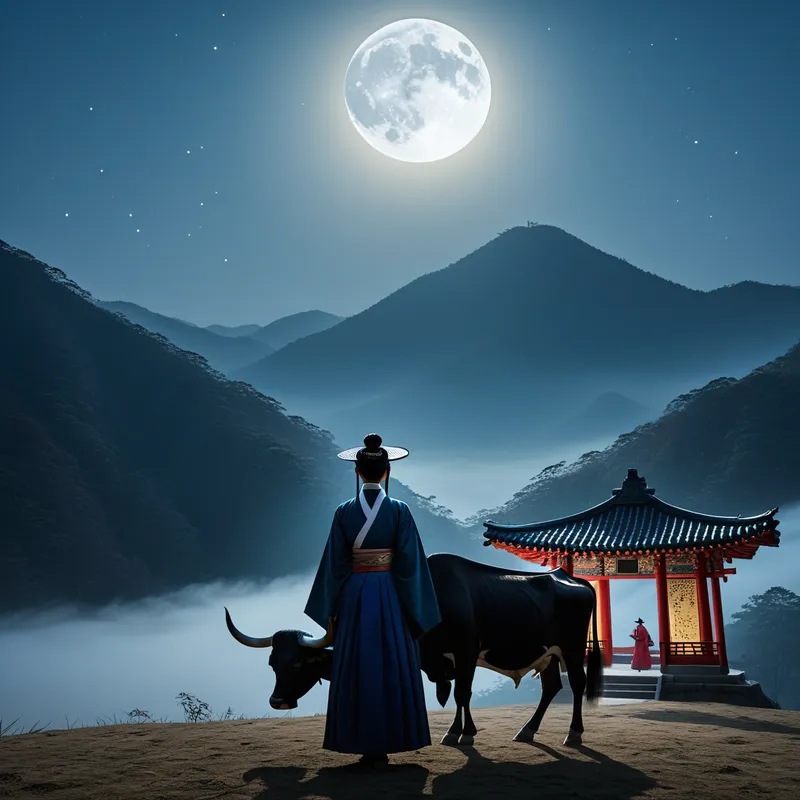
Then, a sound. A soft, persistent thump against the wooden door. Kongji opened it to find not a person, but a great, dark Ox, its eyes holding the deep, patient light of the night sky. Without a word, it lowered its massive head and began to sort the grains—millet to one side, rice to the other—with a speed and precision no human hand could match. As the last grain was placed, the first light of dawn touched the horizon. The ox turned its profound gaze upon Kongji, then melted into the fading shadows, leaving behind only the scent of turned earth and the completed task.
The stepmother’s shock curdled into rage. She devised a final, deadly test. She sent Kongji to draw water from the deepest, coldest well in the forest, hoping she would fall and be lost forever. At the well’s mossy lip, as Kongji peered into the dark water that mirrored the Moon, the stepmother herself appeared and pushed her in.
But the story was not done with Kongji. From the depths, a hand—not of flesh, but of shimmering, aqueous light—reached up and pulled her not down, but through. She emerged in a celestial realm, where a heavenly grandmother clothed her in robes of rainbow silk and sent her home in a palanquin fit for a queen, with a warning: “Do not look back.”
The procession wound down the mountain path. Behind her, Kongji heard Patji’s voice, shrill with envy, calling her name. Her heart, still tender with the memory of pain, fluttered. She glanced back. In that instant, the spell wavered. The palanquin stumbled, and she fell, losing one of her exquisite embroidered shoes in the mud of the mortal world.
It was this shoe that found its way to the hands of a visiting magistrate’s son. Struck by its beauty and the mystery of its owner, he vowed to find the woman whose foot it fit. He came to Kongji’s village. Patji and every other girl tried to force the shoe onto their feet, but it fit none. Then, from the shadows of the kitchen, Kongji stepped forward. The shoe slipped onto her foot as if returning home. The magistrate’s son saw not the cinder-girl, but the woman who had been tempered by the well and chosen by the sky. He took her as his bride. And as for Patji and her mother? The tales say they were swept away by a sudden, righteous flood—a final, cleansing act from the patient, watching mountain.
Cultural Origins & Context
The story of Kongji and Patji is a vital strand in the rich tapestry of Korean oral folklore, classified as a mindam. Unlike the courtly tales recorded in texts like the Samguk Yusa, this story lived on the breath of grandmothers, mothers, and itinerant storytellers in village squares and around hearths. Its primary audience was often women and children, serving as both entertainment and a vessel for cultural values.
Its societal function was multifaceted. On one level, it was a classic moral fable, reinforcing Confucian ideals of filial piety, endurance (innae), and the cosmic certainty that good is ultimately rewarded and evil punished. On a deeper, more psychological level, it gave voice to the powerless—the orphaned, the stepchild, the overworked daughter-in-law. It validated their unseen suffering and offered a fantasy of recognition and radical justice that the rigid social hierarchy often denied. The myth acted as a cultural pressure valve, allowing the expression of hope and resentment in a safe, symbolic container, while also modeling resilience in the face of profound injustice.
Symbolic Architecture
At its core, this is a myth of the Shadow and the Self. Patji and her mother are not merely villains; they are the externalized shadow of Kongji’s world—the embodiment of envy, cruelty, and narcissistic consumption. Kongji’s initial state is that of the pure, oppressed Innocent, who must integrate this shadow to become whole.
The impossible task is never about the grains; it is the psyche’s confrontation with chaos. The separation of millet from rice is the first, agonizing act of discernment—of distinguishing self from not-self, value from worthlessness, in a world that has deliberately confused them.
The celestial Ox represents the first intervention of the deep, instinctual Self. It is an archetypal force of ordering, nurturing, and earthly wisdom that arises when the conscious ego is on the brink of dissolution. The ox does not fight the stepmother; it solves the logical problem she presents, symbolizing how unconscious wisdom can navigate complexities the conscious mind cannot.
The final ordeal—the fall into the Well—is a classic Descent. Kongji does not drown; she is transformed. The well is a baptism into a higher order of being, facilitated by a divine feminine figure (the heavenly grandmother). Her return in splendor, followed by the lost shoe, signifies the emergence of the new, individuated Self into the world. The shoe is her unique imprint, her destiny, which only she can fulfill. The glance back is the poignant, deeply human moment where the newly forged Self is almost pulled back into the old patterns of engagement with the shadow.

The Dreamer's Resonance
When this myth stirs in modern dreams, it signals a profound process of Shadow-Work. To dream of being Kongji is to feel the somatic weight of unfair burdens, the exhaustion of people-pleasing, and the grief of being unseen. The body may feel heavy, the dream environment oppressive and domestic.
The figure of Patji or a cruel stepmother in a dream is rarely about an actual person. She is the dreamer’s own internalized critic, the voice of toxic shame, or the pattern of self-sabotage that says, “You are not enough.” The impossible task in a dream—be it sorting grains, climbing an endless staircase, or preparing a feast for ungrateful guests—maps directly onto a waking-life situation where the dreamer feels set up to fail, overwhelmed by chaotic demands (often internalized expectations).
The appearance of a helping animal or a sudden, miraculous rescue in the dream marks a turning point. It indicates that the psyche’s Self-regulating function is activating. The dream is not just replaying the wound; it is demonstrating the innate, archetypal resource available for healing. The dreamer waking from such a sequence may feel a strange sense of relief or hope, a somatic shift from constriction to a hint of potential space.

Alchemical Translation
The journey of Kongji is a precise map of psychic Individuation. It begins in a state of unconscious identity with the suffering ego (the oppressed maiden). The first alchemical stage, Nigredo, is her life of ash and toil—the burning away of naive innocence.
The stepmother’s cruelty is the prima materia, the base lead of the soul. Without this corrosive agent, the gold of the true Self would never be forced to separate from the dross of mere adaptation.
The sorting of the grains is Albedo, the purification. With the ox’s help, the psyche begins to order its contents, to separate complex, mixed emotions and traumas into identifiable components. This is the dawn of consciousness.
The descent into the well and rebirth is Citrinitas, the connection to a spiritual or transpersonal source. Kongji “dies” to her old identity and is reborn with a new, empowered perspective (the heavenly robes). Finally, her marriage and the fitting of the shoe represent Rubedo, the culmination. The unique Self (the shoe) is united with its destined place in the world (the bridegroom, representing the conscious attitude or life’s purpose). The flood that removes Patji is not a vengeful act, but the final integration: the conscious ego, now aligned with the Self, no longer has a toxic, autonomous shadow complex to battle. It has been assimilated, and its energy returned to the flow of life.
For the modern individual, the myth teaches that the path to wholeness is not through avoiding the “Patji” within—the inner critic, the envy, the rage—but by enduring its projections, performing the impossible tasks it sets, and thereby forcing the emergence of the profound, ordering, and ultimately liberating powers of the deep psyche. Our menial tasks are our grains to sort; our wells of despair are our portals to rebirth.
Associated Symbols
Explore related symbols from the CaleaDream lexicon:
- Water — The well represents the unconscious mind into which Kongji descends for her transformative baptism, emerging cleansed and reborn with a new identity.
- Mountain — The enduring, watchful presence that symbolizes the stability of the natural order and the divine realm from which aid and ultimate justice descend.
- Moon — Reflects the cyclical nature of Kongji’s fate, the feminine intuition that guides her, and the celestial body that often oversees magical transformations in the myth.
- Ox — The divine, instinctual helper that arrives to perform the impossible task, representing nurturing earth energy, patience, and the ordering wisdom of the unconscious.
- Shadow — Patji and her mother embody the externalized psychological shadow—the repressed cruelty, envy, and consumption that Kongji must ultimately integrate or overcome.
- Journey — Kongji’s path from oppressed maiden to recognized bride is an archetypal journey of the soul through suffering, aid, descent, and triumphant return.
- Rebirth — Her fall into the well and emergence in celestial robes is a classic symbol of death-and-rebirth, the shedding of the old, victimized self for a new, sovereign identity.
- Shoe — The lost embroidered shoe is the symbol of unique destiny and wholeness; it represents the perfect fit between the individuated self and its rightful place in the world.
- Goddess — The heavenly grandmother who robes Kongji acts as a divine feminine benefactor, facilitating the final stage of transformation and empowerment.
- Ritual — The stepmother’s impossible tasks are perverse rituals meant to break Kongji’s spirit, but which instead become the sacred trials that forge her strength.