Kombu Myth Meaning & Symbolism
A myth of a sea spirit offering nourishment from the depths, symbolizing the unconscious mind's gifts and the alchemy of bringing shadow into light.
The Tale of Kombu
Listen, and let the salt air fill your lungs. Let the memory of the sea, vast and unknowable, rise within you. This is not a story of grand palaces or clashing gods, but of the quiet, profound exchanges that happen at the world’s edge, where the land, weary and solid, meets the whispering, endless deep.
In a time when the mountains were young and the sea’s voice was the first sound heard each dawn, there lived a fisherman. He was a man of few words, his hands etched with salt and net-marks, his heart as steady as the tide. Each day, he would cast his nets into the grey-green waters, and each day, he would return with just enough—a few silver fish, enough to mend his boat and quiet his hunger. He lived in harmony with the deep, taking only what he needed, offering silent thanks to the unseen powers of the current and the abyss.
One evening, as the sun bled into the western sea and the first star, Hoshi, pricked the twilight, he rowed further than ever before. The water here was a different creature—dark as ink, cold as a forgotten memory. He cast his net, not for fish, but driven by a pull in his spirit he could not name. When he hauled it back, it was not heavy with life, but with a strange, dark treasure. It was a mass of long, leathery fronds, deep green and glistening, unlike any seaweed he had seen. It smelled of the profound depths, of minerals and secrets held for eons.
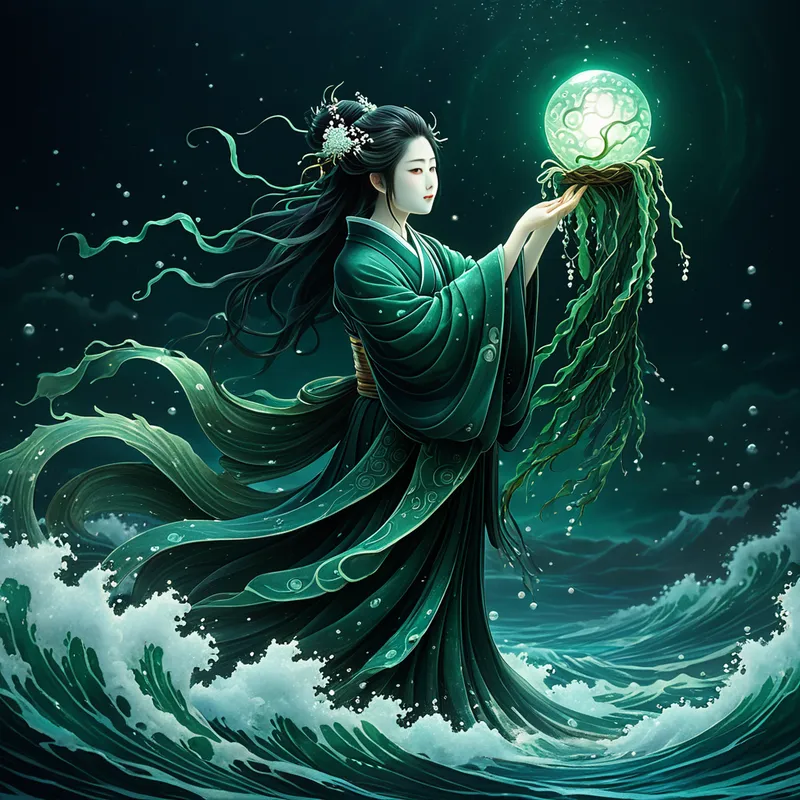
That night, as he sat by his driftwood fire, a mist rolled in from the sea, thick and silent. From within the mist, a form coalesced. It was a woman, yet not a woman. Her hair flowed like the Kuroshio itself, long strands of dark, glistening kelp. Her skin held the pallor of moonlight on deep water, and her eyes were the calm of a sheltered lagoon. She was Kombu, the soul of the deep-sea forest.
“You have taken from my hair,” she whispered, her voice the sound of waves receding over smooth stones. “You have drawn from the depth without fear, with respect. For this, I give you not just a catch, but a covenant.”
She gestured to the strange seaweed by his fire. “This is my body and my blessing. Boil it in water, and it will give you strength the fish cannot. It will heal the sick, nourish the weak, and bring flavor to the blandest broth. It is the gift of the deep to the shore, the hidden made manifest.” She then placed in his hands a smooth, black stone. “When your people are in need, cast this into the sea at high tide, and I will hear you.”
As dawn tinged the sky, she dissolved back into the mist, leaving only the scent of the ocean and the profound weight of her gift. The fisherman returned to his village. He did as instructed, simmering the kelp in a pot of water. A rich, savory aroma, umami itself, filled the air. The broth he made gave strength to the elderly and healed a child’s fever. He shared the knowledge, and the people learned to harvest with reverence, always leaving an offering of rice or salt upon the waves. The deep had spoken, and in its silence, it had offered sustenance.

Cultural Origins & Context
The story of Kombu exists in the oral traditions of coastal communities, particularly in Hokkaido and the Tōhoku region, where kelp harvesting has been a vital part of life and economy for centuries. It is a mukashibanashi, a tale from long ago, passed down by fishermen, grandmothers, and village elders. Unlike the formalized myths of the Kojiki or Nihon Shoki, this story belongs to the folk kami tradition, where natural phenomena and resources possess their own conscious spirit.
Its societal function was multifaceted. On a practical level, it encoded the sustainable practices of kelp harvesting—taking only what is needed, offering gratitude. It explained the origin of dashi, the foundational broth of Japanese cuisine, elevating a simple ingredient to a divine gift. On a spiritual level, it reinforced the Shinto concept of kansha, gratitude for nature’s bounty, and the intimate, reciprocal relationship between humans and the spirit world. The myth served as a reminder that survival and culture itself flowed from a respectful dialogue with the unseen depths.
Symbolic Architecture
At its core, the myth of Kombu is a profound map of the relationship between the conscious ego and the nourishing, mysterious unconscious. The fisherman represents the conscious self—grounded, practical, and operating at the surface of existence. His journey “further than ever before” is the courageous act of venturing into the deeper layers of the psyche, the “dark as ink” waters of the personal and collective unconscious.
The gift from the deep is never what the surface-mind expects; it is not the glittering prize, but the transformative substance.
Kombu herself is the archetypal embodiment of the nurturing aspect of the unconscious—the anima as provider and healer. She is not a maiden or a lover, but a maternal, elemental spirit. Her form, woven from seaweed, symbolizes the fertile, vegetative life of the psychic depths, the tangled, often overlooked growth that holds immense vitality. The act of boiling the kombu to create broth is the central alchemical image: through the “fire” of conscious attention and the “water” of emotion, the raw, unconscious content (the kelp) is transformed into a nourishing, digestible essence (the broth, the umami) that can sustain the entire psychic community.
The black stone is a potent symbol of the connection established—a talisman of the covenant. It represents the solidified, enduring link to the deep self, a tool for conscious recall and communication with the inner wellspring when the “village” of the psyche is in need.
The Dreamer's Resonance
When this mythic pattern stirs in the modern dreamer, it often manifests not as a literal seaweed spirit, but through a series of potent images and somatic feelings. One might dream of discovering a hidden, overgrown garden in a forgotten part of their house, of drawing up a net full of dark, interesting stones instead of fish, or of being offered a simple, warm broth by a serene, non-human figure during a time of exhaustion or illness.
Psychologically, this signals a process where the unconscious is actively seeking to offer its resources to a conscious life that has become depleted, bland, or disconnected. The somatic feeling accompanying such dreams is often one of deep, cellular relief—a warmth in the stomach, a sense of being “filled” in a non-physical way. It indicates that the psyche is initiating a healing process, drawing up nutrients from the shadowy depths of memory, instinct, and forgotten potential to fortify the conscious personality. The dream is an invitation to stop striving for surface-level “catches” and to learn the art of receiving the simpler, more profound sustenance that comes from within.

Alchemical Translation
The individuation process modeled by the Kombu myth is one of humble receptivity and transformative integration. The hero’s journey here is not one of slaying dragons, but of learning to cook—to perform the sacred, domestic alchemy of turning the raw stuff of the unconscious into soul-food.
The first stage is the Venture into the Deep: the conscious ego (the fisherman) must willingly move beyond its habitual fishing grounds—its known thoughts and patterns—into the colder, darker, unknown waters of the inner world. This requires quiet courage and a suspension of goal-oriented thinking (“not for fish”).
The second stage is the Reception of the Raw Gift: This is the encounter with the Kombu-anima, the nurturing face of the unconscious. The ego does not conquer or claim her; it listens. It accepts the gift in its strange, unprocessed form—the kelp, the complex emotion, the memory, the creative impulse that initially seems ungainly and obscure.
Individuation is the slow simmer that extracts flavor from the fibrous; it is the patient transformation of what is given into what sustains.
The final, ongoing stage is the Simmering and Serving: This is the core of psychic transmutation. The ego must apply the steady, low heat of reflection, the water of feeling, and the vessel of a receptive mind to the raw material. It is the work of making dashi—creating the foundational “flavor” of one’s life from the essence of one’s depths. The black stone remains, a symbol that this is not a one-time transaction but a living covenant. The nourished self then has the responsibility and the capacity to nourish the wider “village”—to contribute the unique, umami-rich essence of its own integrated being to the collective broth of humanity. In this myth, wholeness is found not in brilliance, but in depth; not in possession, but in grateful, transformative communion.
Associated Symbols
Explore related symbols from the CaleaDream lexicon: