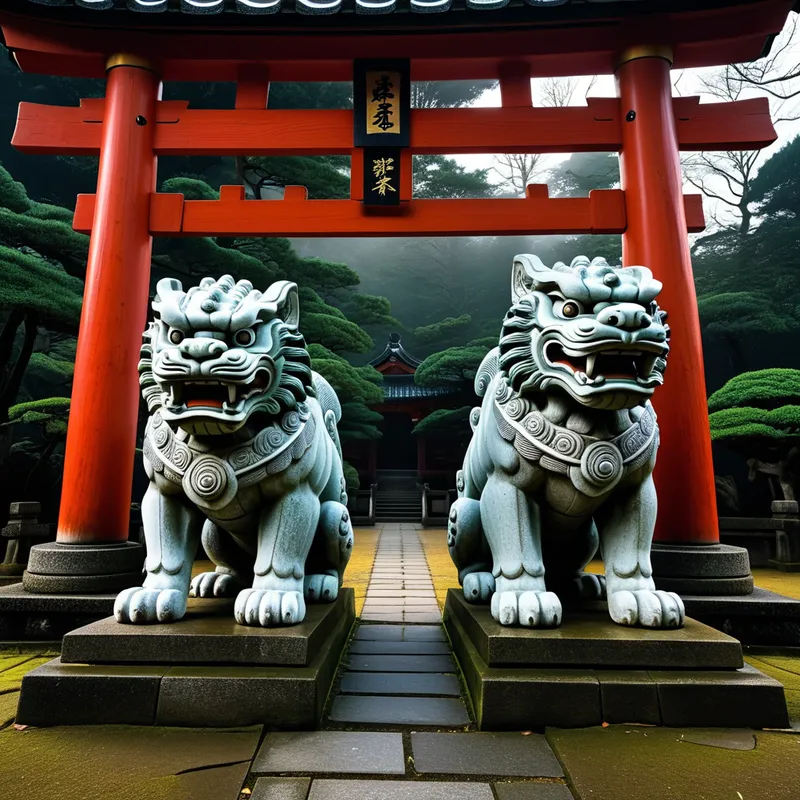
Komainu Myth Meaning & Symbolism
Twin lion-dogs, one roaring, one silent, stand sentinel at sacred gates, embodying the eternal dance of protection, duality, and the sacred boundary.
The Tale of Komainu
Listen, and let the mists of time part. Before the first shrine was raised, before the first prayer was whispered to the kami, there was a silence so profound it was a presence. And from that silence, a need was born—a need for a boundary between the world of form and the world of spirit, between the profane footsteps of humanity and the sacred groves of the divine.
The kami themselves conceived the answer. From the essence of mountain storms and the patience of ancient stone, they shaped a guardian. But a single sentinel was a lonely concept, an incomplete thought. So, they breathed life into a pair, twins born of the same sacred intent, yet divided in their fundamental nature.
The first drew breath with a roar that shook the dew from the cedar leaves—a sound to startle chaos, to declare “Here is a limit!” This was A-gyō, the one with mouth open, uttering the sacred syllable “Ah,” the sound of birth, of beginning, of all manifest creation.
The second drew breath inward, sealing its lips in an eternal, vigilant silence. This was Un-gyō, the one with mouth closed, holding the sacred syllable “Um” (or “N”), the sound of death, of completion, of the unmanifest potential from which all things return.
They were placed not as mere decoration, but as living doctrine in stone and wood. You see them at the threshold: at the gateways of shrines, guarding the torii, flanking the honden. A-gyō, to the left, facing south, roars at the approaching pilgrim, a challenge to purify intention. Un-gyō, to the right, facing north, watches the inner sanctum, its silence a containment of the sacred power within.
They do not sleep. Through centuries of falling cherry blossoms and driving winter snow, through the hum of modern life, they maintain their watch. Their conflict is not with monsters, but with the very entropy of meaning—the slow creep of the mundane into the holy, the forgetfulness that blurs the line between the sacred and the everyday. Their rising action is the daily drama of a thousand visitors passing between them, each one momentarily held in the tension of their duality. Their resolution is eternal, unchanging: the space between them remains a portal, forever defined, forever protected. They are the myth that is not merely told, but encountered with every step across a sacred boundary.
Cultural Origins & Context
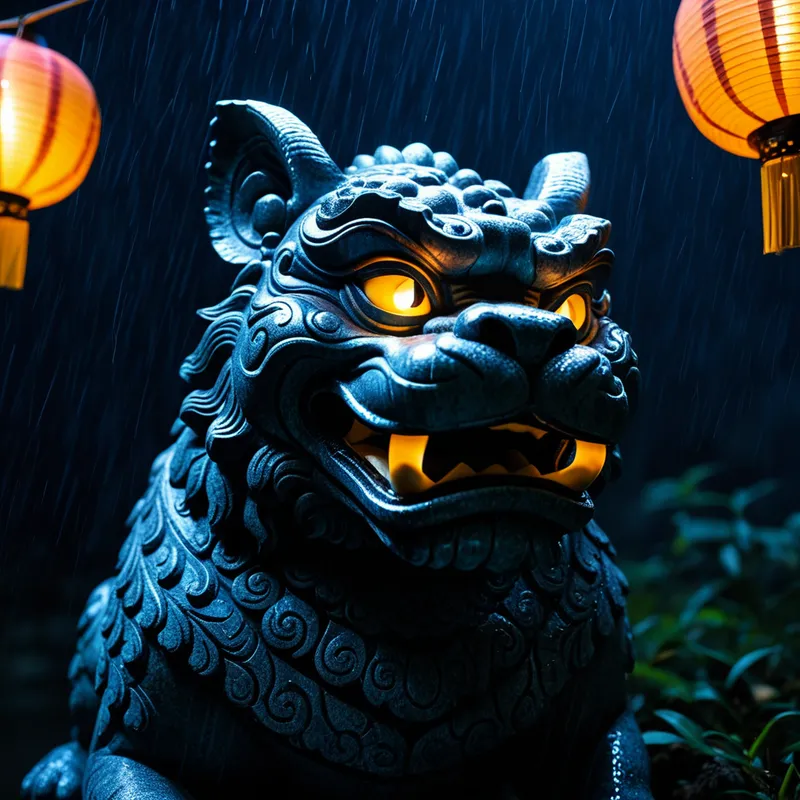
The Komainu, often translated as “Korean dog” or “lion dog,” trace their lineage back along the Silk Road. Their原型 (genkei, original form) is the Chinese guardian lion, which itself has roots in earlier Buddhist traditions from India and West Asia, where lions symbolized the power of the Buddha’s teachings. They arrived in Japan via the Korean peninsula, likely by the 6th or 7th century, as part of the cultural influx that brought Buddhism.
Initially, they were protectors of Buddhist temples. However, in the syncretic spiritual landscape of Japan, where Shinto and Buddhism intertwined for centuries, the Komainu underwent a profound assimilation. They were adopted by Shinto to guard its shrines, shedding some of their explicitly Buddhist iconography and becoming integrated into the native cosmology of the kami. This journey from continental import to quintessential Japanese guardian is a testament to the culture’s ability to absorb and transform external influences into something uniquely its own.
They were passed down not through a single epic poem, but through the hands of generations of sculptors and the repeated rituals of the people. Their societal function was, and remains, deeply practical and psychological: to physically and symbolically mark a transition. They announce, “You are now leaving the ordinary world. Prepare yourself.” They are a collective agreement, carved in stone, about where the sacred begins.
Symbolic Architecture
The Komainu are a masterclass in symbolic duality. They represent the fundamental binary codes of existence, made manifest as guardians.
The open mouth and the closed mouth are not opposites, but the two phases of a single, eternal breath—the inhalation and exhalation of the cosmos itself.
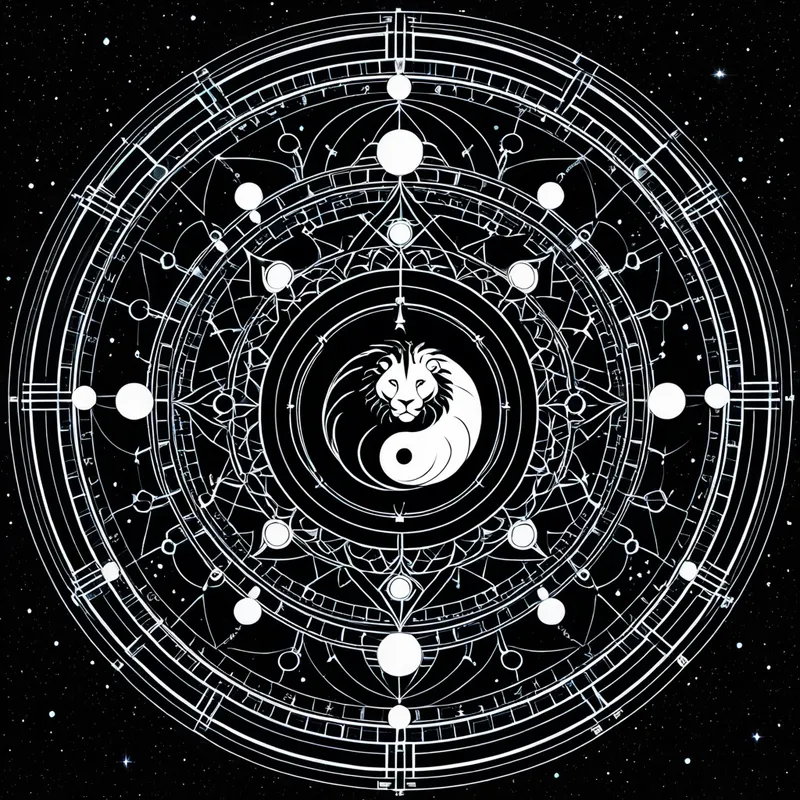
A-gyō, the open-mouthed, symbolizes the active, outward, masculine principle (Yang). It is expression, aggression, proclamation, and the expulsion of evil spirits. Its roar is the creative word, the setting of boundaries, the “Yes.” Un-gyō, the closed-mouthed, embodies the receptive, inward, feminine principle (Yin). It is contemplation, assimilation, hidden strength, and the containment of sacred power. Its silence is wisdom, potential, the “Not-yet,” the “No” that defines by limitation.
Together, they enact the complete cycle of protection: one drives away malevolence; the other nurtures and safeguards the sanctity within. Psychologically, they represent the necessary duality of the healthy psyche: the capacity for assertive action and receptive introspection, for speaking one’s truth and holding wise silence. They guard the threshold of the Self, ensuring that what enters and exits is conscious and intentional.
The Dreamer's Resonance
When the Komainu appear in modern dreams, they rarely come as stone statues. They arrive as felt presences, as a powerful somatic tension of duality at a threshold. To dream of them is to be in a process of navigating a critical boundary in one’s life.
You may dream of two immense, shadowy animals blocking a doorway you need to pass through. One may snarl, causing your heart to race (the somatic activation of A-gyō—confrontation, fear, the need to assert yourself). The other may simply watch, its gaze heavy and knowing, making you feel scrutinized and vulnerable (the somatic activation of Un-gyō—introspection, the feeling of being seen, the pressure to hold something in).
This dream signals a psyche working on a “threshold issue.” It could be a career change, the beginning or end of a relationship, a commitment to a new identity, or a confrontation with a repressed part of the self (the shadow). The Komainu-dream asks: What are you trying to bring into your sacred inner space? What are you trying to keep out? Are you roaring when you should be silent, or silent when you need to roar? The anxiety in the dream is the friction of this psychic negotiation at the gate.

Alchemical Translation
The individuation process—the journey toward psychological wholeness—is, at its core, about establishing conscious boundaries and integrating opposites. The Komainu myth provides a precise alchemical model for this.
First, one must erect the threshold. This is the courageous act of self-definition: “Here is where I end, and the world begins. Here is what is sacred to my being.” This is the placement of the paired guardians.
The alchemical work is not to choose between the roar and the silence, but to become the architect who places them both, who understands their necessary partnership.
The A-gyō principle must be integrated: we must learn to healthily roar, to set boundaries, to express our will, and to confront inner and outer demons. The Un-gyō principle must be equally honored: we must cultivate the capacity for deep listening, for holding space, for containing our energy and insight until the right moment.
The ultimate alchemical translation is the realization that these two guardians are not outside of us. We are the gateway they protect. The open mouth is our conscious engagement with the world; the closed mouth is the mystery of our unconscious depths. The triumph is not in destroying one or the other, but in achieving a dynamic balance where both can stand vigilant. In doing so, the sacred inner sanctum of the Self—the true honden where our unique essence resides—is kept intact, powerful, and accessible, allowing us to move between the inner and outer worlds with purpose and protection. We become, ourselves, a living shrine.
Associated Symbols
Explore related symbols from the CaleaDream lexicon: