Kolyada Myth Meaning & Symbolism
A myth of the young sun god's birth at the solstice, his defeat by the dark god, and his promise of inevitable return and renewal.
The Tale of Kolyada
Listen, and hear the tale of the turning. When the world is a bone-white husk, and the breath of Morana hangs in the air like knives, when the sun is a pale, weak ghost that flees the sky too soon—this is when the story stirs. It begins not with a shout, but with a whisper in the deep, dark earth, beneath the blanket of snow that smothers the land.
In the black heart of the longest night, a struggle older than memory unfolds. The old sun, weary and spent, has retreated. In his place rules Chernobog, the Dark God. His is the kingdom of frost-locked rivers, of silent forests where wolves howl not for hunger, but for the sheer emptiness of the void. He dances a slow, cruel dance of entropy, pulling the world deeper into slumber, into a forgetting from which there may be no awakening.
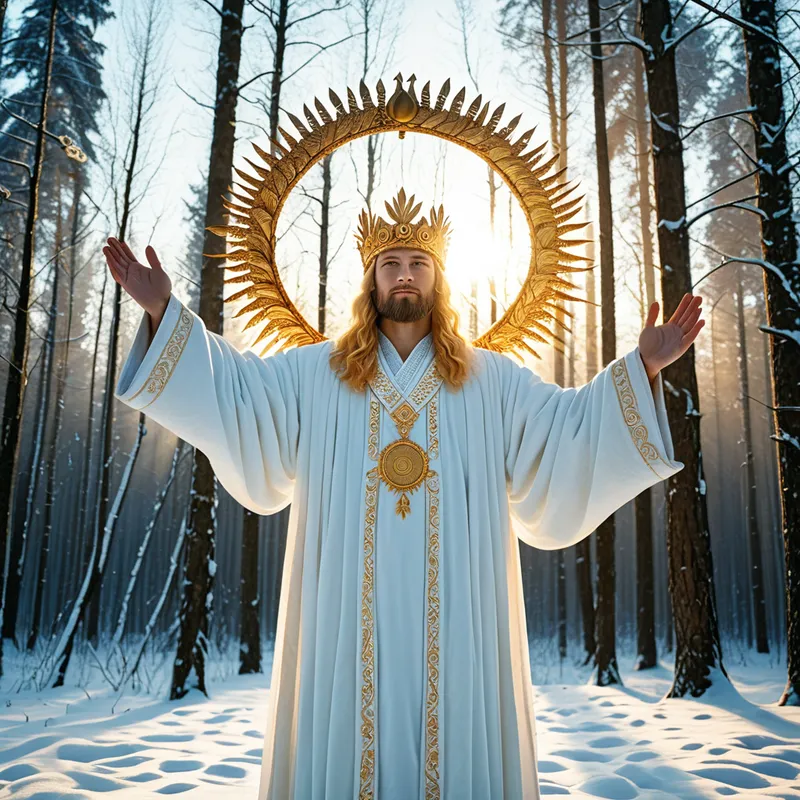
But in the sacred, hidden grove where the great World Tree dreams, a new ember is kindled. It is Kolyada. He is not the mighty, high-summer sun, but the infant sun, the promise. He is born not in a blaze of glory, but as a fragile, determined light in the mothering darkness. The earth herself holds him close. The spirits of the ancestors, sleeping in the roots of the Tree, hum a song of remembrance. He is swaddled not in cloth, but in the first hope.
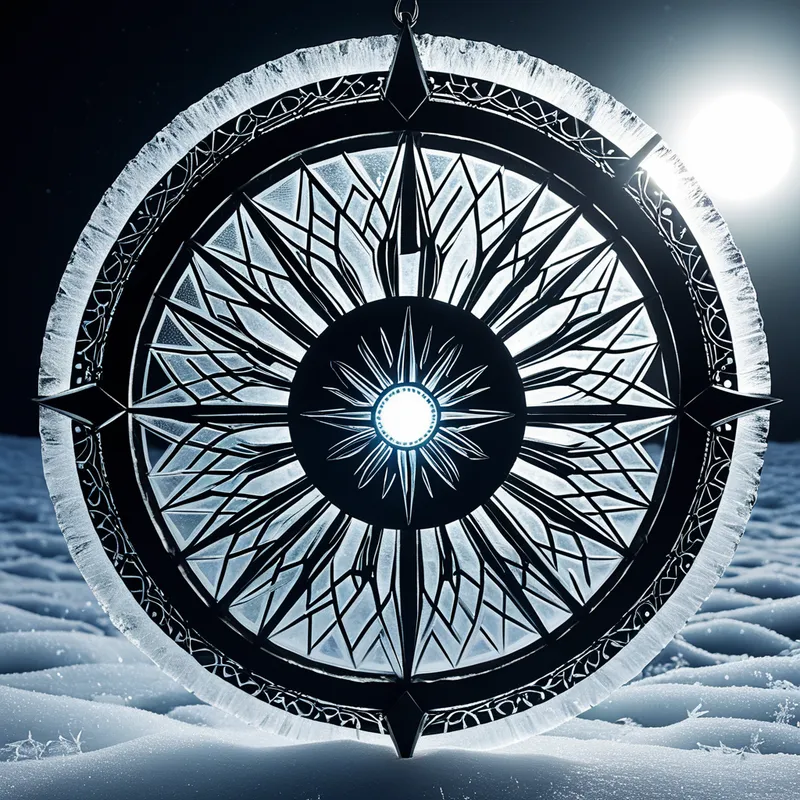
He rises, this golden-haired youth, carrying a wheel—a sun-wheel, a promise of cycles. He walks out from the grove into the frozen world. Where his bare feet touch the snow, it does not melt, but gleams with a faint, inner luminescence, like hoarfrost catching the first hint of dawn. He is the spark. His very presence is a challenge to the endless night, a declaration that the retreat is over.
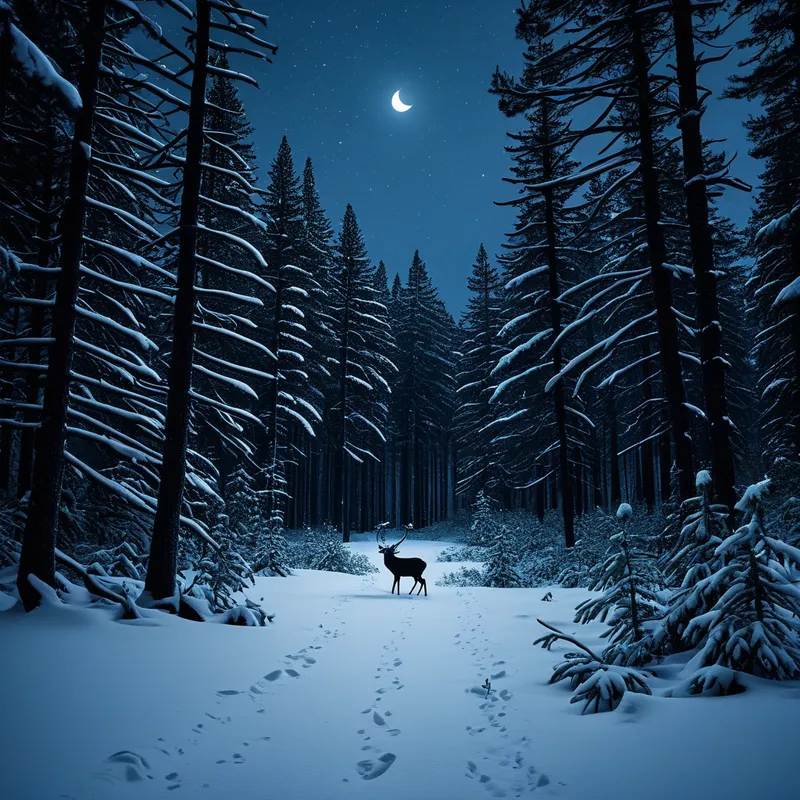
Chernobog feels this intrusion, this pinprick of defiance in his vast domain. From the deepest thicket, where the shadows are thickest, he emerges. He is not a monster of flesh, but a presence—antlered like a stag of the underworld, a shape of biting cold and profound silence. There is no great battle of clashing swords. The conflict is one of essence. Kolyada’s gentle, growing light against the consuming, passive dark. The Dark God does not strike with violence, but with weight, with the sheer mass of winter’s despair. He envelops the young god, not to destroy, but to capture, to still.
And Kolyada falls. His light dims. The wheel slips from his hand and rolls into the snow, half-buried. The world holds its breath. The spark seems to falter. Chernobog stands triumphant over the still form, believing the cycle broken, the light finally vanquished.
But this is the heart of the mystery, the secret known to the wise and the land itself. Kolyada’s fall is not an end. It is a sowing. His body does not lie like a corpse, but like a seed planted in the white earth. His captured light does not extinguish; it goes inward, deep into the dreaming heart of the world. The wheel, half-buried, continues to turn, invisibly, in the rhythm of the sleeping roots.
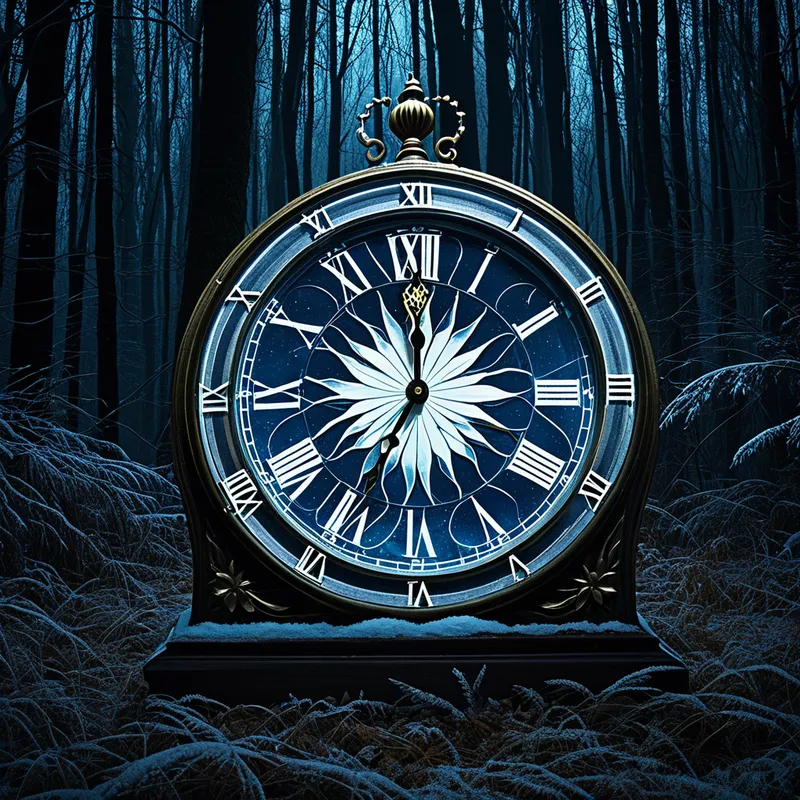
For three days, the world remains in this tense balance, poised on the knife-edge between death and life. Then, on the morning of the fourth day, a miracle, quiet and absolute. From the place where Kolyada fell, a new, tender light—different from before, wiser, more resilient—begins to glow. It is not the fallen youth who rises, but the promise fulfilled. The sun, reborn. The wheel of the year turns, unstoppable. The days begin, imperceptibly at first, to lengthen. The defeat was part of the journey; the capture was necessary for the transformation. Kolyada, in his seeming failure, has won. He has turned the deepest dark into the cradle of his own rebirth.
Cultural Origins & Context
The myth of Kolyada is not a single, canonical text, but a living pattern woven into the seasonal rituals of pre-Christian Slavic peoples. It was not read, but performed—sung, danced, and embodied during the Koliada festivities that spanned from the solstice to early January. The name itself likely derives from the Latin "calendae," hinting at the Roman influence on marking the new solar cycle, but its soul is deeply Slavic.
The tellers of this tale were the community itself, led by elders and ritual specialists. Groups of young people, often called kolyadovshchiki, would go from house to house, singing special, incantatory songs (kolyadki) that recounted the birth of the new sun and bestowed blessings of fertility, health, and abundance for the coming year. In exchange, they received food—a symbolic exchange that cemented the social contract and ensured the "seed" of prosperity was shared. The myth was thus a social and agricultural technology, a collective psychic operation to ensure the sun's return. It functioned as a narrative anchor in a world utterly dependent on seasonal cycles, transforming the terrifying uncertainty of the dying year into a story with a guaranteed, hopeful resolution.
Symbolic Architecture
At its core, the myth of Kolyada is a master symbol of the psyche's relationship with time, despair, and renewal. Kolyada is not the heroic conqueror who obliterates darkness; he is the vulnerable, necessary seed that must be buried by it.
The greatest light is not that which banishes all shadow, but that which is born from the shadow's deepest embrace.
Kolyada represents the nascent, fragile ego-consciousness—the first spark of a new attitude, a new idea, or a new phase of life. Chernobog is not mere evil, but the necessary, regressive pull of the unconscious, the depression, the winter of the soul that demands a retreat from outward striving. The confrontation is not a battle to be won through force, but a sacred, if terrifying, encounter where the new consciousness is overwhelmed and taken down into the underworld of the psyche (the snowy earth). This "defeat" is the alchemical nigredo, the blackening, where the raw material is dissolved.
The three days of stillness are the period of incubation, the mortificatio. The rebirth is the albedo, the whitening, and the beginning of the citrinitas, the dawning of a new, more integrated consciousness. The sun-wheel is the symbol of the Self and its mandala-like order, representing the eternal, cyclical nature of psychic life, where every ending contains the blueprint of a new beginning.
The Dreamer's Resonance
When this myth stirs in the modern dreamer, it often manifests not as a clear narrative, but as a profound somatic and emotional landscape. You may dream of being trapped under ice, feeling a crushing cold paralysis, yet sensing a strange, warm pulse deep in your chest. You may dream of a cherished project—a book, a painting, a relationship—shattering or being buried, accompanied not by horror, but by a deep, inexplicable certainty that this is "right," that it must be lost to be remade.
Psychologically, this is the process of a necessary dissolution. The ego is being invited, or forced, to surrender a current form of identity or striving. The "Chernobog" phase in dreams can feel like clinical depression, burnout, or a catastrophic failure. The dreamer is experiencing the myth's truth: that before a new structure of life or meaning can be built, the old one must fully de-integrate. The dream imagery provides the container for this death, assuring the deeper psyche that this freezing, this falling, is not annihilation, but the prelude to a more authentic rebirth. The body may feel heavy, numb, or cold upon waking—a direct somatic echo of the mythic "capture."
Alchemical Translation
For the individual on the path of individuation, the Kolyada myth models the most counter-intuitive of psychic laws: that progress requires regression, and strength is born of surrender.
The work is not to avoid the fall, but to learn how to fall correctly—to fall as a seed, not as a stone.
The first step is the recognition of the "Kolyada spark"—a new potential, a calling, or a creative impulse that feels bright but vulnerable. The conscious mind often wants to protect this spark, to shield it from the cold world. The myth, however, instructs us to courageously walk it into the very heart of our personal winter—into our neglected shadows, our unresolved grief, our frozen fears (Chernobog). This is the act of conscious engagement with the unconscious.
The critical alchemical operation is the surrender. When the new attitude is inevitably overwhelmed by the weight of old patterns or depression, the task is not to fight harder, but to consciously allow the capture. This is the sacrifice of the hero's hubris. It means stopping the frantic doing, entering a period of intentional stillness, and letting the light go inward. This is the "planting" phase—a time for journaling, dreaming, therapy, or simple, undirected being. It is a trust in the process of the Self, symbolized by the ever-turning wheel, which operates on a timeline deeper than the ego's impatience.
The rebirth is not a return of the same, but the emergence of something transformed. The new sun that rises is more resilient because it has integrated the darkness. It carries the memory of the underworld within its light. For the individual, this translates as a renewed sense of purpose that is less brittle, a creativity that draws from the depths, and an ego that is humbler yet more grounded, having made peace with the cyclical nature of its own existence.
Associated Symbols
Explore related symbols from the CaleaDream lexicon:
- Sun — The central symbol of Kolyada himself, representing consciousness, life force, and the promise of renewal that is born from its apparent death at the solstice.
- Darkness — Embodied by Chernobog, it represents the necessary, fertile void of the unconscious, the time of incubation and dissolution that precedes all creation.
- Seed — Kolyada in his fallen state is the divine seed planted in the winter earth, containing the entire potential for the new cycle within a vulnerable husk.
- Wheel — The sun-wheel Kolyada carries is the symbol of cosmic and psychic order, the eternal cycle of death and rebirth that governs all things.
- Sacrifice — Kolyada's willing capture and fall is the ultimate sacrifice, a surrender of the young ego to a greater cyclical law to ensure the continuation of life.
- Rebirth — The core promise of the myth, the inevitable emergence of new light and life from the depths of darkness and symbolic death.
- Winter — The seasonal and psychological setting of the myth, a time of enforced stillness, introspection, and the cold testing of what is essential.
- Tree — The World Tree as the stable axis of the cosmos, within whose roots the new sun is nurtured and from which he emerges.
- Light — Not as a conquering force, but as a fragile, persistent ember that must journey through darkness to gain its true strength and character.
- Cycle — The fundamental law illustrated by the myth, the understanding that life, psyche, and time move not in a line but in a sacred, repeating circle.