Koke-dera Myth Meaning & Symbolism
A grieving monk's sorrow transforms a barren temple into a living sanctuary of deep green moss, revealing a sacred covenant between human heart and earth.
The Tale of Koke-dera
Listen, and let the mists of kamiyo part. There was a temple, once, high in the mountains where the air is thin and the silence is a presence. It was not always called the Temple of Moss. In its beginning, it was a place of bare wood and stark stone, a severe outpost of devotion where a monk lived a life of austere ritual. His prayers were precise, his movements measured, but within his chest beat a heart heavy with a private ocean of grief.
He had loved, and lost. The memory was a stone lodged in his soul. Each day, he would perform his duties before the altar, but his chants were dry leaves, his sutras empty vessels. The temple grounds reflected his inner world: barren, hard-packed earth, stones bleached by sun and scoured by wind, a landscape of profound absence. No softness grew there. No green thing dared take root.
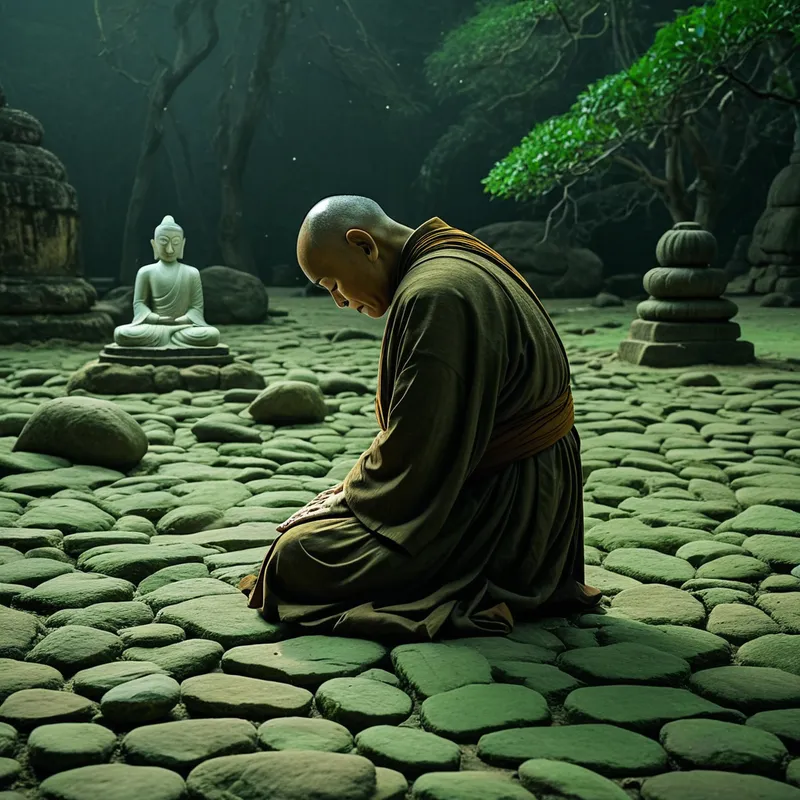
One evening, as the monk knelt in his cell, the weight became unbearable. It was not a storm of weeping, but a quiet, final surrender. A single tear, holding the salt of a lifetime’s sorrow, escaped his eye. It fell onto the dry tatami mat. And then another. And another. He did not wipe them away. He let them fall, a silent, sacred offering to the emptiness.
He rose and walked into the temple courtyard under a moon like a sliver of bone. Moving as if in a trance, he began to walk the paths, the stone steps, the bases of the lanterns. And as he walked, his tears fell upon the earth. Where each tear landed on the barren stone, a miracle, slow and secret, began. Not a flash of light, but a whisper of life. A faint, almost imperceptible greenness—a softening.
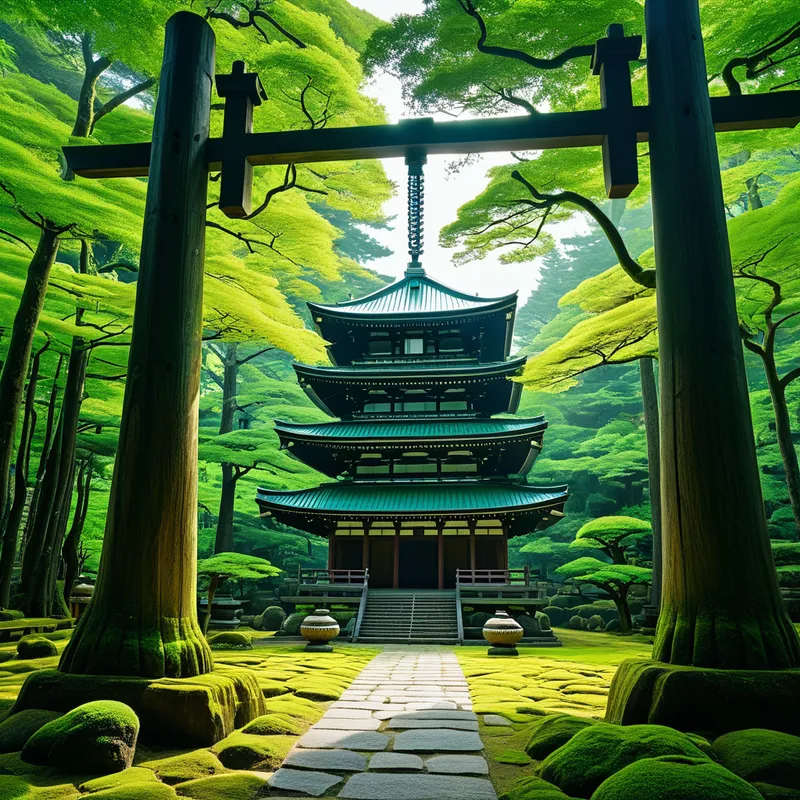
The monk did not notice at first. He continued his tearful pilgrimage night after night, his grief flowing out of him and into the bones of the temple. And the temple began to drink it in. The hard angles of stone began to blur. The gray surfaces grew a tender fuzz. A deep, emerald moss, of a kind never seen in those mountains, began to spread. It crept over the pathways, clothing the stones in velvet. It climbed the wooden pillars and draped the roof tiles. It transformed the stark torii gate into a living archway. The entire temple complex was being swallowed by a gentle, relentless, green silence.
One morning, the monk awoke and stepped outside. He blinked. The world had changed. The harsh light was filtered through a canopy of green. The air was cool and smelled of damp earth and profound peace. The sound of the wind was muffled by a thousand soft surfaces. His temple, his world of grief, had become a sanctuary. He knelt on a cushion of moss, and for the first time, his prayer was not a plea, but a sigh of gratitude. The moss had not erased his memory; it had cradled it, transforming a monument to loss into a living testament to the healing embrace of the earth. And so, Koke-dera was born.
Cultural Origins & Context
The story of Koke-dera exists in the liminal space between folklore and spiritual anecdote, often attached to real temples in Japan famed for their moss gardens, such as Saihō-ji in Kyoto. It is a setsuwa, a moral tale passed down not by grand imperial chronicles but through oral tradition, likely by monks, pilgrims, and lay storytellers. Its function was deeply pedagogical, serving the Buddhist and Shinto-infused worldview.
In a culture that views nature not as a resource but as a community of sentient spirits (kami), the myth reinforces a sacred reciprocity. It teaches that human emotion is not separate from the natural world but a potent force within it. The tale would have been told to illustrate the Buddhist concept of mujō, not as a bleak truth, but as a transformative one: even grief, when fully felt, changes form and gives birth to new, unexpected beauty. It served as a somatic map for processing loss, showing that spiritual practice (the monk’s devotion) must eventually make room for raw, human feeling for true transformation to occur.
Symbolic Architecture
At its core, Koke-dera is an alchemical map of grief. The barren temple symbolizes the psyche in a state of petrified sorrow—orderly, functional, but devoid of life-giving moisture and softness. The monk represents the conscious ego, attempting to maintain discipline while housing an unconscious, emotional truth that demands expression.
The tears are the crucial catalyst. They are not mere water; they are the distilled essence of felt experience, the soul’s liquid truth breaking through the dam of stoic control.
The most profound healing often begins not with a solution, but with a dissolution—the sacred, salty waters of the heart softening the hardened ground of the self.
The moss is the symbol of the emergent, integrative life that follows authentic emotional release. Moss is a primordial, non-vascular plant; it requires constant moisture, thrives in shade, and creates ecosystems from seemingly inert stone. Psychologically, it represents the slow, organic growth of a new attitude—one of acceptance, softness, and interconnectedness. It does not replace the stone (the core self or memory); it envelops it, creating a new, more complex, and living whole. The transformation of the temple into a forest sanctuary signifies the birth of an inner himorogi—a sacred space where the human and the natural, the personal and the transpersonal, are reconciled.

The Dreamer's Resonance
To dream of Koke-dera is to dream in the key of deep, somatic processing. One might not dream of a literal moss-covered temple, but of analogous symbols: a childhood home overgrown with lush, peaceful vines; a scar on the body that blossoms into a beautiful, intricate pattern; a hardened, metallic object in the chest that slowly becomes porous and sprouts delicate ferns.
These dreams signal that the psyche is engaged in a profound work of melancholic alchemy. The conscious mind may be holding onto a narrative of loss, bitterness, or emotional drought. The dream presents the counter-movement: the unconscious, life-affirming impulse toward envelopment and healing. The somatic sensation upon waking may be one of deep, unexpected peace, a "green" feeling, or a release of tension in the chest or throat—as if the moss within is doing its silent work of holding and transforming old, crystallized pain. It is the dream of the caregiver archetype within, finally turning its compassion inward.

Alchemical Translation
The myth of Koke-dera provides a non-heroic, profoundly feminine model of individuation. The process is not one of slaying dragons or seeking glorious quests, but of yielding, moistening, and allowing.
The first alchemical stage is Recognizing the Barren Temple: The conscious acknowledgment of one’s inner state of emotional aridity, where routine has become a prison and feeling has been exiled.
The crucial operation is The Sacred Dissolution: This is the nigredo, the darkening. It is the conscious, courageous decision to feel the grief, the loss, or the sorrow fully—to let the tears fall without narrative, without justification, without stopping them. This is the offering of one’s most vulnerable substance to the unconscious.
The alchemical vessel is not a flask of glass, but the humble, human heart cracked open by its own truth.
The transformation is The Emergence of the Viriditas: A medieval mystic’s term for the greening power, the spiritual moisture of life. The moss represents this viriditas—the slow, silent, organic growth of a new psychic structure. It is the integration of the shadow (the grief) not by analysis, but by envelopment. The ego (the monk) does not do anything to the moss; it witnesses its growth and learns to live within its new, softened reality.
The final stage is Dwelling in the Sanctuary: This is the rubedo, the reddening or fulfillment, manifested here as deep green peace. The individuated self is no longer the austere monk in a barren yard, but a humble resident in a living, breathing, interconnected whole. The personal pain has been transmuted into a general capacity for empathy, stillness, and a profound sense of ecological belonging—a true kannagara. One becomes, like the temple itself, a sanctuary where life, in all its tender, persistent forms, is welcome to grow.
Associated Symbols
Explore related symbols from the CaleaDream lexicon: