Koji-kin mold Myth Meaning & Symbolism
A myth of a divine mold, born from sacred decay, that transforms the raw into the sublime, teaching the alchemy of spirit through fermentation.
The Tale of Koji-kin mold
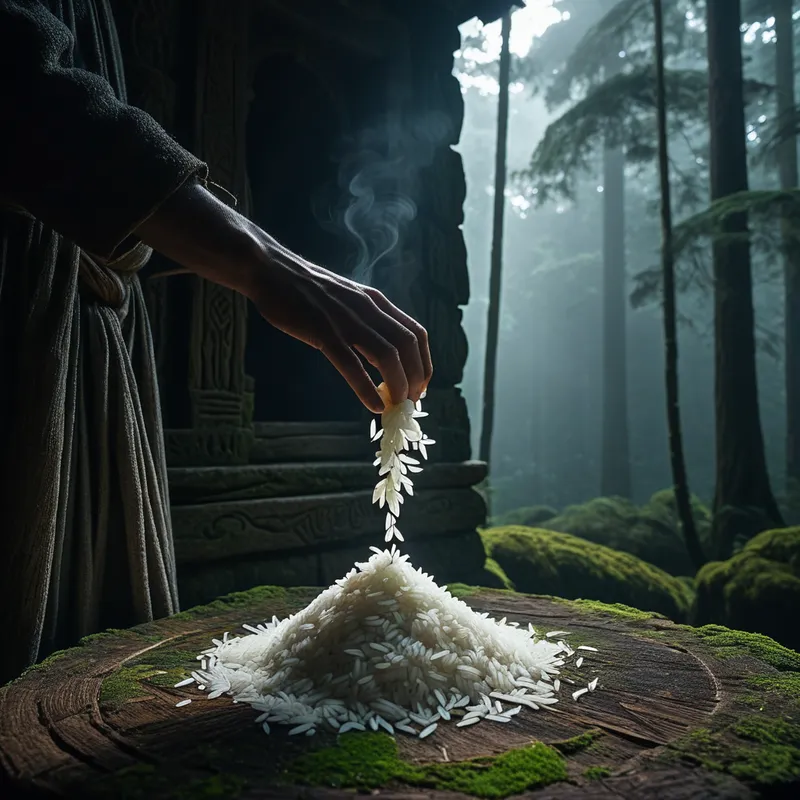
In the time when the world was still soft from the breath of the Kami, when the mountains were young and the rivers sang their first songs, there existed a profound silence within the heart of matter. The people received the bounty of Ukanomitama, the steamed rice, white and pure as cloud-flesh. It was sustenance, but it was static. It filled the belly but did not stir the spirit. It was a gift awaiting a second, more mysterious giver.
This silence was heard by a presence that dwells not in the bright realm of the sun, but in the fertile, humid dark—the threshold between being and un-being. From the sacred decay of offerings left in the still, shadowed alcoves of forest shrines, a whisper took form. It was the spirit of transformation itself, a Kami born of patience and subtle warmth. They called it Koji-kin.
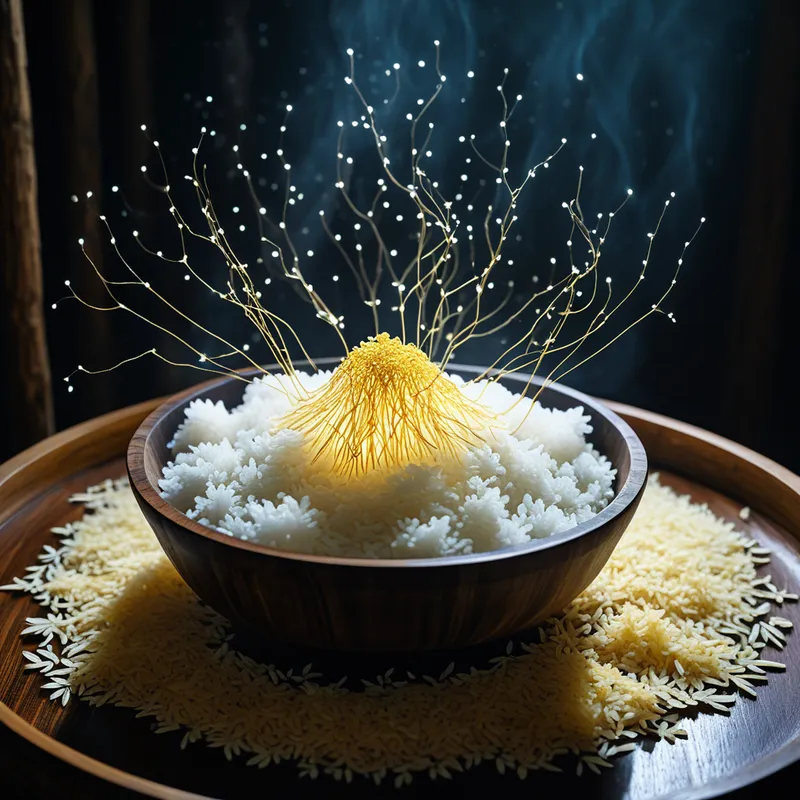
It did not arrive with thunder, but with a scent—a sweet, profound, and earthy fragrance that hung in the air of the storehouse like a promise. The people witnessed a miracle of gentle conquest. Where the steamed rice lay, a dusting of celestial mold appeared, a bloom as delicate as the first frost, yet pulsating with a quiet, golden life. It was not a corruption, but a colonization by the sacred. Fine, white mycelial threads, like the roots of a hidden world, embraced each grain, weaving them into a single, breathing entity.
The mold worked its silent magic, a sacred digestion. It sacrificed its own being to break apart the starches, the solid sugars, transforming them into a sweetness that had not existed before. It was an alchemy of the threshold, turning the dense gift of the earth into something ethereal, something that could ascend. From this transformed heart, the first sake was born—not squeezed, but summoned. It was the tears of joy from the rice itself, liberated by the mold’s embrace. The miso deepened into umami soul, and the shoyu became the liquid shadow of flavor.
The conflict was not of battle, but of perception: to see the beauty in the process of controlled decay, to recognize the divine in the agent of transformation, not just in the pristine gift. The resolution was a feast for the gods and humans alike, a shared cup of transformed spirit. The Koji-kin mold, the humble, powerful kami of the in-between, taught that the raw material of life is not an end, but a beginning, awaiting the touch of the sacred ferment to reveal its true, intoxicating spirit.
Cultural Origins & Context
The mythos of Koji-kin is woven into the practical and spiritual fabric of Japanese life, its origins inseparable from the development of staple ferments like sake, miso, and soy sauce. Unlike grand cosmogonic tales recorded in the Kojiki, the story of Koji-kin was passed down not through imperial anthologies, but through the oral traditions of brewing families (sakagura) and village elders. It was a kuden—a secret, transmitted wisdom—of the fermentation masters.
Its societal function was multifaceted. On a practical level, it encoded crucial microbiological knowledge in a sacred narrative, ensuring respect for the precise, clean conditions needed to cultivate the beneficial mold and ward off harmful spirits (contaminants). Spiritually, it reinforced the core Shinto principle of kami residing in all processes of nature, especially those of life, death, and regeneration. The toko (fermentation room) was a sanctified space, and the brewmaster a priest tending a living ritual. This myth served as a bridge, transforming a technical craft into a sacred collaboration with invisible, vital forces, ensuring both material sustenance and spiritual continuity.
Symbolic Architecture
At its core, the Koji-kin myth is a master symbol of mediated transformation. The mold is not the source material (rice), nor the final product (sake). It is the essential, catalytic third thing that makes the journey possible.
The true alchemist is not the gold, nor the lead, but the mysterious medium that allows one to become the other.
Psychologically, Koji-kin represents the transforming function of the psyche—often associated with the Trickster-Magician. It is that inner agency capable of "digesting" raw experience (the steamed rice of our lives—nutritious but bland, factual but unintegrated) and breaking it down into fermentable sugars of meaning and emotional resonance. It works in the warm, dark, and often neglected chambers of the unconscious, requiring patience, the right conditions, and a surrender of the ego's desire for pristine control.
The mold’s action is a sacred decay. It symbolizes the necessary psychological process of breaking down rigid structures, outdated identities, and compacted memories to release their latent sweetness and potential for spirit. This is not destruction, but a purposeful deconstruction guided by an innate, intelligent principle within the soul itself.

The Dreamer's Resonance
When this mythic pattern stirs in the modern dreamer, it often manifests in imagery of controlled decomposition, fungal growth, or processes happening in warm, dark, enclosed spaces (cellars, attics, the body itself). One might dream of food transforming on its own, of their own skin becoming a network of roots or mycelium, or of a forgotten room in a house where something is quietly, beautifully sprouting from the damp.
Somatically, this can correlate with feelings of deep, internal warmth, a humming patience, or the peculiar sensation of something working inside—akin to the gentle fermentation of ideas or emotions. Psychologically, the dreamer is likely in a potent incubation phase. A significant life experience or a dense emotional "grain" has been received and is now being processed by the psyche's own Koji-kin. The conflict felt is the anxiety of this "decay"—the fear that one is falling apart, rather than being subtly remade. The dream reassures: the process is sacred, intelligent, and will yield a new spirit, a new intoxicating clarity, if given the proper, respectful space and time.

Alchemical Translation
The individuation journey modeled by this myth is one of embracing the catalyst within. It moves beyond the heroics of conquering external dragons to the more subtle, profound work of internal fermentation.
The first step is the "steaming"—the application of life's heat and pressure to make our raw nature receptive. Then, one must consciously create the toko, the sacred, bounded space (through meditation, journaling, therapy, creative practice) where the transforming function can work. Here, we invite the Koji-kin—our inner Magician—and learn to trust its silent, pervasive work.
The goal is not to become the mold, but to become the vessel in which its sacred transformation can occur, yielding the sake of a more profound and spirited consciousness.
This requires a sacrifice: the willingness to let our certainties, our "solid" sense of self, be broken down into something more fluid and complex. The ego, like the rice, must submit to a process it does not control. The triumph is the distillation of a new substance—a symbolic sake or miso. This is the deeper flavor of the self, the intoxicating wisdom, the resilient umami of soul that can only emerge from the alchemy of time, darkness, and the gentle, relentless work of the spirit-mold. We learn that we do not just have experiences; we ferment them, and in doing so, we discover the divine agent of transformation that has been within us, and within all processes of life, all along.
Associated Symbols
Explore related symbols from the CaleaDream lexicon: