
Koji-kin Myth Meaning & Symbolism
A mythic tale of a divine ferment, born from celestial breath and earthly grain, catalyzing creation and embodying the sacred transformation of substance and spirit.
The Tale of Koji-kin
Listen, and let the steam of the sacred kettle carry you back. Before the first sake warmed a throat, before the first miso deepened a broth, there was a silence in the world of mortals. The grains—rice, barley, soy—lay dormant in their stores, full of potential but locked in stasis, their sweetness a secret kept from the tongue of humanity.
In the high plain of Takamagahara, the kami watched. They saw the people’s hunger extend beyond the belly, into a thirst for joy, for communion, for a warmth that mere fire could not provide. Amaterasu-Ōmikami, whose light coaxed life from the soil, felt a divine compassion. But her light alone could not unlock the spirit within the seed.
Thus, she breathed upon a cloud of her own radiant essence, mingling it with the moist, life-giving breath of the wind kami, Fūjin. This mingled exhalation, a sigh of celestial intent, descended to the mortal realm as a gentle, golden-hued spore. It drifted on the autumn wind, through the slatted walls of a humble storehouse where the season’s rice harvest lay.
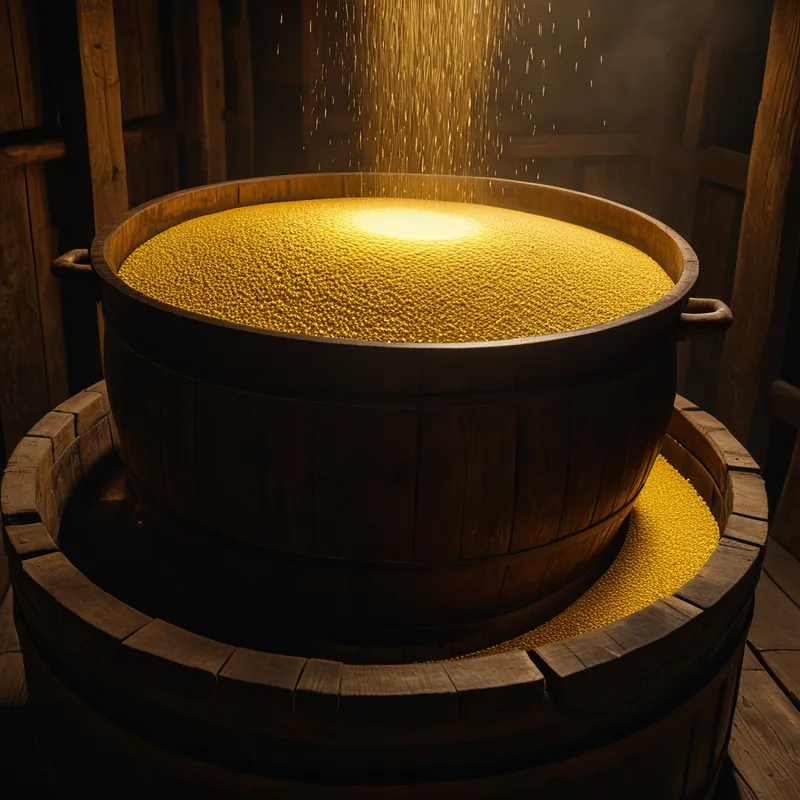
There, in the cool, dark stillness, the spore found its destiny. It settled upon a single, perfect mound of steamed rice. For three days and three nights, a sacred vigil unfolded unseen. The spore awoke, sending forth filaments as fine as spider-silk, a living lace of delicate, pale gold. It was a quiet conquest, a benevolent invasion. The rice grains, once separate, were woven into a single, breathing entity. A sweet, profound fragrance—earthy, fruity, and deeply comforting—began to emanate from the vessel.
The brewer, drawn by the scent, approached with trepidation. Peering into the vat, he did not see rot, but a miracle. The rice was cloaked in a majestic, downy fur of gold, glowing with a soft, internal luminescence. He heard a whisper, not with his ears, but in his soul: a promise of transformation. This was Koji-kin, the divine ferment, born from the sacrifice of the grain’s solitary form and the gift of celestial breath.
With reverence, the brewer used this sacred catalyst. Mixed with water and yeast, Koji-kin’s enzymes worked their magic, transmuting starch into the fiery, clarifying spirit of sake. Combined with soybeans and salt, it began the slow, patient alchemy into the deep, savory soul of miso. The locked sweetness was freed, not as mere sugar, but as spirit and umami—the very essence of depth and connection. Koji-kin became the silent, essential partner to humanity, a living bridge between the raw gift of the field and the crafted wisdom of culture, between sustenance and sacrament.
Cultural Origins & Context
The myth of Koji-kin is not found in a single, canonical text like the Kojiki, but is woven into the very fabric of Japan’s culinary and spiritual identity. It is a folklore of process, passed down through generations of tōji (master brewers) and miso artisans in brewery lodges and darkened muro (fermentation rooms). The story was told not to entertain, but to instruct and instill awe for the invisible, living force upon which an entire food culture depended.
This myth served a vital societal function: it sacralized a microbial process. In an age before microscopes, the miraculous transformation of grain was attributed to a kami—specifically, a kodama (spirit) of fermentation. Rituals and purity taboos surrounded its cultivation. Brewers would often enshrine a kamidana (small Shinto altar) in the koji room, offering sake and salt to ensure a successful, "happy" fermentation. The myth thus framed technology as a sacred collaboration with nature’s unseen spirits, ensuring that this powerful, sometimes unpredictable, biological force was approached with humility and respect.
Symbolic Architecture
At its heart, the Koji-kin myth is a profound allegory for the principle of catalytic transformation. Koji-kin itself is not the final product—it is the agent of change. It represents the necessary third thing, the "spirit" or "soul" that must intervene to convert latent potential (the grain) into actualized spirit (sake) or profound depth (miso).
The catalyst does not seek to become the hero; its triumph is the transformation it enables in others.
Psychologically, Koji-kin symbolizes the mediating function of the psyche—what Carl Jung might call the transcendent function or the archetype of the trickster-magician. It is that inner capacity to hold tension between opposites (sweet/savory, raw/cultured, earthly/celestial) and generate a third, entirely new possibility. The "celestial breath" signifies the influx of conscious intention or divine inspiration (the Self), while the "earthly grain" is the raw, unconscious material of our being. The myth tells us that for true creation to occur, the self must be willing to be "infected," broken down, and rewoven by a transformative principle.

The Dreamer's Resonance
When this mythic pattern stirs in the modern unconscious, it may manifest in dreams of fermentation, cultivation, or benevolent decay. One might dream of a cherished room in their house becoming a warm, humid incubator where something is quietly growing. They may discover a forgotten container in a cellar, pulsing with a soft, golden light, evoking both fascination and unease.
Somatically, this resonates with processes of digestion—both physical and psychological. It speaks to a phase where we have "ingested" an experience, a idea, or an emotion, and it is now in the necessary, often uncomfortable, stage of breakdown. The dream assures us this is not illness, but a sacred processing. The psychological process is one of active patience and trust in the unseen. It is the ego learning to relinquish control to a deeper, autonomic psychic process that works in darkness to convert the raw starch of experience into the digestible nutrients of wisdom.

Alchemical Translation
The individuation journey modeled by Koji-kin is the opus of gentle, persistent transmutation. It is not the hero’s violent slaying of a dragon, but the magician’s careful cultivation of a culture.
First, we must prepare our "grain"—the steamed, softened aspects of our personality, made receptive through heat (suffering) and moisture (emotion). Then, we must invite the "celestial spore," the germ of a higher insight or calling, often felt as a subtle inspiration or a compelling intuition. This begins the incubation, the nigredo of the process, where our old structures are broken down by enzymes of self-reflection. It can feel like a loss of solidity, a fearful dissolution.
The alchemy of the soul requires a willing descent into the vessel, where the self is not destroyed, but patiently re-woven by a golden thread of meaning.
The resolution is not a return to the original state, but the emergence of a tertium non datur—a third thing. The sweetness of naive innocence (the rice) is gone, but in its place is the complex, fiery spirit of consciousness (sake) or the deep, sustaining savor of embodied wisdom (miso). The modern individual learns to become both the brewer and the vessel, tending to the inner Koji-kin—that sacred, mediating function that tirelessly works to ferment our base experiences into the intoxicating and nourishing substances of a soulful life. We discover that our deepest transformations are often conducted not by force of will, but through collaboration with the quiet, living mysteries we host within.
Associated Symbols
Explore related symbols from the CaleaDream lexicon: