Koinobori Myth Meaning & Symbolism
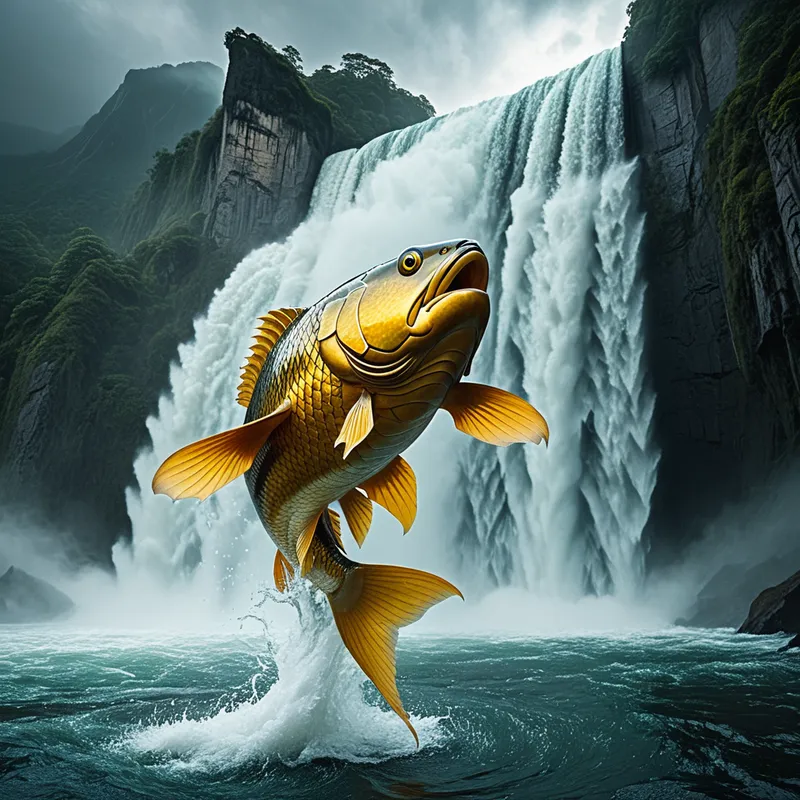
A carp's impossible ascent up a waterfall, rewarded with apotheosis into a dragon, symbolizing the triumph of will over circumstance.
The Tale of Koinobori
Listen, and hear the tale whispered by the river’s rush, told in the sigh of the wind through the pines. It begins not in the heavens, but in the deep, shadowed pools of the Longmen. Here, the water is cold and the light is faint, and a thousand thousand carp swim in endless, contented circles. They are silver and gold, red and black, a living tapestry of the river’s bounty. But their world is bounded by stone and current, and the great roar from above is a constant, daunting hymn.
Among them swam one carp, whose scales held not just the river’s hue, but a flicker of the sun it had never seen. While others fed and darted in the eddies, this one would linger, gazing up through the water’s lens at the terrible, glorious cascade that thundered down from the unseen world above. The elders of the shoal called it the Ryūmon, the Gate of the Dragon. “It is the end of things,” they murmured. “Its currents are knives; its height, a wall of despair. To attempt it is to embrace a fool’s death.”
But the carp felt a pull, a yearning etched into its very bones—a memory it had never lived. The roar was not a threat, but a call. One day, as the spring melt swelled the river to a torrent, the carp ceased its circling. With a powerful thrust of its tail, it broke from the shoal and faced the mountain of falling water.
The first leap was a shock of pain and noise. The cascade hammered it down, tumbling it back into the froth. Gasping, battered, it tried again. And again. Scale by scale, it was stripped away. Its flesh met rock, the current sought to crush its spirit. For days, or perhaps years—time held no meaning in this struggle—it fought. It found purchase on a slick, merciful ledge, gathered its failing strength, and launched once more into the white fury.
This was not swimming; it was a defiance of nature itself. Each upward surge was a prayer made of muscle and will. The world narrowed to the next inch, the next moment of upward thrust against the infinite downpour. Just as its vision darkened and its strength became a phantom memory, it felt a change. The water’s pressure shifted. The roar softened into a rumble, then a whisper.
With one final, impossible effort, it breached the crest.
Silence.
It lay on the still, placid surface of an upper realm, a lake mirroring a vast and open sky. As it drew breath, not water but clear, thin air, a fire ignited within its core. Its tattered fins stretched and broadened into vast, majestic wings. Its scarred scales hardened, shimmering into iridescent plates. A crown of horns sprouted from its brow, and wisdom flooded its now-ancient eyes. The river’s yearning carp was gone. In its place, coiling into the clouds with a rumble of thunder that answered the waterfall’s forgotten roar, was a Ryū, a dragon—sovereign of the storm, master of the heights it had earned.
Cultural Origins & Context
The myth of the carp ascending the Ryūmon to become a dragon has its roots in ancient Chinese legend, but it was woven into the fabric of Japanese culture during the Heian period, carried across the sea with other elements of continental philosophy and symbolism. It found fertile ground in a society that valued perseverance (gaman), familial aspiration, and the transformative potential of effort.
It was not a myth confined to priestly classes or secret scrolls; it became a public, celebratory narrative. Its primary vessel of transmission is the festival of Tango no Sekku, now Kodomo no Hi. Here, the story takes to the sky literally, in the form of koinobori. A black carp streamer (magoi) for the father, a red (higoi) for the mother, and subsequent, often blue or green, streamers for each child, all swimming against the wind as if it were the legendary waterfall. The societal function is clear and potent: it is a public prayer and a symbolic enactment for the health, strength, and future success of children, particularly sons in its earlier context. The family flies its hopes on the wind, visualizing each child’s journey through life’s difficulties toward a noble and realized destiny. The myth thus moved from esoteric tale to a shared, communal ritual, embedding its message of triumphant struggle into the annual rhythm of life.
Symbolic Architecture
At its core, the myth is an alchemical map of the soul’s potential. The carp in its dark pool represents the unactualized self, brimming with latent energy but confined by its environment, its nature, and the low expectations of its peers. The waterfall is the impossible challenge, the overwhelming obstacle that life presents—be it a personal ordeal, a societal barrier, or the inherent suffering of existence.
The waterfall does not exist to be conquered; it exists to be met. In the meeting, the carp discovers it is not merely a fish.
The transformation into the dragon is not a reward given but a new state of being unveiled by the journey itself. The dragon is the symbol of realized potential, sovereignty, and spiritual power. It commands the elements (air, water, storm) that once threatened to destroy it. Psychologically, the dragon represents the integrated Self in Jungian terms—the culmination of the individuation process where one becomes the master of one’s own inner and outer world. The struggle up the waterfall is the ego’s confrontation with the unconscious, with shadow material, and with the painful but necessary process of breaking one’s own limitations.
The Dreamer's Resonance
When this myth stirs in the modern dreamer, it often manifests not as a literal carp, but as the sensation of an arduous, vertical struggle. One might dream of climbing an endless staircase, scaling a sheer cliff face, or fighting against a powerful current. The somatic feeling is one of immense exertion, breathlessness, and the burning of muscle. Psychologically, this dream pattern signals a critical phase of ascent in the dreamer’s life.
This is the psyche working through a process of overcoming. The dreamer is likely facing a real-world challenge that feels “impossible”—a career hurdle, a creative block, a period of intense personal growth, or recovery. The dream is not a prophecy of success, but an enactment of the struggle itself. The presence of the waterfall, even in symbolic form, confirms the dreamer is engaged in the correct, albeit difficult, work. If the dream culminates in a feeling of breaking through, of soaring or gaining a new perspective, it marks a recognition of progress and a shift in self-conception. To dream of being stuck, or falling, is not a failure, but an image of the resistance that must be acknowledged and integrated to gather strength for the next leap.
Alchemical Translation
For the modern individual navigating a world of flat narratives and instant gratification, the Koinobori myth provides a sacred blueprint for psychic transmutation. The alchemical process begins with the nigredo: the carp in the dark water—a state of dissatisfaction, of feeling “stuck” in one’s own nature or circumstances. The call of the waterfall is the first stirring of the Self, a disruptive intuition that there is more to life than circular contentment.
The arduous ascent is the albedo and citrinitas—the whitening and yellowing—the painful purification and illumination. Here, the ego’s attachments (symbolized by the carp’s scales being stripped away) are sacrificed. Old identities, comforting narratives, and inherited limitations are battered by the relentless flow of reality. This is the work of therapy, of shadow integration, of disciplined practice, of enduring failure. It feels like regression, but it is essential erosion.
The dragon was always within the carp. The waterfall was merely the crucible required for its revelation.
The final breach and transformation is the rubedo—the reddening, the achievement of the philosopher’s stone. This is not becoming someone else, but becoming fully what one always was at the deepest archetypal level: the sovereign Self. The dragon is the individual who has metabolized their struggle into wisdom, their will into power, and their journey into their identity. The myth teaches that our highest potential is not granted, but forged in the relentless, willing engagement with our own personal waterfall. We do not find our destiny by avoiding the cascade; we find our true form by swimming directly into its heart.
Associated Symbols
Explore related symbols from the CaleaDream lexicon: