Koi Transformation Myth Meaning & Symbolism
A humble koi swims against a raging waterfall, earning through sheer perseverance the ultimate transformation into a celestial dragon.
The Tale of Koi Transformation
Listen, and hear the tale whispered by [the river](/myths/the-river “Myth from Buddhist culture.”/) stones and sung by the mountain winds. It begins not in the heavens, but in the deep, shadowed pools at the foot of a mighty cataract known as the Ryūmon. Here, in the cold, clear waters, swam a school of koi. They were beautiful, flashes of crimson and gold against the dark rock, but their world was bounded by the cliff’s sheer face and the thunder that never ceased.
Among them was one koi, its spirit a flickering flame that the placid currents could not cool. While others accepted the pool as their world, this koi watched the waterfall. It saw not just falling [water](/myths/water “Myth from Chinese culture.”/), but a ladder of foam and fury leading to an unseen realm above. A legend was known to all in the river: that any fish who could ascend the Ryūmon, who could conquer its impossible current, would be granted a magnificent transformation.
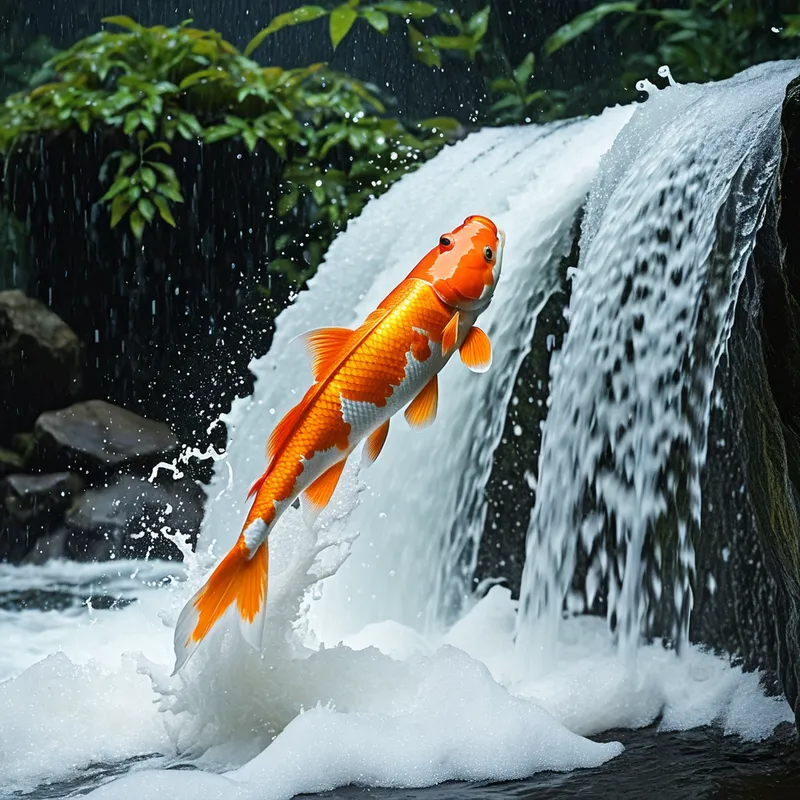
Driven by a yearning it could not name, the koi began its attempt. The first leap was a failure, its body slapped back into the pool by the water’s brutal hand. Again and again it tried, its scales bruised, its fins aching. Seasons turned. Other koi called it foolish. Some fell away, exhausted, their dreams dashed on the rocks. But the determined koi persisted. Its struggle became its entire being—a hundred leaps, a thousand, each one a silent prayer written in muscle and will.
Then, on a day when the sun pierced [the mist](/myths/the-mist “Myth from Celtic culture.”/) in spears of light, the koi gathered every ounce of its strength for one final, all-or-nothing ascent. It shot from the water, not as a mere fish, but as a living arrow of intent. It fought through the cascade’s core, a realm of deafening noise and blinding force. Just as its strength was about to fail, it breached the crest.
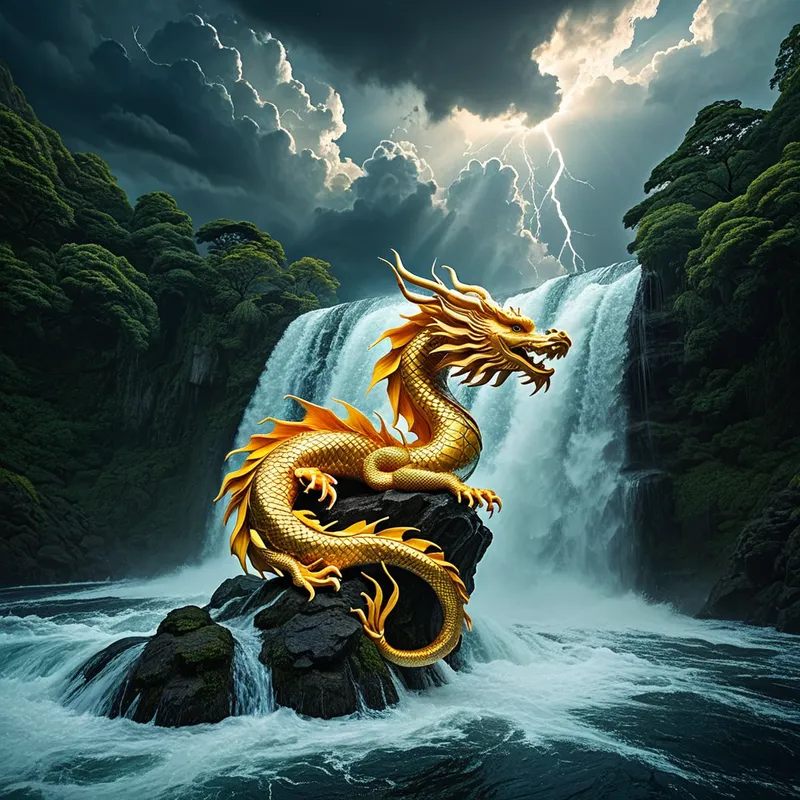
Silence. Calm. [The world](/myths/the-world “Myth from Tarot culture.”/) opened into a serene, upper stream. As the koi rested in the sun-dappled water, a celestial energy enveloped it. Its scales hardened and lengthened, shimmering with newfound power. Its body stretched and soared, sprouting claws and majestic whiskers. A golden horn erupted from its brow. With a roar that echoed the waterfall’s former thunder, the koi was no more. In its place, a magnificent Ryū, a dragon of the heavens, ascended into the clouds, master of the skies it had once only dreamed of.
Cultural Origins & Context
The myth of the koi’s transformation, while deeply embedded in Japanese culture, traces its roots to ancient Chinese folklore, specifically the legend of the [Longmen](/myths/longmen “Myth from Chinese culture.”/) (Dragon Gate). It traveled to Japan, likely with Buddhist texts and cultural exchange, where it was seamlessly woven into the native tapestry of symbols. In Japan, the koi (koi) was already admired for its strength and vitality, able to swim against strong currents. The myth found fertile ground.
It was not a tale confined to priestly classes but a folk story, told to inspire perseverance (nintai). It became associated with Kodomo no Hi, where families fly [koinobori](/myths/koinobori “Myth from Japanese culture.”/)—carp-shaped streamers—for each child. These wind-borne koi represent the parents’ hopes: that their children will embody the koi’s strength and determination to overcome life’s obstacles and ascend to a successful, empowered adulthood. The myth functioned as a societal metaphor for meritocratic ascent, spiritual perseverance in Buddhist practice, and the [Samurai](/myths/samurai “Myth from Japanese culture.”/) ideal of unwavering resolve in the face of immense challenge.
Symbolic Architecture
The myth is a perfect, self-contained [allegory](/symbols/allegory “Symbol: A narrative device where characters, events, or settings represent abstract ideas or moral qualities, conveying deeper meanings through symbolic storytelling.”/) of the [soul](/symbols/soul “Symbol: The soul represents the essence of a person, encompassing their spirit, identity, and connection to the universe.”/)’s potential. The koi represents the embodied, striving self—rooted in the [material](/symbols/material “Symbol: Material signifies the tangible aspects of life, often representing physical resources, desires, and the physical world’s influence on our existence.”/) world (the pool), yet imbued with an innate, divine spark of aspiration. The [waterfall](/symbols/waterfall “Symbol: Waterfalls in dreams often signify a release of emotions or a transformation, symbolizing the flow of life and the transition of feelings.”/) is the great [obstacle](/symbols/obstacle “Symbol: Obstacles in dreams often represent challenges or hindrances in waking life that intercept personal progress and growth. They can symbolize fears, doubts, or external pressures.”/), the trial by fire (or [water](/symbols/water “Symbol: Water symbolizes the subconscious mind, emotions, and the flow of life, representing both cleansing and creation.”/)). It is the sum of all external hardships, societal pressures, and internal doubts that seem insurmountable.
The waterfall is not merely an obstacle; it is the sacred forge. Without its relentless pressure, the gold of the spirit remains scattered, unformed.
The act of swimming upstream is the core of the [symbolism](/symbols/symbolism “Symbol: The use of symbols to represent ideas or qualities, often conveying deeper meanings beyond literal interpretation. In dreams, it’s the language of the unconscious.”/). It is conscious, willful [movement](/symbols/movement “Symbol: Movement symbolizes change, progress, and the dynamics of personal growth, reflecting an individual’s desire or need to transform their circumstances.”/) against the natural flow of complacency, decay, and unconsciousness. Every leap is a [moment](/symbols/moment “Symbol: The symbol of a ‘moment’ embodies the significance of transient experiences that encapsulate emotional depth or pivotal transformations in life.”/) of focused intent, a failure that teaches, a [resilience](/symbols/resilience “Symbol: The capacity to recover quickly from difficulties, adapt to change, and maintain strength through adversity.”/) that builds. The transformation at the top is not a reward given, but a state of being earned and subsequently revealed. The [dragon](/symbols/dragon “Symbol: Dragons are potent symbols of power, wisdom, and transformation, often embodying the duality of creation and destruction.”/) is the latent, transcendent Self—the integrated being that possesses the koi’s grounded perseverance and [the dragon](/myths/the-dragon “Myth from Chinese culture.”/)’s celestial [vision](/symbols/vision “Symbol: Vision reflects perception, insight, and clarity — often signifying the ability to foresee or understand deeper truths.”/) and power. It symbolizes mastery, wisdom, and the activation of one’s full potential.

The Dreamer’s Resonance
When this myth surfaces in modern dreams, it often signals a critical phase of psychological exertion and potential metamorphosis. To dream of being a koi struggling upstream is to feel the somatic weight of a life challenge—a career hurdle, a creative block, a period of intense personal growth. The dreamer may feel they are expending tremendous energy with little visible progress, fighting a “current” of depression, anxiety, or external opposition.
The water in the dream is key. Is it clear or murky? The clarity of the goal versus the confusion of the [psyche](/myths/psyche “Myth from Greek culture.”/). Is the waterfall visible, or is the swimmer simply in a relentless current? This speaks to the dreamer’s awareness of the specific nature of their trial. The moment of transformation in a dream is rare but profound, often accompanied by sensations of soaring, expansion, or awe. More commonly, the dream ends in the struggle, indicating the process is ongoing. The body remembers the myth’s pattern: pressure, effort, repetition, breakthrough. The dream is the psyche’s way of rehearsing this alchemy, reminding the conscious self that the struggle itself is the transformative agent.

Alchemical Translation
For the modern individual navigating a world of distraction and superficiality, the koi’s journey is a masterclass in psychic alchemy—the individuation process. The first step is the [nigredo](/myths/nigredo “Myth from Alchemical culture.”/), the blackening: the koi’s realization of its confinement in the pool. This is the often-painful awakening to one’s own limitations, neuroses, or the unsatisfying nature of an unconscious life.
The endless leaping is the albedo, the whitening: the purifying, repetitive work of confronting shadows, building discipline, and failing forward. This is therapy, meditation, the dedicated practice of a craft, the hard conversations. It is the conscious choice to move against the gravitational pull of the old self.
The dragon is not waiting at the top of the waterfall; it is being forged in every muscle fiber of the leap.
Finally, the transformation is the [rubedo](/myths/rubedo “Myth from Alchemical culture.”/), the reddening: the achievement of the philosopher’s stone. It is not about becoming a literal dragon, but achieving a state of psychic integration. The “dragon” is the person who has internalized the struggle. They have accessed their own inner authority (the dragon’s sovereignty), gained a transcendent perspective on their life (the aerial view), and channel their primal energy (the koi’s life-force) with wisdom and purpose. The myth teaches that our highest self is not found by avoiding the waterfall, but by consecrating our entire being to the swim. The goal is not to escape the world, but to transform our relationship to it so utterly that we, and the world, are revealed in a new, golden light.
Associated Symbols
Explore related symbols from the CaleaDream lexicon: