
Koi Fish Myth Meaning & Symbolism
A koi swims against a raging river, transforms into a dragon, and embodies the soul's relentless journey toward its highest destiny.
The Tale of Koi Fish
Listen, and hear the whisper of [the river](/myths/the-river “Myth from Buddhist culture.”/). It does not speak of gentle flows, but of a roar—a thunderous challenge carved into the stone heart of the mountains. This is the tale of the Dragon Gate, and of those who dared to answer its call.
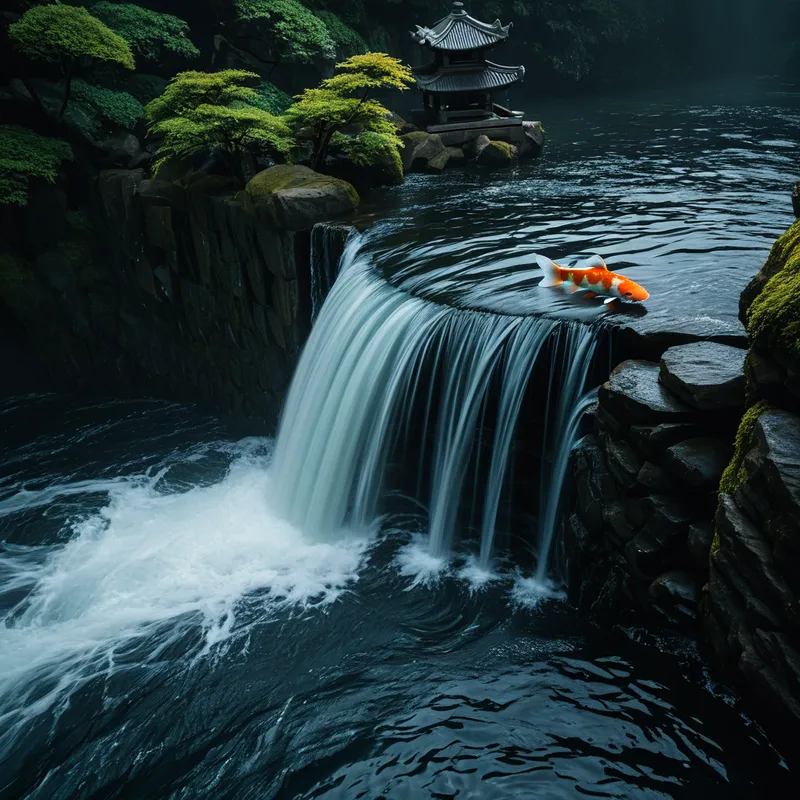
In the ancient, mist-wreathed highlands, where clouds clung to pine trees like ghosts, there flowed a river of impossible ambition. Its waters were not clear, but churned with the silt of a thousand storms, cold and relentless. And where the land fell away in a sheer cliff of weeping stone, the river became a fury—a vertical, plunging torrent known to all as [the Dragon Gate](/myths/the-dragon-gate “Myth from Chinese/Japanese culture.”/) Falls. The legend, carried on the breath of monks and the songs of fishermen, was this: any koi fish possessed of enough spirit, enough unwavering will, to swim upstream against the river’s rage and leap the full, terrifying height of the falls, would be transformed. The river itself would grant it a new form: that of a celestial dragon, a Ryū, master of rains and clouds, a being of power and majesty.
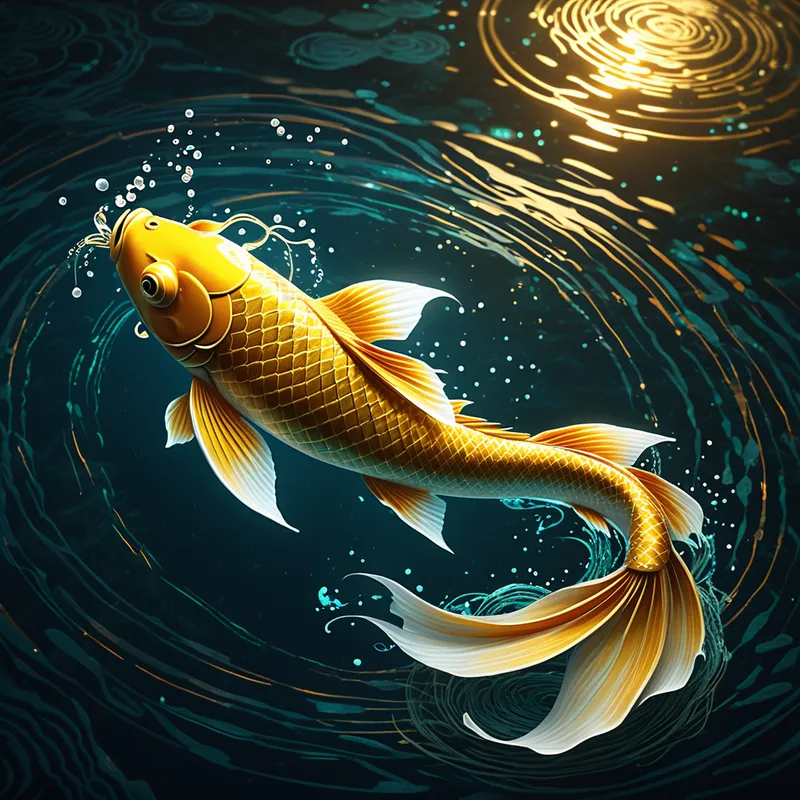
For years uncounted, the koi of the lower pools would gaze up at the distant, mist-shrouded summit. Most saw only a wall of deadly white [water](/myths/water “Myth from Chinese culture.”/). But a few—a rare few with fire in their blood and a longing in their souls that the placid ponds could not satisfy—felt the pull. One such koi, scales the color of burnished gold and determination like forged steel, gathered its strength. It began the ascent, not with a frantic dash, but with a slow, deliberate push against the current. The river fought back. Rocks became battering rams. Eddies sought to spin it into oblivion. Predators, sensing its diverted focus, struck from the shadows. The koi’s scales were scraped, its fins torn. Yet, on it pressed, a living arrow shot against the stream.
Finally, it reached the base of the falls. Here, the roar was deafening, the air thick with spray that felt like needles. The waterfall was not a curtain of water, but a collapsing mountain. The koi rested in a turbulent pool, gathering the last of its spirit. Then, with a thrust of its powerful tail, it launched itself into the maelstrom. The water hammered it down. Again it tried, and again was cast back. Each failure was a lesson in the waterfall’s architecture, a mapping of fleeting updrafts and slightly softer flows. On the one-hundredth attempt, or the thousandth—for time had lost all meaning—it found the hidden path. It rode a surge of water, coiled its body, and with a final, transcendent effort, shot upwards through the pounding heart of the cascade.
It broke the surface not into another pool, but into a realm of light and silence. A bolt of celestial fire descended from a suddenly clear sky, enveloping the exhausted fish. Its golden scales erupted into plates of jade and [pearl](/myths/pearl “Myth from Chinese culture.”/). Its body lengthened, grew mighty limbs tipped with claws. Whiskers became flowing tendrils of cloud, and from its brow sprouted horns of power. Where a koi had leaped, a dragon now soared, its first roar shaking the mists from the mountains. It had not escaped the river; it had become its master.
Cultural Origins & Context
This myth, while sharing roots with the Chinese legend of the Lóngmén, found fertile ground in the Japanese cultural [psyche](/myths/psyche “Myth from Greek culture.”/). It is not a tale confined to a single sacred text, but a folktale (mukashibanashi) that lived in the oral tradition, told by elders to children, referenced in renga, and depicted in ukiyo-e art. Its societal function was multifaceted. For the [samurai](/myths/samurai “Myth from Japanese culture.”/) class, it was a parable of gaman and ultimate [triumph](/myths/triumph “Myth from Roman culture.”/) against impossible odds, mirroring the warrior’s path. For the common people, it was a story of hope and social mobility—the idea that through sheer, virtuous effort, one could transcend their born station. During the Edo period, the koi’s journey became a popular motif for Tango no Sekku, where [koinobori](/myths/koinobori “Myth from Japanese culture.”/) streamers fly to symbolize the wish for sons to grow up strong and successful, capable of overcoming life’s obstacles. The myth served as a cultural engine, reinforcing values of perseverance, resilience, and the belief in transformative potential earned through struggle.
Symbolic Architecture
The myth’s power lies in its stark, elegant [symbolism](/symbols/symbolism “Symbol: The use of symbols to represent ideas or qualities, often conveying deeper meanings beyond literal interpretation. In dreams, it’s the language of the unconscious.”/). The [koi fish](/symbols/koi-fish “Symbol: A symbol of perseverance, transformation, and spiritual aspiration, often associated with overcoming adversity and achieving enlightenment.”/) itself is not a magical [creature](/symbols/creature “Symbol: Creatures in dreams often symbolize instincts, primal urges, and the unknown aspects of the psyche.”/) to begin with; it is a creature of mud and [pond](/symbols/pond “Symbol: A pond in dreams represents the unconscious mind, emotions, and tranquility.”/), representing the nascent, undeveloped self, the potential [hero](/symbols/hero “Symbol: A hero embodies strength, courage, and the ability to overcome significant challenges.”/) latent in the ordinary. The upstream [journey](/symbols/journey “Symbol: A journey in dreams typically signifies adventure, growth, or a significant life transition.”/) is the conscious, arduous [choice](/symbols/choice “Symbol: The concept of choice often embodies decision-making, freedom, and the multitude of paths available in life.”/) to move against the natural drift of [life](/symbols/life “Symbol: The symbol of ‘Life’ represents a journey of growth, interconnectedness, and existential meaning, encompassing both the joys and challenges that define human experience.”/)—against complacency, [fate](/symbols/fate “Symbol: Fate represents the belief in predetermined outcomes, suggesting that some aspects of life are beyond human control.”/), or societal expectation.
The true current to be overcome is not the river, but the inertia of the unlived life.
The [waterfall](/symbols/waterfall “Symbol: Waterfalls in dreams often signify a release of emotions or a transformation, symbolizing the flow of life and the transition of feelings.”/), the Ryūmon, is the ultimate ordeal, the seemingly insurmountable [barrier](/symbols/barrier “Symbol: A barrier symbolizes obstacles, limitations, and boundaries that prevent progression in various aspects of life.”/) that separates the known self from the realized self. It represents the [crisis](/symbols/crisis “Symbol: A crisis symbolizes turmoil, urgent challenges, and the need for immediate resolution or change.”/) point, the initiatory trial that cannot be bypassed. The transformation into the [dragon](/symbols/dragon “Symbol: Dragons are potent symbols of power, wisdom, and transformation, often embodying the duality of creation and destruction.”/) is not a reward given, but a state of being revealed through the process. [The dragon](/myths/the-dragon “Myth from Chinese culture.”/) symbolizes the integrated, potent, and sovereign self—the individual who has mastered their own inner [chaos](/symbols/chaos “Symbol: In Arts & Music, chaos represents raw creative potential, uncontrolled expression, and the breakdown of order to forge new artistic forms.”/) (the waters) and gained wisdom and power (kami-like [authority](/symbols/authority “Symbol: A symbol representing power structures, rules, and control, often reflecting one’s relationship with societal or personal governance.”/)) as a result. The myth maps the entire arc of individuation: from the watery unconscious (the pond), through conscious struggle (the [ascent](/symbols/ascent “Symbol: Symbolizes upward movement, progress, spiritual elevation, or striving toward higher goals, often representing personal growth or transcendence.”/)), a symbolic [death](/symbols/death “Symbol: Symbolizes transformation, endings, and new beginnings; often associated with fear of the unknown.”/)/[rebirth](/symbols/rebirth “Symbol: A profound transformation where old aspects of self or life die, making way for new beginnings, growth, and renewal.”/) at the [climax](/symbols/climax “Symbol: The peak moment in a narrative or musical composition, representing resolution, transformation, or ultimate expression.”/) (the leap), and [emergence](/symbols/emergence “Symbol: A process of coming into being, rising from obscurity, or breaking through a barrier, often representing birth, transformation, or revelation.”/) as a more complete, mythic entity (the [dragon](/symbols/dragon “Symbol: Dragons are potent symbols of power, wisdom, and transformation, often embodying the duality of creation and destruction.”/)).
The Dreamer’s Resonance
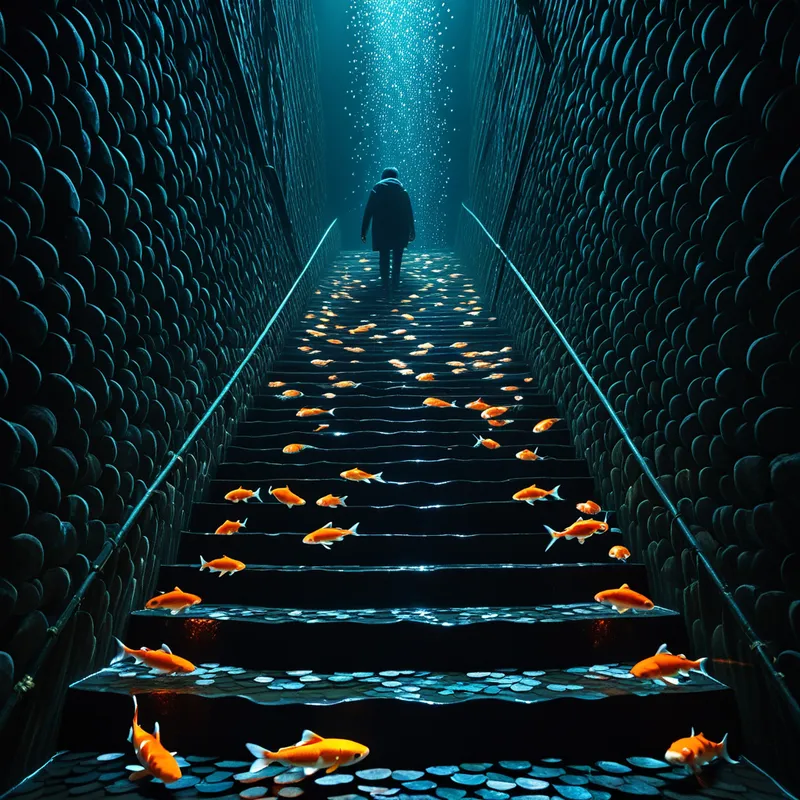
When this myth stirs in the modern dreamer’s psyche, it often manifests as dreams of swimming against a powerful current, climbing endless stairs, or facing a colossal, immovable wall. The somatic feeling is one of immense effort, fatigue, and often frustration. Psychologically, this signals that the dreamer is engaged in a profound inner struggle—perhaps striving for a major goal, battling an addiction, or working through a complex emotional or creative block. The dream is not a commentary on failure, but an affirmation of the struggle itself. The presence of the koi or the waterfall in the dream confirms that the dreamer’s psyche has framed their life challenge within this heroic, transformative narrative. If the dream culminates in a sense of breaking through, or a glimpse of a vast, new landscape (or [the self](/myths/the-self “Myth from Jungian culture.”/) transforming), it marks a pivotal moment of potential psychic shift, where perseverance is about to yield a new level of personal integration.
Alchemical Translation
The alchemy of the koi myth is a precise model for psychic transmutation. The base material ([prima materia](/myths/prima-materia “Myth from Alchemical culture.”/)) is the instinctual, swimming life-force—our raw desires, talents, and unresolved complexes (the koi in the muddy pond). The opus, [the great work](/myths/the-great-work “Myth from Alchemical culture.”/), is the conscious decision to engage in the difficult, counter-instinctual work of self-reflection and discipline (swimming upstream). The waterfall represents the [nigredo](/myths/nigredo “Myth from Alchemical culture.”/), the darkest night of the soul, where all seems lost and [the ego](/myths/the-ego “Myth from Jungian culture.”/) feels shattered against the rocks of reality.
The leap is the moment of albedo, where the relentless effort itself becomes a kind of grace, illuminating the path through the darkness.
The final transformation into the dragon is the [rubedo](/myths/rubedo “Myth from Alchemical culture.”/). It is the creation of the philosophical gold—the fully realized Self. The dragon is not a different creature; it is the koi’s true nature, actualized. For the modern individual, this translates to the process of turning leaden habits into golden discipline, murky emotions into clear insight, and scattered energies into focused will. The myth teaches that our highest potential is not granted, but forged in the relentless, humble, repeated act of trying again. Our “dragonhood” awaits not at the end of the struggle, but is embodied and revealed within each stroke against the current.
Associated Symbols
Explore related symbols from the CaleaDream lexicon: