
Koi ascending waterfalls Myth Meaning & Symbolism
A koi's legendary struggle up a waterfall, rewarded by transformation into a celestial dragon, symbolizing perseverance and ultimate metamorphosis.
The Tale of Koi ascending waterfalls
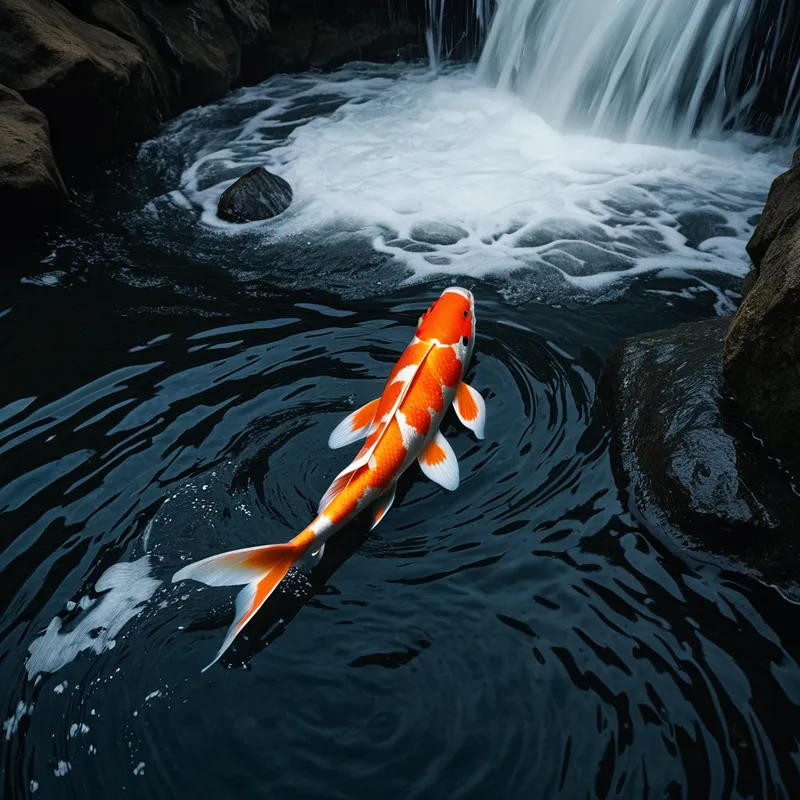
Listen, and hear the roar of the [Longmen](/myths/longmen “Myth from Chinese culture.”/). Its waters are not just [water](/myths/water “Myth from Chinese culture.”/); they are the voice of the mountain, a thunderous song of descent that shakes the very bones of [the earth](/myths/the-earth “Myth from Hindu culture.”/). In the deep, shadowed pool where [the river](/myths/the-river “Myth from Buddhist culture.”/) gathers its breath before the final plunge, a school of koi swims. They are beautiful, flashes of crimson, gold, and pearlescent white against the dark stone. But their beauty is a quiet, contained [thing](/myths/thing “Myth from Norse culture.”/), a jewel in the mud.
Among them is one whose scales catch not just light, but seem to hold a fire within. For a hundred years it has swum these placid depths, feeling the distant, ceaseless vibration of the falls—a call it cannot name. On the day the sun stands highest, when [the world](/myths/the-world “Myth from Tarot culture.”/) holds its breath, the call becomes a command. The koi turns its gaze upstream, to where the water becomes a vertical, living wall of sound and fury. The other fish watch, their movements stilled. To attempt the ascent is madness. Many have tried. Their broken forms are whispered about in the deep eddies.
Yet, this one pushes forward. The current at the base is a maelstrom, a whirlpool that seeks to grind it against the rocks. With a lash of its powerful tail, it breaks through, entering the main cascade. Here, the world is reduced to pure, hammering force. Each droplet is a stone. The waterfall is not a path but an avalanche in reverse. The koi’s body is slammed, twisted, driven back. Its scales are scraped raw. Its gills scream for air in the aerated, violent torrent. It finds a momentary purchase on a slick, moss-covered rock, muscles burning, only to be torn away again.
The climb is an eternity of failure and regrouping. It is not a graceful swim but a desperate, thrashing battle—an inch won, a foot lost. The deities of the river, the kami of the current, test its spirit. They send sudden surges of water to dash it down. They hide [the way](/myths/the-way “Myth from Taoist culture.”/) behind curtains of spray. The koi’s mind empties of all but one imperative: upward. Its world narrows to the next rock, the next impossible leap against gravity’s will.
Finally, after a final, convulsive surge that drains the last of its strength, it crests the tumult. The hammering ceases. The roar fades to a rumble below. It floats, exhausted, in a calm, sun-dappled pool at [the summit](/myths/the-summit “Myth from Taoist culture.”/) it was told did not exist. [The sky](/myths/the-sky “Myth from Persian culture.”/) opens. A voice that is the harmony of storm and stillness speaks. A bolt of celestial fire descends, not to destroy, but to transmute. Where there was a scarred and weary koi, now coils a being of power and majesty—a ryū, its scales like polished jade and sky, its form crackling with the energy of the heavens. It has not just climbed a waterfall; it has forged itself anew in [the crucible](/myths/the-crucible “Myth from Alchemical culture.”/) of the impossible.
Cultural Origins & Context
The myth of the koi ascending the waterfall, known most famously through the Longmen legend, entered Japanese culture from Chinese folklore, where it was deeply intertwined with Confucian ideals of scholarly perseverance. In Japan, it was seamlessly adopted and adapted, finding fertile ground in the native Shintō worldview, which saw spirit and will in all natural phenomena. The story was passed down not as a formal religious text, but as a popular folktale and a potent visual allegory. It was depicted in ukiyo-e, painted on screens, and told to children as a lesson in gaman—enduring the seemingly unbearable with patience and dignity.
Its societal function was multifaceted. For the [samurai](/myths/samurai “Myth from Japanese culture.”/) class, it symbolized unwavering loyalty and the ultimate reward for perseverance in one’s duty, even unto death. For commoners, it was a folk promise that relentless effort could lead to a transcendent change in station or fortune. During the Edo period, it became associated with the rigorous examination system for bureaucrats—a scholarly “waterfall” to be ascended. The myth served as a cultural engine, reinforcing values of resilience, ambition, and the belief that raw effort, when purified by trial, could enact a fundamental change in one’s very nature.
Symbolic Architecture
At its [heart](/symbols/heart “Symbol: The heart symbolizes love, emotion, and the core of one’s existence, representing deep connections with others and self.”/), the myth is a perfect map of the [psyche](/myths/psyche “Myth from Greek culture.”/)’s [journey](/symbols/journey “Symbol: A journey in dreams typically signifies adventure, growth, or a significant life transition.”/) from unconscious potential to conscious, realized power. The koi in the tranquil pool represents the latent Self, beautiful but unactualized, dwelling in the comfortable [depths](/symbols/depths “Symbol: Represents the subconscious, hidden emotions, or foundational aspects of the self, often linked to primal fears or profound truths.”/) of the known world. The [waterfall](/symbols/waterfall “Symbol: Waterfalls in dreams often signify a release of emotions or a transformation, symbolizing the flow of life and the transition of feelings.”/) is the call to individuation—the difficult, often painful, process of becoming who one is meant to be. It is the daunting challenge, the societal expectation, the internal [mountain](/symbols/mountain “Symbol: Mountains often symbolize challenges, aspirations, and the journey toward self-discovery and enlightenment.”/) of [shadow](/symbols/shadow “Symbol: The ‘shadow’ embodies the unconscious, repressed aspects of the self and often represents fears or hidden emotions.”/) that must be faced.
The waterfall is not an obstacle on the path; it is the path itself. Its torrent is the necessary friction that forges the spirit.
The relentless current symbolizes the [resistance](/symbols/resistance “Symbol: An object or tool representing opposition, struggle, or the act of pushing back against external forces or internal changes.”/) of the world, the pull of old habits ([the personal unconscious](/myths/the-personal-unconscious “Myth from Jungian Psychology culture.”/)), and the [gravity](/symbols/gravity “Symbol: The fundamental force that pulls objects toward each other, representing attraction, inevitability, and the weight of existence.”/) of a [life](/symbols/life “Symbol: The symbol of ‘Life’ represents a journey of growth, interconnectedness, and existential meaning, encompassing both the joys and challenges that define human experience.”/) lived by inertia. Each setback and scar is not a failure but an integral part of the [alchemical process](/symbols/alchemical-process “Symbol: A symbolic transformation of base materials into spiritual gold, representing inner purification, integration, and the journey toward wholeness.”/). The transformation into the [dragon](/symbols/dragon “Symbol: Dragons are potent symbols of power, wisdom, and transformation, often embodying the duality of creation and destruction.”/) is not a reward for the climb, but the inevitable result of the climb. [The dragon](/myths/the-dragon “Myth from Chinese culture.”/) is the fully integrated Self—the koi that has incorporated the power of the waterfall into its own being. It gains sovereignty ([flight](/symbols/flight “Symbol: Flight symbolizes freedom, escape, and the pursuit of one’s aspirations, reflecting a desire to transcend limitations.”/)), wisdom (the [dragon](/symbols/dragon “Symbol: Dragons are potent symbols of power, wisdom, and transformation, often embodying the duality of creation and destruction.”/)’s ancient gaze), and a new [relationship](/symbols/relationship “Symbol: A representation of connections we have with others in our lives, often reflecting our emotional state.”/) to the elements; it commands the [water](/symbols/water “Symbol: Water symbolizes the subconscious mind, emotions, and the flow of life, representing both cleansing and creation.”/) it once struggled against.

The Dreamer’s Resonance
When this myth surfaces in modern dreams, it rarely appears as a literal koi. The dreamer may find themselves struggling up a sheer cliff face, an endless escalator moving downward, or trying to run through thigh-deep water toward a distant, glowing door. The somatic feeling is universal: immense effort with agonizingly slow progress, a profound muscular and psychic exhaustion.
Psychologically, this dream pattern signals that the dreamer is in the thick of a profound developmental struggle. They are engaging with their own “waterfall”—perhaps a creative project that feels insurmountable, the arduous healing from trauma, or the daunting task of breaking a lifelong pattern. The dream is not a warning but a confirmation: You are in the process. The feeling of being battered and pushed back mirrors [the ego](/myths/the-ego “Myth from Jungian culture.”/)’s resistance to the transformative demands of [the Self](/myths/the-self “Myth from Jungian culture.”/). To dream of this ascent is to experience, in the safe theatre of the unconscious, the full weight and necessity of one’s current trials. It is the psyche’s way of validating the struggle and hinting that the current form—the “koi-self”—is in a state of active, if painful, transmutation.
Alchemical Translation
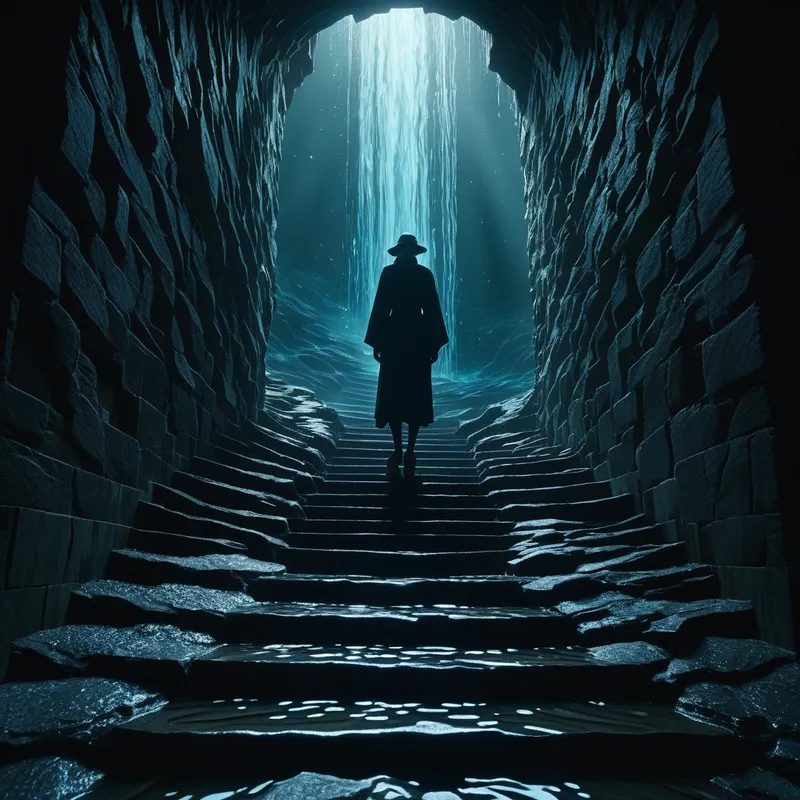
The myth models the entire arc of psychic transmutation, or individuation, with stark clarity. [The first stage](/myths/the-first-stage “Myth from Alchemical culture.”/), [nigredo](/myths/nigredo “Myth from Alchemical culture.”/) (the blackening), is represented by the koi’s decision to leave the dark pool—a voluntary descent into the chaos of the endeavor. The arduous climb itself is the albedo (the whitening), the endless purification through effort, where all that is non-essential is scoured away by the relentless current of confrontation.
The moment of cresting the falls is the citrinitas (the yellowing), the first dawning of a new consciousness, a glimpse of the summit of one’s own being. Finally, the divine transformation is the [rubedo](/myths/rubedo “Myth from Alchemical culture.”/) (the reddening), the culmination of the alchemical work. Here, the base metal of instinctual life (the koi) is irrevocably changed into the spiritual gold of the realized Self (the dragon).
Individuation is not about becoming something other. It is the koi realizing, through unimaginable effort, that it always contained the dragon. The waterfall is merely the revelation.
For the modern individual, the allegory is direct. Our “waterfalls” are the commitments we choose that test our very core—the therapy session, the artistic practice, the moral stand, the act of deep forgiveness. The myth teaches that the goal is not to reach the top unscathed, but to be changed by the climb. The [triumph](/myths/triumph “Myth from Roman culture.”/) is not avoiding the battering force, but developing the spiritual musculature to meet it, again and again, until [the force](/myths/the-force “Myth from Science Fiction culture.”/) that opposed you becomes the very element of your newfound sovereignty. We are not called to simply endure our trials, but to be forged in their current, until we can, at last, rise from their waters transformed.
Associated Symbols
Explore related symbols from the CaleaDream lexicon: