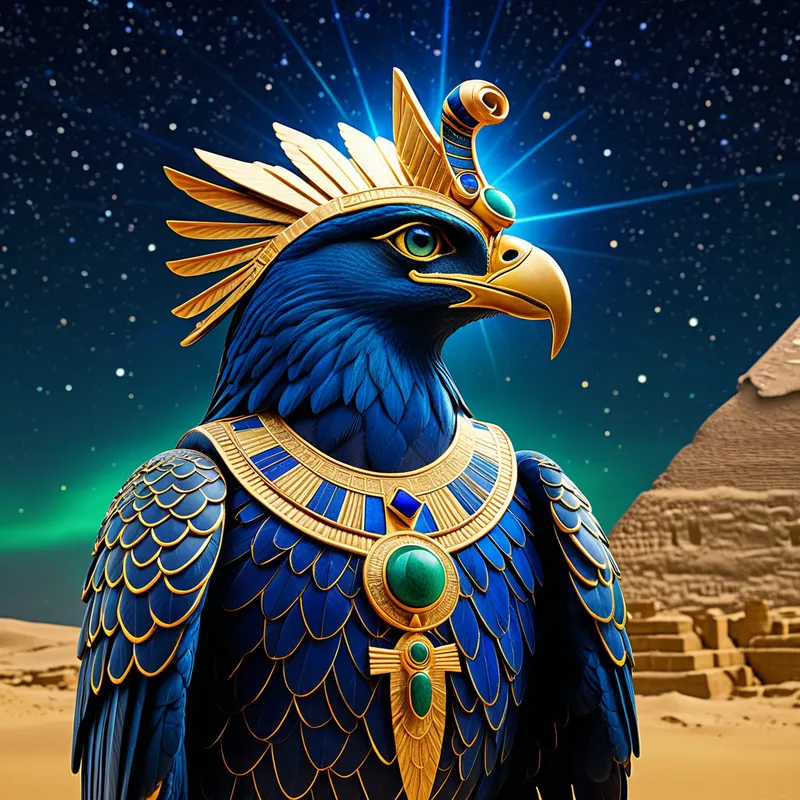
Kohl Myth Meaning & Symbolism
A tale of divine vengeance, sacrifice, and restoration, where the torn eye of a god becomes a symbol of wholeness and a protector against chaos.
The Tale of Kohl
Hear now the tale whispered on the hot breath of the desert wind, a story not of stone and sand, but of fire and blood and a light that was lost and remade.
In the time when gods walked the earth and the Nile ran red with the memory of betrayal, a great battle raged. It was not a battle of men, but of principles: Maat against Isfet, the rightful heir against the usurper. Horus, the Avenger, his heart a furnace of grief for his slain father, Osiris, faced his uncle Set in a duel that shook the pillars of the sky. Set, whose form was a mystery of strength and terror, fought not like a man, but like the storm itself—unpredictable, brutal, and blinding.
Their struggle churned the sands into glass and cracked the bedrock of the world. Horus, with the piercing sight of the falcon, sought order and justice. Set, with the raw power of the desert tempest, sought only dissolution. In a climactic, furious clash, Set’s weapon—a blow born of pure chaos—found its mark. Not the heart, not the limb, but the very organ of perception. He tore the left eye of Horus from its socket.
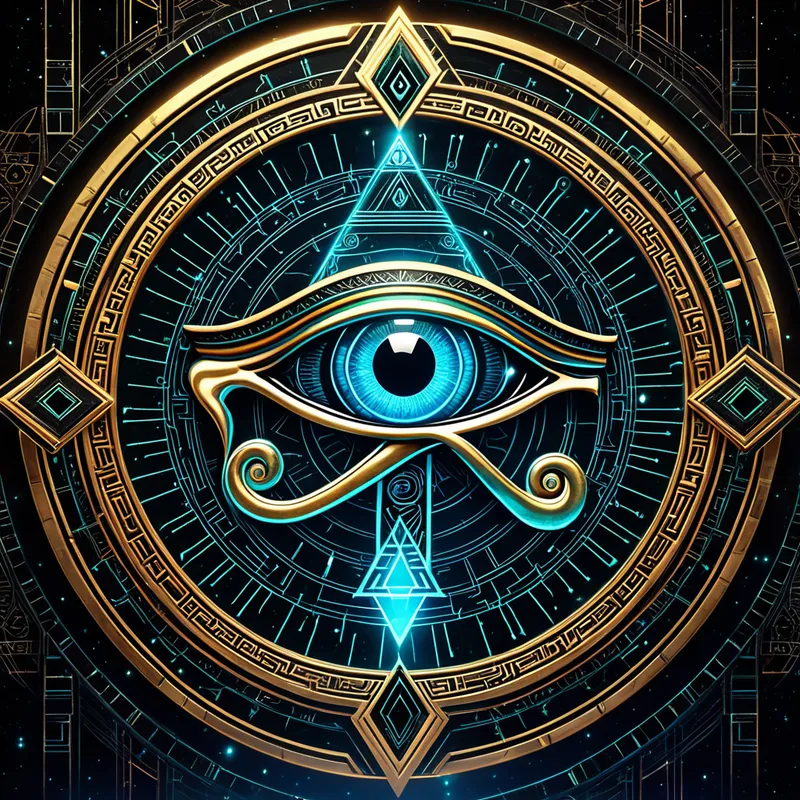
The god’s cry was not of pain, but of a deeper sundering—the world seen through the lens of divine order went dark. The eye, the Wedjat, fell to the earth, shattering into six luminous fragments that scattered across the barren land like fallen stars. The light of reason and celestial sight was extinguished, and the shadow of Isfet grew long.
But the story does not end in darkness. For where there is fragmentation, the impulse toward wholeness stirs. Isis, the mother, whose magic had already pieced her husband back together, wept not in despair but in determination. And Thoth, the scribe of the gods, healer and measurer of all things, descended. Under the cool, calculating light of the moon—Thoth’s own domain—he moved across the battlefield. With infinite patience and a knowledge deeper than the waters of Nun, he sought out each glimmering piece: the pupil that held vision, the brow that held thought, the tear line that held sorrow. One by one, he gathered them.
This was no mere repair. This was a sacred act of heka. Thoth, the divine physician, did not simply restore the eye. He reconsecrated it. He washed it in moonlight, anointed it with spells of protection, and made it whole again—not as it was, but as it could be. A vessel now containing both the memory of its shattering and the power of its restoration. When he placed the Wedjat back into Horus’s socket, it did more than see. It knew. It had become the Kohl, an eye that had stared into the abyss of loss and returned, armed against it.
Horus, with his sight restored and amplified, did not use this renewed vision for further blind vengeance. He presented the restored Kohl to his resurrected father, Osiris, in the underworld. This act of offering—giving the very instrument of his own perception to the source of his lineage—cemented his kingship. It was the final piece that restored not just a god’s eye, but the cosmic order itself. The Kohl became the prototype for all protective amulets, a shield against the fragmenting forces of chaos, watching eternally over the kingdom of the living and the dead.

Cultural Origins & Context
This is not a single myth from one papyrus, but a narrative constellation woven into the very fabric of ancient Egyptian civilization. The story of the Eye of Horus is embedded in the Pyramid Texts, the Coffin Texts, and the Book of the Dead. It was told not for entertainment, but for existential survival. Priests recited it in temples to maintain cosmic order. Embalmers invoked it during mummification to protect the deceased’s senses in the afterlife. Every pharaoh was the living Horus, and thus the fate of the Wedjat was the fate of the nation.
The myth functioned on multiple levels: as a divine precedent for pharaonic legitimacy (Horus avenging Osiris), as a medical and mathematical metaphor (the fractions of the eye were used in hieratic notation), and most pervasively, as a cornerstone of protective magic. To wear or inscribe the symbol of the Kohl was to participate directly in this myth of restoration, to place oneself under the vigilant, healed gaze of the divine.
Symbolic Architecture
At its core, the myth of the Kohl is a master narrative of fragmentation and sacred reassembly. The eye represents far more than sight; it is the organ of consciousness, of perception, of the self’s interface with reality.
To lose the eye is to suffer a psychic catastrophe—a shattering of one’s worldview, identity, or moral compass through trauma, betrayal, or profound loss.
The six fragments symbolize the disintegration of a unified perspective into disparate, often conflicting, parts: intuition, thought, sensation, emotion, memory, and spirit. Thoth, as the archetypal Mercurius figure, embodies the transcendent function—the capacity of the psyche to engage in a healing synthesis. His act is not erasure, but integration. He does not create a new, naive eye; he rebuilds the old one with the scars included, transforming wound into wisdom.
The restored Kohl, therefore, is the symbol of the complex, resilient self. It is consciousness that has processed its own destruction. It sees clearly not in spite of its history, but because of it. Its power as a protective amulet lies in this very quality: it has faced the chaos (Set) and incorporated that experience into its structure. It is now “chaos-resistant.”
The Dreamer's Resonance
When this myth stirs in the modern unconscious, it often manifests in dreams of broken mirrors, lost or damaged glasses, or a sudden blindness that terrifies yet feels significant. One might dream of searching for precious, glowing shards in mud or sand, or of a wise, non-human figure (an ibis, a baboon, a librarian) patiently helping to reassemble a shattered vase or puzzle.
Somatically, this can correlate with a period of intense psychological or physical recovery. The “fragmentation” could be burnout, the aftermath of a relational rupture, a crisis of faith, or the integration of a traumatic memory. The dream process mirrors Thoth’s work: the psyche is instinctively gathering the scattered pieces of the self that were lost in the conflict. The emotional tone is not typically one of active battle (that is the Horus-Set conflict), but of the poignant, meticulous, and often lonely work of reassembly that comes after the storm has passed. It is the body-mind’s deep knowing that wholeness must be reconstructed, not merely wished for.

Alchemical Translation
The alchemical journey mirrored in the Kohl myth is the opus contra naturam—the work against nature, which is really work toward a higher, integrated nature. The initial state (the whole, naive eye) is the prima materia. The violent confrontation with Set represents the essential stage of mortificatio or separatio—the necessary dissolution of the old, rigid structure of the personality.
The crushing of the ore is necessary to extract the precious metal. The shattering of the eye is the precondition for the creation of the Kohl.
The scattering is the nigredo, the dark night of the soul, where all seems lost and incoherent. Thoth’s gathering is the beginning of albedo, the whitening, where elements are purified and sorted. The actual reconsecration—the spellcasting, the lunar washing—is the citrinitas, the yellowing, where new meaning is applied. The final restoration and offering of the Kohl is the rubedo, the reddening, the production of the sacred and durable “philosopher’s stone”—which in psychological terms is the attained, resilient, and conscious Self.
For the modern individual, this myth models the path of individuation through trauma. It teaches that the goal is not to return to a pre-traumatized, innocent state (that eye is gone forever). Nor is it to remain forever shattered. The path is to become the artisan of your own Kohl. To, with the help of the inner Thoth (the guiding intellect, therapy, creative expression, spiritual practice), gather your fragments—the anger, the grief, the broken trust, the lost hope—and reassemble them into a new, more complex, and potent form of consciousness. This new “eye” is your protective amulet. It allows you to see the world, and yourself, with a depth, compassion, and strength that was impossible before the breaking. You offer this hard-won perception back to the source of your being, completing the circle and establishing your own inner kingship.
Associated Symbols
Explore related symbols from the CaleaDream lexicon: