
Kobolds Myth Meaning & Symbolism
A tale of the earth's capricious spirit, the Kobold, who guards the soul of the mountain, demanding respect and offering gifts to those who see truly.
The Tale of Kobolds
Listen, and lean close to the hearth-stone. The fire crackles not just with wood, but with memory. Beneath your very floor, in the spaces between the stones of your cellar, in the deep, breathing dark of the mountain’s heart, they dwell. They are the Kobold.
Do not picture a fairy-tale creature of gentle mien. See instead a form wrought from the mountain’s own stubbornness: small, yes, but dense as iron ore, with skin like tanned hide or rough, mossy stone. Their eyes are chips of quartz that catch the faintest glimmer of candle or starlight, holding a knowing that is ancient and utterly alien to the sunlit world. They wear rags of lichen or leather, and sometimes, a curious hat, red as fresh-spilled blood or the heart of a furnace.
In the deep mines of the Harz mountains, the air is thick with dust and the scent of fear. The miners’ picks ring out a desperate prayer. Here, the Kobold is master. He is the Berggeist, the mountain spirit. To some, he is a terror—a sudden rockfall, a snuffed lantern, a whispered curse that turns rich veins to worthless stone. His laugh is the echo of a collapsing tunnel. But to the miner who leaves a crust of bread, who spills a drop of milk upon the earth, who speaks with respect into the darkness, the Kobold reveals himself differently. He is the soft tap-tap-tap that leads a pick to a glittering seam of silver. He is the invisible hand that steadies a ladder. He is the keeper of the mountain’s secret wealth, and he trades it not for gold, but for acknowledgement.
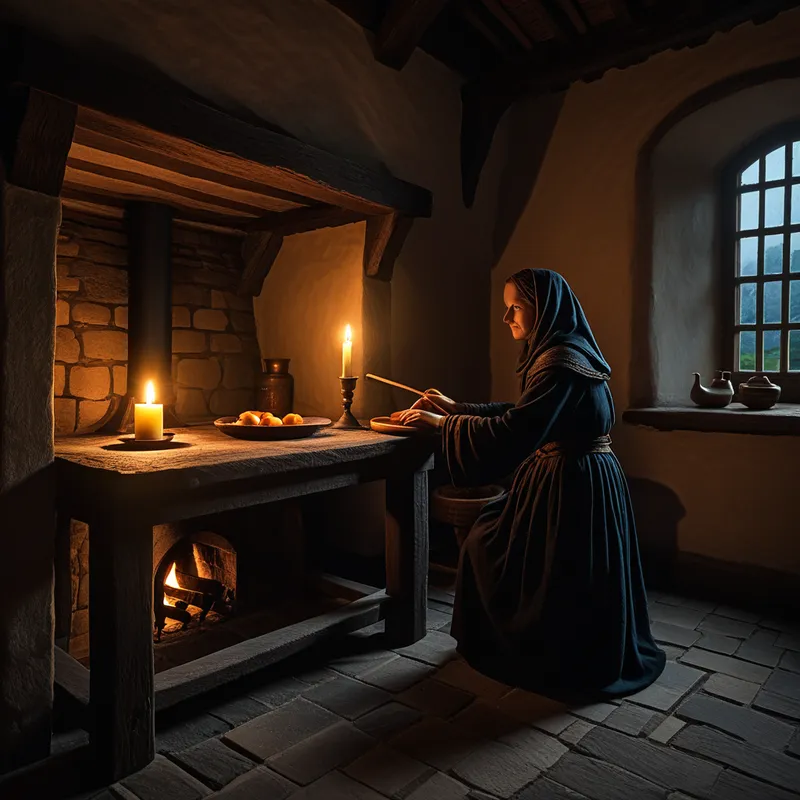
Above, in the timbered farmhouse, his cousin dwells. The Heinzelmännchen is a creature of the threshold, of the warm, dark places behind the stove and under the stairs. He is a whirlwind of industry when the moon is high. Come dawn, the weary farmer finds his fire laid, his boots polished, his butter churned. But let that farmer be so foolish as to try and spy upon his nocturnal helper, to offer a gift of fine clothes in mockery or pride… then the spell breaks. The Kobold vanishes with a shriek of offended dignity, leaving behind only silence and chores undone. His payment is not wages, but the sacred, unspoken contract of mutual need. He demands to remain a mystery, a power in the periphery.
Cultural Origins & Context
The Kobold is not a god from a forgotten pantheon, but a spirit of the people, born from the very soil and struggle of Central European, particularly Germanic, life. His tales are not preserved in grand epics but in the warnings of miners to their apprentices, in the hushed stories told by hearthlight to explain a creaking floorboard or a missing tool. He is folklore in its purest, most functional form: an animistic explanation for the capriciousness of the natural and domestic world.
These narratives served as a vital psychological and social technology. For the miner, facing literal and metaphorical darkness daily, the Kobold personified the real dangers of cave-ins and toxic gases, as well as the profound, often terrifying, mystery of extracting wealth from the living earth. The myth enforced a code of respect for the environment and humility in one’s work. In the home, the Kobold myth regulated social behavior, teaching lessons about gratitude, the perils of curiosity overstepping into intrusion, and the value of unseen labor. He was a folkloric embodiment of the household’s luck, its genius loci, which could be nurtured or driven away by human action.
Symbolic Architecture
The Kobold is a master symbol of the shadow and the trickster archetype. He does not reside in a far-off realm but in the basement of the world and the psyche—the subterranean, the repressed, the foundational.
The Kobold is the psyche’s innate craftsman, working in the dark on the raw materials we ignore or fear.
As a dweller in mines, he represents the unconscious contents that must be “mined” for psychological wealth—our instincts, creative sparks, and primal energies. He can be a destructive poltergeist if repressed or disrespected, causing psychic “cave-ins” of depression or outbursts of anger. Yet, when approached with respect (conscious attention), he becomes a guide to inner riches. The domestic Kobold symbolizes the autonomous, complex life of the unconscious mind that operates without the ego’s direct control, managing the mundane yet vital processes of memory, habit, and intuition. His aversion to being seen directly is the psyche’s defense of its own autonomy; the ego cannot command the unconscious, only collaborate with it.

The Dreamer's Resonance
To dream of a Kobold is to encounter the psyche’s foundational trickster. It often signals a period where the dreamer is grappling with ignored responsibilities, repressed talents, or a sense of something vital operating just outside their conscious control.
A dream of a helpful Kobold tinkering in a basement or fixing machinery suggests the unconscious is efficiently integrating experiences or repairing a psychological structure. The dreamer may be in a phase of productive introspection where insights come effortlessly. Conversely, a dream of a malicious Kobold sabotaging household systems or causing mischief in a workplace points to neglected aspects of the self rebelling. This is the somatic signal of “something in the foundations” being unstable—perhaps a ignored creative drive turning toxic, or a buried resentment beginning to leak out as passive-aggression. The small, persistent nature of the Kobold in dreams mirrors how these shadow elements often manifest not as grand crises, but as nagging anxieties, repetitive mistakes, or a general feeling of things being “off” at home.

Alchemical Translation
The myth of the Kobold models the alchemical stage of nigredo—the blackening, the descent into the prima materia, the chaotic base matter of the soul. The journey into the mine is the journey into one’s own darkness. The modern individual’s “individuation” requires this descent to meet their inner Kobold.
The contract with the Kobold is the sacred pact between the ego and the unconscious: we agree to acknowledge its power, and it agrees to cease its sabotage and share its treasure.
The first step is to stop trying to see it directly. We cannot force the unconscious to conform to egoic logic. Instead, we must learn its language of symbol, symptom, and synchronicity. We leave our “crust of bread”—small acts of attention like journaling, engaging with art, or mindful reflection. We acknowledge the shadow’s presence without demanding it perform for us. The transmutation occurs when we shift from seeing the Kobold as a pest to be eradicated to a potential ally to be respected. The psychic “silver” it offers is the integration of those rough, earthy parts of ourselves: our raw ambition, our stubbornness, our cunning, our capacity for deep, focused work. The Kobold teaches that our greatest wealth is not in the sunlit fields of our persona, but in the respectfully tended darkness below, where the soul’s true ore is forged.
Associated Symbols
Explore related symbols from the CaleaDream lexicon: