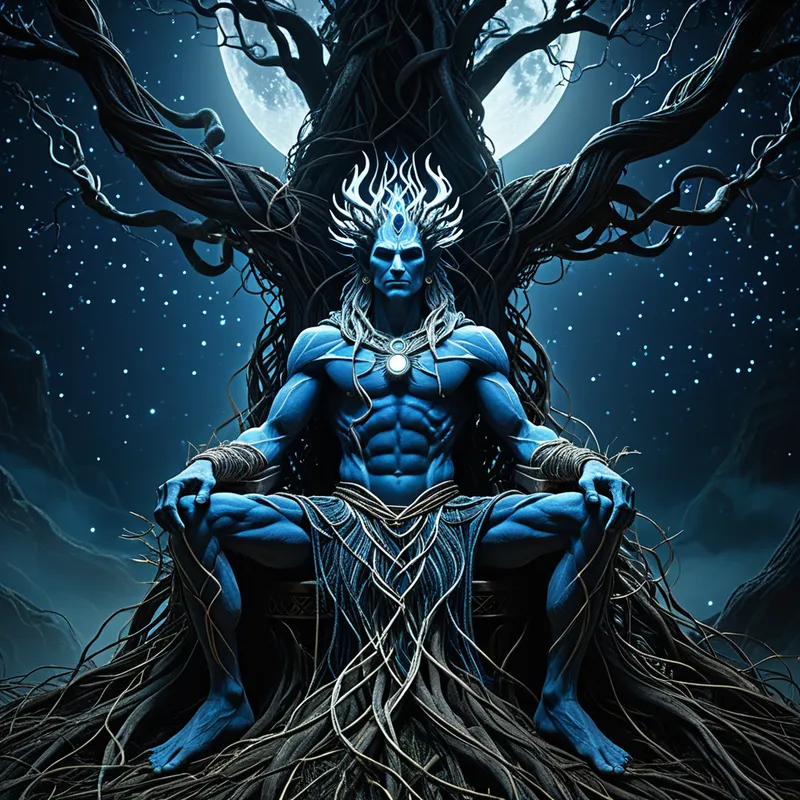
Knot Magic & Cord Rituals Myth Meaning & Symbolism
An ancient, cross-cultural myth where binding cords weave destiny, and untying knots liberates the soul from fate's predetermined pattern.
The Tale of Knot Magic & Cord Rituals
Listen. Before the world was fixed in its ways, when the wind still whispered secrets to the stones and the rivers remembered their source, there existed the Weaver of the Unseen Loom. She did not dwell in a palace of gold, but in the liminal space where the taproot of the great World Tree drank from the waters of potential. Her tools were not hammer and anvil, but spindle and distaff, needle and the first thread spun from the sigh of chaos becoming form.
Each life was a thread in her grand tapestry. Yet, she saw that the threads were wild, prone to tangling into misery or snapping in despair before their color could be fully revealed. So, from her own essence, she spun a singular, sacred cord—neither wholly material nor entirely spirit. It shimmered with the silver of moonlit spiderwebs and the deep crimson of heart’s blood. This was the Red String of Fate, but also its master key.
The Weaver descended to the nascent villages of humanity. She found a chieftain grieving a stillborn child, a hunter lost to a wasting sickness, lovers divided by a clan feud. To each, she did not give a prophecy, but a lesson. She taught the griever to take a strand of the child’s blanket and tie a simple knot, whispering into it all the love that had no place to go. “Bind the memory,” she said, “so it does not unravel into ghostly sorrow.” The knot was tied, and the crushing weight in the griever’s chest loosened, transformed into a tender, bearable ache.
To the hunter’s family, she gave a complex braid of three cords. “With each twist,” she instructed, “speak a virtue of his spirit—his courage, his laughter, his kindness. Bind the essence, not the failing body.” They braided through the night, and as dawn broke, the hunter awoke, weak but clear-eyed, the fever’s knot within him undone.
For the lovers, she took a single, long cord. She gave one end to each, and had them walk in opposite directions around the sacred oak, wrapping it until the cord grew taut. “You are bound by the choices of your families,” she said, her voice like wind through reeds. “This cord is that binding. Now, together, find the knot.” They followed the cord, hand over hand, until they met at its center, a gnarl of conflict and old oaths. “Now,” the Weaver commanded, “untie it. Not with force, but with understanding. Each loosened loop is a forgiven slight, a released expectation.” Their fingers worked not in opposition, but in concert, and as the final knot slipped free, the cord fell slack, no longer a restraint but a connection between their joined hands.
The Weaver smiled, a faint, sad curve of her lips. “Remember this. The cord is neutral. It can bind a wound or bind a prisoner. It can tether a soul to a curse or to a blessing. The magic is not in the fiber, but in the intention of the hands that knot and unknot. You now hold a fragment of fate in your palms. Use it wisely.”
And with that, she faded back into the whisper of the leaves, leaving behind not a deity to worship, but a profound and terrible power entrusted to human hands.
Cultural Origins & Context
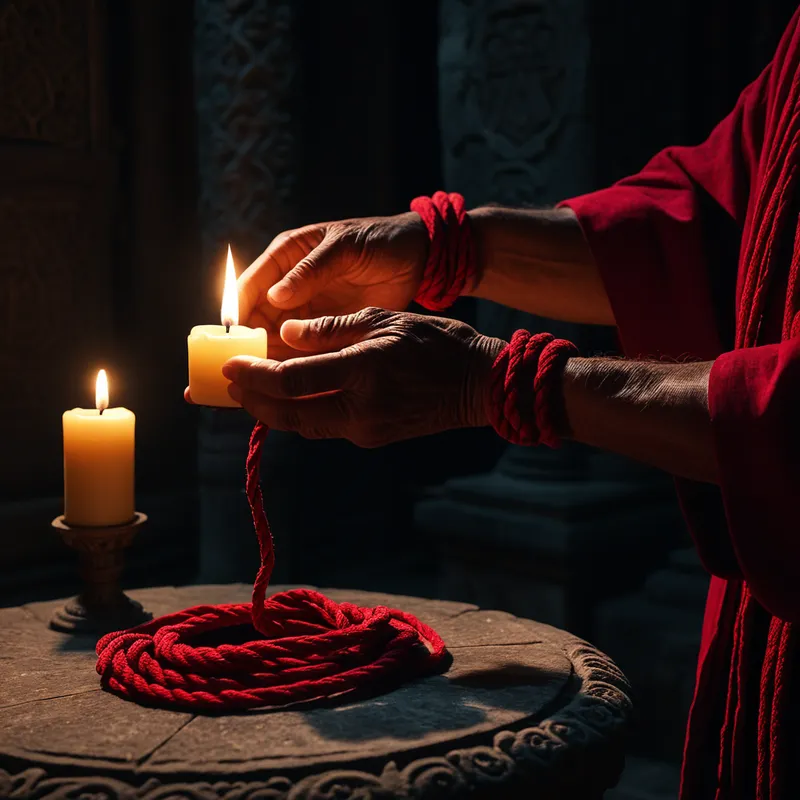
This is not a myth from a single scroll or epic, but a pattern etched into the bone-memory of humanity. We find its echoes in the Moirai of Greece, spinning, measuring, and cutting the thread of life. We hear it in the Norse wyrd, woven by the Norns beneath Yggdrasil. We see it in the Mouli or Janeu of Hindu rites, in the Thread Cross (Namkha) of Tibet, and in the "witches' ladders" of European folk magic.
Its societal function was profoundly pragmatic and psychological. In a world perceived as capricious and filled with invisible forces, knot magic provided a tangible technology of intention. It externalized internal states—grief, love, illness, conflict—into a physical object that could be ritually manipulated. The shaman, the wise woman, the village elder acted as technicians of this craft, performing rituals to bind harmful influences, secure blessings, or untangle social discord. The myth justified and sanctified a universal human impulse: to influence the seemingly unchangeable threads of circumstance.
Symbolic Architecture
At its core, the myth presents the cord as the ultimate symbol of connection and constraint. It is the literal line of a life’s narrative, the tether of relationship, the binding of an oath, and the snare of a neurosis.
The knot is a solidified moment of choice, a pause in the flow of time where intention crystallizes into form.
The act of tying is one of focusing, committing, and containing. It can be protective (a knot to seal in health), malicious (a knot to bind an enemy’s tongue), or creative (a knot to secure a vow). The cord itself represents the continuum—of time, relationship, or psychic energy. The knot is the event, the complex, the problem, or the pledge that interrupts that flow.
The Weaver represents the archetypal force of cosmic order and interconnection. Her gift, however, is the democratization of fate. She does not retain sole authority; she delegates the responsibility of managing life’s threads to humanity itself. This is the myth’s radical psychological insight: we are not merely passive subjects of fate (Ananke), but active, if often unconscious, participants in its weaving.
The Dreamer's Resonance
When this myth surfaces in modern dreams, it signals a profound engagement with the themes of binding and liberation. To dream of tangled cords, of being tightly bound, or of desperately trying to untie a knot speaks to a somatic experience of constraint. The dreamer may be feeling trapped in a job, a relationship, or a repetitive psychological pattern (“I’m tied up in knots”). The body in the dream translates the psychic tension into physical sensation.
Conversely, dreaming of deftly untying a complex knot, or of weaving a beautiful, strong cord, indicates a conscious process of working through a problem. It is the psyche’s representation of integrative problem-solving, of patiently disentangling conflicting loyalties, repressed emotions, or knotted communication. The dream of receiving a cord often points to a new connection or responsibility entering one’s life, its meaning dependent on the color and texture of the cord itself. These dreams are the soul’s ritual space, where the internal Senex or Magician works on the snarls that conscious awareness has yet to fully address.

Alchemical Translation
The individuation process, the journey toward psychic wholeness, is the ultimate untying of the complex. The myth provides a perfect model for this alchemical work.
First, one must identify the cord. What is the continuous thread running through my life? Is it a pattern of abandonment? A drive for perfection? A longing for creative expression? This is the distinctio, the separating out of the specific material from the chaotic mass of the unconscious.
Next, one must locate the knot. Where is the thread tangled? At what event, relationship, or decision did it stop flowing freely and become a hardened, repetitive snarl? This requires brutal honesty and shadow work—the nigredo of the alchemical process.
Then comes the sacred, patient work of untying. This is not a heroic slashing through, which would sever the thread of the Self entirely. It is the meticulous, often frustrating work of therapy, introspection, and conscious choice. Each released loop is a reframed memory, a forgiven part of oneself or another, an integrated aspect of the shadow.
The final goal is not a thread without knots, but a thread that is conscious of its own weaving, capable of tying intentional knots of commitment and gracefully untying the knots of past conditioning.
The liberated cord, now under the conscious guidance of the ego in service to the Self, can then be used to weave anew. The modern individual becomes their own Weaver, not to control an external fate, but to consciously participate in the creation of their own character and destiny. They move from being bound by fate to being responsibly bound to their own deepest, most authentic intentions. This is the magnum opus: the transformation of the leaden, knotted chain of compulsion into the golden, flexible cord of conscious connection.
Associated Symbols
Explore related symbols from the CaleaDream lexicon: