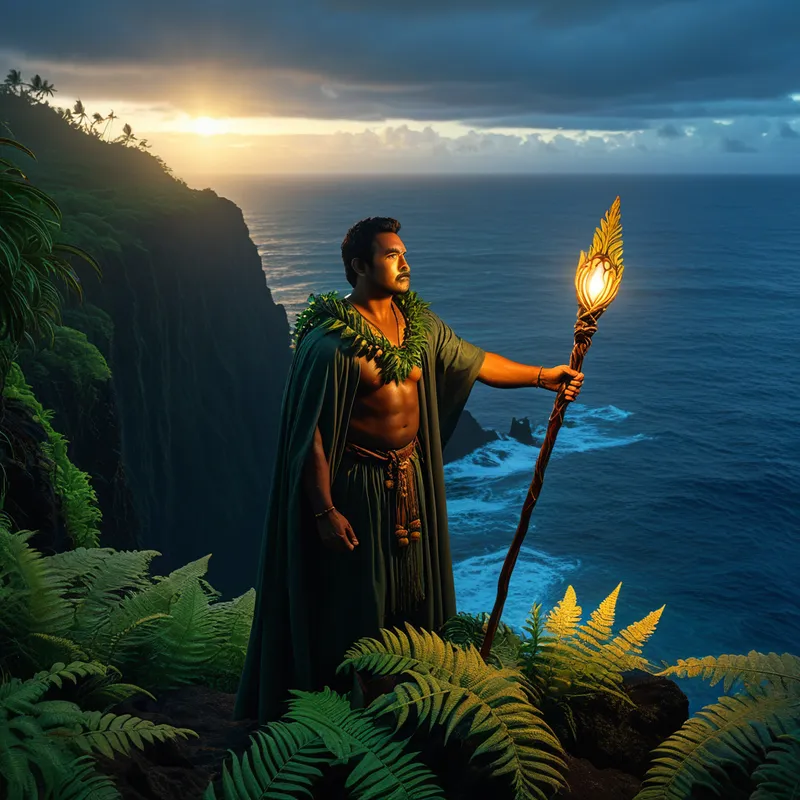
Kāne Myth Meaning & Symbolism
The myth of Kāne, the primal Hawaiian creator god who shaped the world from darkness, bringing forth light, water, and the first humans.
The Tale of Kāne
In the beginning, there was only Pō. A deep, silent, endless dark, a slumbering ocean without shore or sky. There was no up, no down, no time, only the long, unbroken dream of potential. From within this profound Pō, a stirring began. Not a sound, but a presence. A consciousness that was not yet a form.
This was Kāne. He awoke in the dark and knew himself. And with that knowing came a first, impossible desire: to see. But there was nothing to see. So, from his own essence, he drew forth light. It was a soft, silver glow, like the first hint of dawn behind a distant mountain. It did not illuminate, for there was nothing to illuminate, but it was. It was the first thing that was not Pō.
He was not alone in the stirring. Two other presences coalesced from the same deep source: Kanaloa, of the deep, mysterious currents, and Kū, of fierce, unyielding substance. Together, the three moved through the endless dark. Kāne carried the light. He reached out with it, not as a hand, but as an intention.
He spoke a word that was not a sound, but a command of being. "Let there be an up." And the light defined a ceiling to the dark. "Let there be a down." And the light defined a floor. The ocean of Pō was now between them. But it was still a formless sea.
Kāne then took the light and thrust it like a spear into the waters. Where it struck, the first land, a hard, dark stone, broke the surface. He and his companions stood upon it, the first solid thing in all existence. But the world was dry and silent. Kāne looked to the vast sky he had named, and with Kanaloa, he called forth the great wai. Not the salt of the primordial sea, but sweet, clear water. It fell from the sky as rain and sprang from the stone as springs. It pooled in the hollows of the new land, creating the first streams, the first sacred pools.
With light, land, and fresh water, the triad of life was present. Now, Kāne took red earth, the rich clay of the new land, and mixed it with the pure wai. He shaped a form—a head, a body, limbs. He breathed into its mouth, and the breath was his own name, "Kāne." The figure stirred. It was the first man. He repeated the act, and the first woman stood beside him. He set them by a spring of sparkling water, under the light of a sky he had made, on the land he had raised, and they lived.
Kāne then traveled the length and breadth of the new world. Where he struck his staff, new springs burst forth. Where he placed his hand, new plants unfurled. He did not conquer the Pō; he brought forth from it. He did not battle chaos; he introduced the first, gentle notes of a song of order—light, water, life. His work done, he receded, not to a distant heaven, but into the hidden places: the dappled light of the forest, the sparkle in the water, the breath in the lungs. He was the world's first parent, who, having given it life, stepped back to let it breathe on its own.
Cultural Origins & Context
The myth of Kāne is not a single, codified scripture, but a living tapestry of mele and moʻokūʻauhau passed down through generations of kāhuna and storytellers. It was recited in the heiau, not as mere entertainment, but as a sacred act of remembrance and alignment. To chant the coming of Kāne was to participate in the original act of creation, to reaffirm the sacredness of the natural order he established.
His primary role as the god of fresh water defined his societal function. In the fragile ecosystem of the islands, water was life itself. Kāne was present in every taro patch irrigated by an ʻauwai, in every spring where offerings of ʻawa were left. He was the "progenitor," the ultimate ancestor, and thus the foundation of all pono (righteous order). Unlike the more demanding Kū, Kāne was not typically offered animal sacrifices; his offerings were pure water, greenery, and quiet prayer. He represented the sustaining, life-giving principle that made all other human endeavors possible.
Symbolic Architecture
Kāne is not a god who slays monsters to create the world; he is a god who differentiates it. His myth is a profound map of consciousness emerging from the unconscious.
The first act of creation is not an explosion, but a gentle distinction: the separation of light from dark, of self from the void. This is the birth of awareness itself.
The primordial Pō represents the undifferentiated unconscious—the state of potential where all things are one, but nothing is manifest. Kāne's awakening is the spark of ego-consciousness. His first act, creating light, is the fundamental act of perception. It allows for the "seeing," the making of distinctions: up/down, sky/earth. The triad with Kanaloa and Kū symbolizes that creation is not a solo act. It requires the interplay of principles: the generative light (Kāne), the mysterious depths of the unknown (Kanaloa), and the firm, structuring principle that gives form (Kū).
Most crucially, Kāne creates life from the very materials of the world—earth and water—and animates it with his own breath, his name. This symbolizes the incarnation of spirit into matter. He does not impose from outside; he draws forth from within. His subsequent withdrawal signifies that true creation grants autonomy. The divine becomes immanent, hidden within the fabric of the living world.
The Dreamer's Resonance
When the archetype of Kāne stirs in the modern psyche, it often manifests in dreams of profound clarity and quiet genesis. One does not dream of battling Kāne, but of being in his presence or enacting his principles.
You may dream of discovering a hidden spring of impossibly clear water in a barren place. This is the somatic signal of a deep, life-giving insight welling up from the personal Pō of your unconscious. The body in the dream often feels a sense of relief, quenching, and purification. Alternatively, you might dream of a dark room where a single, sharp beam of sunlight suddenly pierces the gloom, illuminating dust motes that dance like nascent worlds. This is the psyche modeling the first moment of a new understanding, a "Eureka!" moment that brings order to an internal chaos. The emotional tone is not of excitement, but of awe and serene certainty.
These dreams mark a phase of psychic differentiation. The dreamer is not in turmoil, but at the precipice of a new internal structure. It is the process of naming what was previously formless—a feeling, a talent, a forgotten memory—and bringing it into the light of conscious awareness so it can be integrated and give life.
Alchemical Translation
The alchemical journey modeled by Kāne is the opus of Prima Materia—the work on the original, chaotic matter of the soul. For the modern individual, the myth charts the path of authentic self-creation, or individuation, which begins not with grand deeds, but with quiet, internal distinctions.
The first and most sacred act of self-creation is to stand in your own darkness and declare, "Let there be light." To simply acknowledge, "I am."
The Pō is our own unexamined life, our inherited patterns, our shadowy potentials and repressed energies. Kāne's awakening is the courageous decision to engage in self-reflection, to turn the light of awareness inward. The "land" that rises is the first solid ground of a core identity, separate from the fluid expectations of family and society. The "fresh water" called down is the emotional and spiritual resource—often found in solitude, nature, or creative practice—that nourishes this nascent self.
The creation of humans from earth and water is the ultimate alchemical goal: the creation of the Homunculus, or the fully realized individual. We are to take the raw material of our experiences (the earth) and our deepest feelings (the water), and consciously shape them into a coherent being. Breathing the name "Kāne" into this form is the act of claiming your own authority, your own divine spark of consciousness as the animating principle of your life.
Finally, Kāne's withdrawal is critical. It teaches that the goal of individuation is not to become a monument to the ego, but to become a living, autonomous world. The creative power, once consciously integrated, should recede into the background, operating as the hidden spring that sustains all you do, the inherent light by which you see, and the silent, life-giving breath in your every action. You become, like the islands born of his will, a distinct and thriving presence, sustained by the deep, sacred waters within.
Associated Symbols
Explore related symbols from the CaleaDream lexicon: