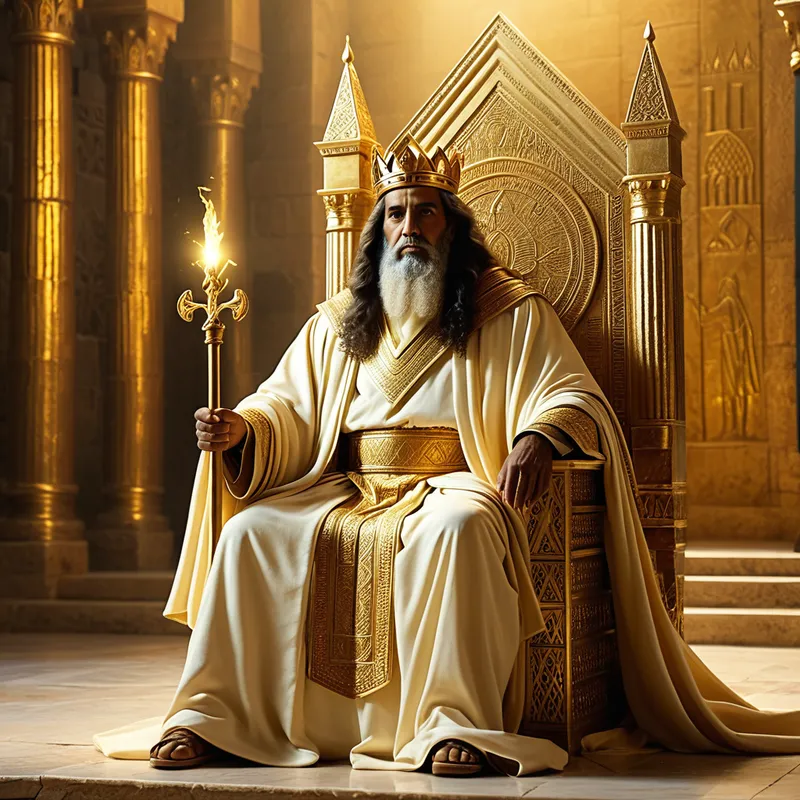
King Solomon Myth Meaning & Symbolism
A king granted divine wisdom builds a temple to unity, yet his heart is divided by foreign loves, embodying the eternal conflict between luminous order and shadowy desire.
The Tale of King Solomon
Hear now the tale of the man who held the sun in one hand and the moon in the other, and found his palms burned by both.
In the twilight of his father David's reign, a whisper moved through the corridors of cedar and stone: Who will grasp the scepter? From the strife of brothers, Solomon, son of Bathsheba, emerged, anointed not by the sword's edge but by a promise. In the thin, holy air of Gibeon, the young king offered a thousand burnt offerings upon the altar. The smoke curled heavenward, a priestly plea. And in the deep of night, the voice of YHWH came to him in a dream: "Ask. What shall I give you?"
The air hummed with potential. Riches? Long life? The heads of his enemies? Solomon, feeling the weight of the people like a cloak of lead, spoke into the divine silence: "Give your servant an understanding heart to judge your people, that I may discern between good and evil." The request pleased the Divine. For this, he was granted a wise and understanding heart, like which there was none before him, nor would there be after. And with it, riches and honor were added, a cascade of unasked-for glory.
And so, the Age of Solomon dawned. His wisdom became a living river, flowing to the ends of the earth. Kings and queens, like the famed Queen of Sheba, journeyed through deserts, drawn by the rumor of his mind, to hear the proverbs that fell from his lips like ripe fruit and to test him with hard questions. He spoke of trees, from the mighty cedar to the hyssop clinging to the wall, and of beasts, birds, creeping things, and fish. His judgment became legend: two women, one child living, one dead, each claiming the living babe as her own. Before the hushed court, Solomon called for a sword. "Divide the living child in two," he declared, "and give half to one, half to the other." The true mother's heart tore open, her love crying out to spare the child, even if it meant loss. And so, wisdom saw what eyes could not: the heart's truth.
With this wisdom, he undertook the great work: to build a house for the Name of YHWH. For seven years, the sound of chiseling stone and fragrant cedar filled Mount Moriah. The Temple rose, a geometric prayer in gold and olive wood, a vessel for the uncontainable. The Holy of Holies held the Ark of the Covenant, and when the work was done, a cloud of glory filled the house, so thick the priests could not stand to minister. Solomon dedicated it with a prayer that stretched to the heavens, a plea for mercy and hearing.
But a shadow grew with the temple. The king, in his glittering wisdom, loved many foreign women—seven hundred princesses, three hundred concubines. And as he grew old, these wives turned his heart. To please them, he built high places for Chemosh and Molech, gods who demanded what the God of Israel forbade. He offered incense and sacrifice on hills east of Jerusalem. The heart that once discerned between good and evil now housed them both in a palace of compromise.
The divine voice returned, not in a dream of gift, but in a prophecy of rupture. "Since you have not kept my covenant... I will surely tear the kingdom from you." The sun that had risen in Gibeon began its slow, irrevocable descent. The man who had built a house for unity sowed the seeds of division. Solomon slept with his fathers, and the weight of his glory and his failure passed to a son who would not bear it. The kingdom of gold and wisdom fractured, leaving behind proverbs, a temple, and the eternal echo of a divided heart.
Cultural Origins & Context
The Solomon narrative is woven into the Tanakh, primarily in the books of 1 Kings and 2 Chronicles, and echoed in the wisdom literature of Proverbs, Song of Songs, and Ecclesiastes. These texts were compiled, edited, and shaped by the Deuteronomistic historians during and after the Babylonian Exile (6th century BCE). Their function was not mere chronicle but theological reflection: to explain the catastrophic fall of Jerusalem and the dissolution of the Davidic kingdom.
Solomon represents the zenith of the Israelite monarchy, the fulfillment of God's promise to David. His story served as a national origin myth for Israel's golden age—a time of unmatched peace (shalom, a pun on his name), international prestige, and theological centrality with the Temple. Yet, it also served as a cautionary tale. Told by priests and scribes to a people in exile, the narrative answered the agonizing question, "Why did this happen to us?" The answer lay in Solomon's later years: the failure of even the wisest king to maintain covenant fidelity. The myth thus functioned as a divine pedagogy on the perils of power, the seduction of foreign alliances (spiritual and political), and the non-negotiable demand for a heart undivided in its devotion.
Symbolic Architecture
Solomon is the archetype of the Cosmic King, the ego that seeks to order chaos into a coherent, glorious, and lasting kingdom. His received wisdom is the divine sanction of this ordering principle. The Temple is his masterpiece—a symbol of the integrated Self, a sacred architecture where the transcendent (the glory cloud) can interface with the immanent (the people). It is the psyche made holy, a container for the ultimate value (the Ark).
The true test of wisdom is not in building temples, but in discerning the living heart from the dead claim within one's own soul.
Yet, the myth's profound depth lies in its shadow. Solomon's "understanding heart" (lev shomea) is linguistically tied to "hearing." He can hear the truth in others, but becomes deaf to the truth within his own multiplying desires. The foreign women and their gods represent the allure of the unintegrated Shadow and the Anima. These are not evil in themselves—they are parts of life's richness—but they become destructive when they "turn the heart" away from the central, orienting principle. The high places he builds are altars to psychic fragmentation, the worship of partial truths and instinctual compulsions that ultimately dismantle the temple of the Self.

The Dreamer's Resonance
To dream of Solomon is to dream of a critical juncture in one's psychological governance. It may manifest as a dream of brilliant, awe-inspiring judgment in a complex situation, reflecting the dreamer's conscious capacity for discernment. More commonly, it surfaces in dreams of magnificent, empty palaces; of being a revered ruler who feels like a hollow fraud; or of a beautiful, intricate structure (a building, a machine, a system) that is secretly crumbling from within.
The somatic sensation is often one of immense, burdensome weight—the weight of responsibility, of a reputation, or of a life's structure that no longer feels authentic. The dream may present two irreconcilable lovers or loyalties, echoing the two women and the sword. This is the psyche signaling a "Solomon moment": the ruling consciousness has achieved order and success but has done so by excluding vital, "foreign" parts of the self. These exiled elements now clamor for recognition, threatening to divide the kingdom of the psyche. The dream is a call from the Self to lower the sword of harsh judgment and to listen, not just to the arguments, but to the heart-cry of what is truly alive.
Alchemical Translation
The alchemical journey of Solomon is the opus of the Ruler archetype, moving from the nigredo of potential chaos (the succession crisis) to the albedo of brilliant, divinely-inspired order (wisdom, judgment, the Temple), and ultimately confronting the fatal rubedo—the confrontation with one's own passionate, "red" shadow.
The initial gift of wisdom represents the conscious ego's alignment with the Self's ordering principle. The building of the Temple is the conscious work of individuation—creating a stable, sacred inner space. But the process is incomplete. True alchemical gold requires the integration of the prima materia, the base, foreign, and seemingly incompatible elements symbolized by the many wives and their gods.
Individuation fails when the ruler in us builds only for the light, and declares the rest of the kingdom foreign, forbidden, and unfit for the temple grounds.
Solomon's failure is the failure to undertake this second, more dangerous integration. He houses his foreign elements, but does not marry them to his central purpose; he lets them remain separate cults that eventually subvert the central altar. The alchemical lesson is that wisdom without self-knowledge is a glittering trap. The psychic transmutation demands that the king must not only judge between two mothers but must also recognize both the pure and the possessive mothers within himself. He must take the sword meant to divide and instead use it to cut away his own blindness, to sacrifice his own spiritual complacency. The kingdom fractures not as a punishment, but as the inevitable consequence of an inner division made outer. For the modern individual, the myth instructs that any temple we build—a career, a relationship, an identity—will remain vulnerable until the ruler of the psyche dares to descend from the throne of pure judgment and consciously, respectfully, invite the foreign gods of passion, doubt, and earthly desire into a renewed covenant. Only then can the temple stand, not as a monument to one man's wisdom, but as a living city for the whole self.
Associated Symbols
Explore related symbols from the CaleaDream lexicon: