King Minos and the Minotaur Myth Meaning & Symbolism
A king's broken oath births a monster, confined in a labyrinth, demanding sacrificial tribute until a hero dares to face the beast within.
The Tale of King Minos and the Minotaur
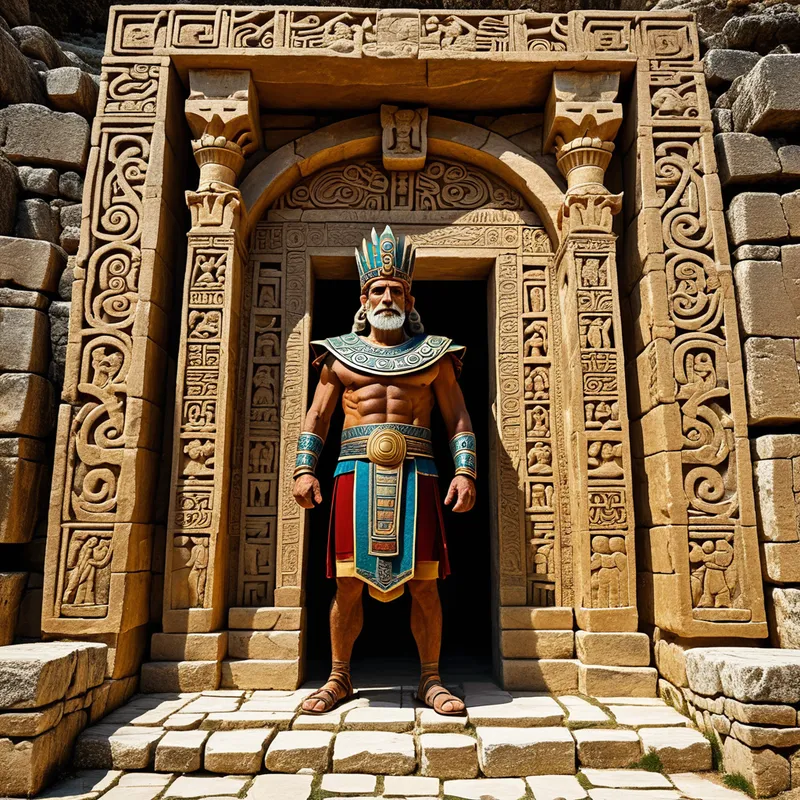
Hear now of a king whose power was born from [the sea](/myths/the-sea “Myth from Greek culture.”/), and of the monstrous child of his pride. In the sun-drenched age of Minoan glory, King [Minos](/myths/minos “Myth from Greek culture.”/) ruled from his labyrinthine palace at Knossos. To prove his divine right, he prayed to [Poseidon](/myths/poseidon “Myth from Greek culture.”/), Lord of the Deep, to send a bull from the waves, promising to sacrifice it in the god’s honor. [The sea](/myths/the-sea “Myth from Greek culture.”/) foamed and parted, and a magnificent, snow-white bull emerged, a creature of pure power and salt-spray. But [Minos](/myths/minos “Myth from Greek culture.”/), beholding its perfection, was seized by greed. He could not bear to destroy such a prize. He hid the divine bull and sacrificed another in its place.
The sea knows deceit. Poseidon’s wrath was not a storm, but a curse of passion. He caused Minos’s queen, Pasiphaë, to burn with an unnatural, irresistible desire for the white bull. In her torment, she sought the aid of the master craftsman Daedalus. From wood and hide, he constructed for her a hollow cow, a deceptive shell so convincing it tricked the beast itself. From this blasphemous union was born a child—but no ordinary child. He was named Asterion, though all would know him as the [Minotaur](/myths/minotaur “Myth from Greek culture.”/). His body was the body of a man, but his head and tail were those of a bull, and his soul was a roaring, insatiable hunger.
Shamed and terrified, Minos again summoned Daedalus. “Build me a prison,” he commanded, “a place from which this… [thing](/myths/thing “Myth from Norse culture.”/)… can never escape, and into which no one who enters can find their way out.” And so Daedalus, with a heavy heart, conceived the [Labyrinth](/myths/labyrinth “Myth from Various culture.”/). Not a simple maze, but a place of endless, winding corridors that turned back upon themselves, a stone confusion where sound died and hope was lost. There, in the sunless heart of [the earth](/myths/the-earth “Myth from Hindu culture.”/), [the Minotaur](/myths/the-minotaur “Myth from Greek culture.”/) was placed, and his bellows echoed through the stone veins of Crete.
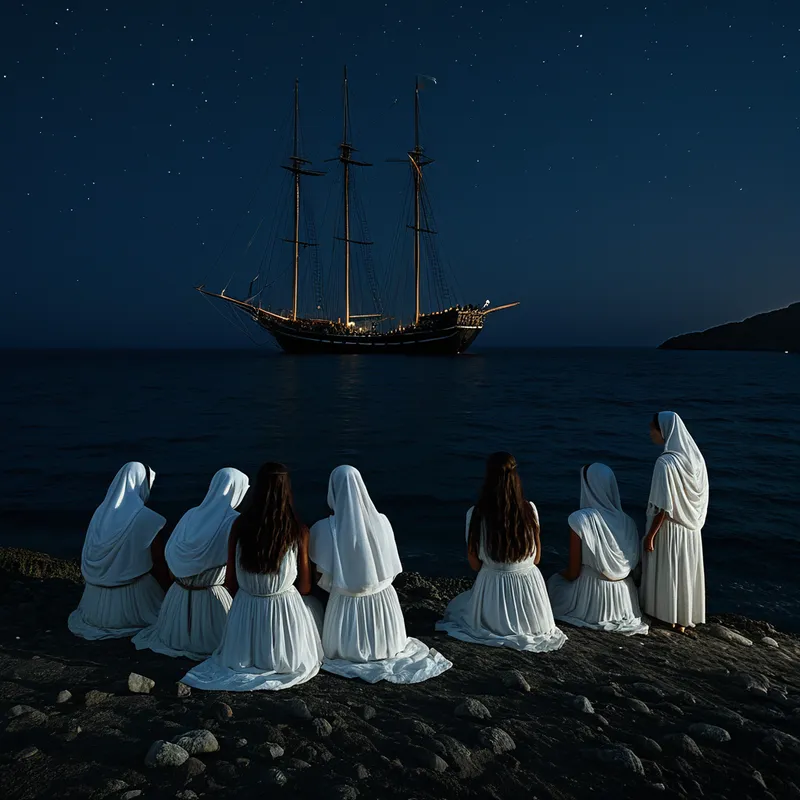
But the story of the monster demanded a tribute. For Minos’s son, Androgeos, had been slain in Athens. In his vengeance, Minos laid siege and won a terrible price: every nine years, seven Athenian youths and seven Athenian maidens were to be sent to Crete, cast into [the Labyrinth](/myths/the-labyrinth “Myth from Greek culture.”/) to be devoured by the beast. The black-sailed ship became an omen of despair.
Until the third tribute. Until [Theseus](/myths/theseus “Myth from Greek culture.”/), prince of Athens, volunteered to be among the sacrifices. His heart was set on ending the horror. When his ship arrived at Knossos, Ariadne, the king’s daughter, saw him and was struck as if by a god. She could not bear for him to die. In secret, she went to Daedalus, who gave her the means of salvation: a simple, brilliant skein of thread. She found [Theseus](/myths/theseus “Myth from Greek culture.”/). “Take this,” she whispered, her voice trembling in the palace shadows. “Tie one end to the entrance. The labyrinth will try to steal your mind, but this will lead you back to [the world](/myths/the-world “Myth from Tarot culture.”/) of light.”
Theseus took the thread and entered the mouth of darkness. The air grew cold and still. The only sounds were the scuff of his own feet, the pounding of his heart, and a distant, rhythmic snuffling that grew ever closer. He followed the sound, the thread unspooling behind him like a lifeline. Deeper and deeper he went, until he turned a final corner and stood in the beast’s lair. The Minotaur rose, a mountain of muscle and rage, its eyes holding the ancient madness of the sea and the betrayal of a king. The fight was brutal, primal—man against the monster of his father’s sin. With a final, mighty effort, Theseus slew the beast.
Silence fell in the labyrinth’s heart. Then, hand over hand, he followed the glimmering thread back through the winding stone, past the bones of those who had no such guide, and emerged, blinking, into the Cretan sun, a hero stained with the blood of the impossible. He took Ariadne and set sail for home, but in his [triumph](/myths/triumph “Myth from Roman culture.”/), he forgot a fatal promise to his father, Aegeus—to change his ship’s black sails to white. Seeing the black sails on [the horizon](/myths/the-horizon “Myth from Various culture.”/), Aegeus believed his son dead and cast himself into the sea that bears his name. Thus, the myth ends in liberation, love, loss, and the ever-turning wheel of consequence.
Cultural Origins & Context
This myth is a profound palimpsest, a Greek narrative layered over the fading memory of the actual Minoan civilization that dominated the Aegean. For the later Greeks, Crete under Minos represented a powerful, ancient, and somewhat alien thalassocracy. The myth served multiple societal functions. It explained Athenian subjugation to Minoan power in a legendary past, justifying the tribute as punishment for a crime. It also celebrated Athenian heroism and eventual ascendancy through the figure of Theseus.
The story was a cornerstone of Athenian civic identity, told and retold in epic poetry, tragic drama, and visual art on vases and in temples. It was not a children’s fable but a foundational narrative about the consequences of broken oaths to the gods, the dangers of hubris, and the necessity of the heroic quest to confront chaos. The labyrinth itself may echo the complex, multi-leveled architecture of the real Knossos palace, which to later Greeks seemed a bewildering maze. The myth, therefore, acts as a cultural memory, transforming historical power dynamics and architectural wonders into a timeless drama of the human condition.
Symbolic Architecture
At its core, this myth is a masterful depiction of the [psyche](/myths/psyche “Myth from Greek culture.”/)’s [structure](/symbols/structure “Symbol: Structure in dreams often symbolizes stability, organization, and the framework of one’s life, reflecting how one perceives their environment and personal life.”/) and its perils. [King](/symbols/king “Symbol: A symbol of ultimate authority, leadership, and societal order, often representing the dreamer’s inner power or external control figures.”/) Minos represents the ruling [consciousness](/symbols/consciousness “Symbol: Consciousness represents the state of awareness and perception, encompassing thoughts, feelings, and experiences.”/), [the ego](/myths/the-ego “Myth from Jungian culture.”/) that seeks order and control. His sin is not mere greed, but a failure of sacred reciprocity—he hoards the divine gift (the [bull](/symbols/bull “Symbol: The bull often symbolizes strength, power, and determination in many cultures.”/)) for himself. This act of spiritual [bankruptcy](/symbols/bankruptcy “Symbol: A state of financial insolvency representing loss, failure, and the collapse of material security or personal foundations.”/) gives [birth](/symbols/birth “Symbol: Birth symbolizes new beginnings, transformation, and the potential for growth and development.”/) to the [Shadow](/symbols/shadow “Symbol: The ‘shadow’ embodies the unconscious, repressed aspects of the self and often represents fears or hidden emotions.”/), the [Minotaur](/symbols/minotaur “Symbol: The Minotaur, a creature from Greek mythology, is often interpreted as a symbol of inner turmoil and the struggle between human and beast.”/).
The monster in the maze is not an external enemy, but the incarnate consequence of a suppressed oath, a disowned desire made flesh and left to hunger in the dark.
The [Labyrinth](/symbols/labyrinth “Symbol: The labyrinth represents a complex journey, symbolizing the intricate path toward self-discovery and understanding one’s life’s direction.”/) is the brilliant [symbol](/symbols/symbol “Symbol: A symbol can represent an idea, concept, or belief, serving as a powerful tool for communication and understanding.”/) of repression and complexification. It is not designed to keep the [monster](/symbols/monster “Symbol: Monsters in dreams often symbolize fears, anxieties, or challenges that feel overwhelming.”/) in, but to make it impossible to find. It represents the convoluted pathways of denial, rationalization, and fear we construct to avoid confronting what we have created and disowned. The Athenian tribute is the ongoing psychic cost of this repression—the periodic sacrifice of our vitality, our [youth](/symbols/youth “Symbol: Youth symbolizes vitality, potential, and the phase of life associated with growth and exploration.”/), our potential (the seven youths and maidens) to feed the hidden [beast](/symbols/beast “Symbol: The beast often represents primal instincts, fears, and the shadow self in dreams. It symbolizes the untamed aspects of one’s personality that may need acknowledgment or integration.”/).
Ariadne’s thread is the symbol of [gnosis](/symbols/gnosis “Symbol: Direct, intuitive spiritual knowledge or enlightenment that transcends ordinary understanding, often associated with mystical experiences and esoteric traditions.”/), of conscious [insight](/symbols/insight “Symbol: A sudden, deep understanding of a complex situation or truth, often arriving unexpectedly and illuminating hidden connections.”/) and [connection](/symbols/connection “Symbol: Connection symbolizes relationships, communication, and bonds among individuals.”/). It is the thin, fragile, but unbreakable line of [awareness](/symbols/awareness “Symbol: Conscious perception of self, surroundings, or internal states. Often signifies awakening, insight, or heightened sensitivity.”/) that allows the ego (Theseus) to descend into the unconscious (the labyrinth), engage [the Shadow](/myths/the-shadow “Myth from Jungian culture.”/) (the Minotaur), and return to consciousness integrated, rather than be lost forever. Theseus’s victory is not the eradication of the unconscious, but the conscious [integration](/symbols/integration “Symbol: The process of unifying disparate parts of the self or experience into a cohesive whole, often representing psychological wholeness or resolution of internal conflict.”/) of its power; he masters the beast born of his [father](/symbols/father “Symbol: The father figure in dreams often symbolizes authority, protection, guidance, and the quest for approval or validation.”/)’s generation’s sin.
The Dreamer’s Resonance
When this mythic pattern stirs in modern dreams, it signals a profound encounter with the personal Shadow. To dream of being lost in a maze or complex building suggests a state of psychological confusion, where the dreamer feels trapped by their own mental constructs and cannot find a way forward. The feeling is one of somatic dread—tightness in the chest, shortness of breath—a literal embodiment of being cornered by one’s own psyche.
Dreaming of a hidden, monstrous presence, especially one that is hybrid or “unnatural,” points directly to an aspect of [the self](/myths/the-self “Myth from Jungian culture.”/) that has been deemed unacceptable—perhaps a raw instinct, a buried rage, a potent creativity, or a deep vulnerability—that has been locked away and has grown ravenous. The dream is the psyche’s demand for tribute; it will no longer be ignored. The process underway is one of recognition. The labyrinthine dream is not a punishment, but an invitation—or a final warning—to begin the search, to find the thread of self-awareness that will lead to the center of the disturbance.
Alchemical Translation
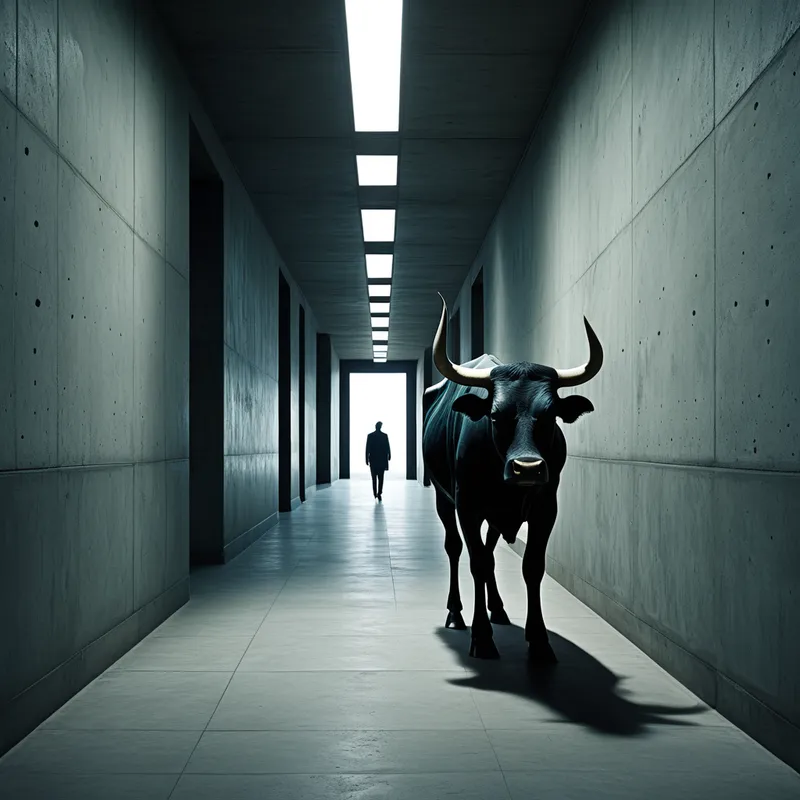
The myth of the Minotaur is a precise map for the alchemical process of individuation. It begins with the [nigredo](/myths/nigredo “Myth from Alchemical culture.”/), the blackening: the broken oath, the birth of the monster, the descent into the labyrinth—all symbolizing a fall into confusion, depression, or crisis, where the old ruling principle (Minos’s order) is revealed as flawed.
The hero’s journey into the maze is the [solutio](/myths/solutio “Myth from Alchemical culture.”/), the dissolution of the ego’s certainty in the face of the unconscious. Theseus, guided by the thread (the emerging symbol of the Self, the organizing center of the total psyche), undergoes the [separatio](/myths/separatio “Myth from Alchemical culture.”/), distinguishing himself from both the monster and the maze. The combat is the coagulatio, the confrontation and solidification of what was formless shadow into a tangible reality that can be engaged and transformed.
To slay the Minotaur is not to kill a part of oneself, but to break its compulsive, autonomous power, to transmute blind hunger into conscious strength.
The return, following the thread, is the albedo, the whitening or illumination, where the reclaimed energy is integrated. The final, tragic note—Aegeus’s death—reminds us that this process changes everything. The old king, the old conscious attitude that could only see in terms of black sails (death) or white (life), must die for the new, more complex consciousness to fully reign. The individual who has faced their labyrinth does not return to the shore they left; they are, fundamentally, reborn. The myth teaches that the path to wholeness winds through the darkest center of our own creation, and the only tool we need to navigate it is the unwavering thread of our own conscious attention.
Associated Symbols
Explore related symbols from the CaleaDream lexicon: