King David's Census Myth Meaning & Symbolism
A king's prideful act of numbering his people incurs divine wrath, revealing the peril of quantifying a soul and the cost of forgetting the sacred.
The Tale of King David's Census
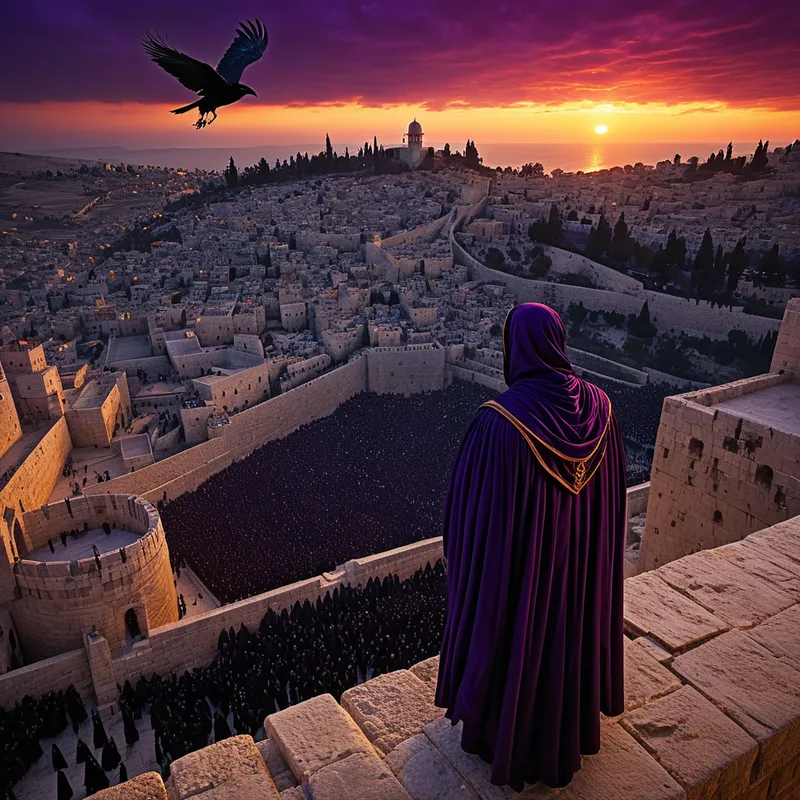
The kingdom rested, a heavy jewel in the hand of God. King David, having subdued his enemies on every side, sat in his house of cedar. Yet, a cold quiet had settled in his bones where the heat of battle once roared. He paced the polished stones of his palace, his gaze turning inward, to the ledger of his soul, and outward, to the kingdom he had forged from blood and promise.
A whisper, thin and sharp as a serpent’s tooth, coiled in the silence. It spoke not of gratitude for the peace, but of inventory. It asked not who his people were, but how many. "Number them," it hissed, a voice from the empty places of power. "Count the swords, the spears, the souls. Know the measure of your strength."
The king summoned Joab, his fist of iron. "Go," David commanded, his voice echoing in the vast hall, "through all the tribes of Israel, from Dan to Beersheba. Number the people, that I may know the sum of them."
A shadow passed over Joab’s warrior face. "May the LORD your God add to the people a hundred times over," he pleaded, "but why does my lord the king delight in this thing?" But the king’s word prevailed against the word of his servant. For nine months and twenty days, Joab and the captains of the host traveled the length and breadth of the land. They passed through walled cities and tented valleys, their tally marks a silent scar upon the living landscape. They reduced songs, stories, births, and burials to a single, stark number: eight hundred thousand valiant men who drew the sword in Israel, and five hundred thousand in Judah.
And as the final count was sealed, David’s heart smote him. The weight of the number became a millstone around his neck. He had not counted blessings; he had audited grace. He cried out to the LORD, "I have sinned greatly in what I have done. Now, O LORD, please take away the iniquity of your servant, for I have done very foolishly."
That morning, the prophet Gad, David’s seer, came to him, his eyes holding the terrible clarity of one who has spoken with God. "Thus says the LORD," Gad declared, his voice stripping all comfort from the air, "I offer you three things; choose one of them, that I may do it to you." The choices hung like three swords: seven years of famine, three months of flight before your foes, or three days of pestilence in the land.
David, his kingship now a crown of thorns, chose the direct hand of God. "Let us fall into the hand of the LORD, for his mercy is great; but let me not fall into the hand of man." So the angel of the LORD was sent, and a plague descended from Dan to Beersheba. Seventy thousand men fell. As the angel stretched out his hand toward Jerusalem to destroy it, the LORD relented. "Enough," the voice thundered. "Stay your hand."
The angel of the LORD stood by the threshing floor of Araunah the Jebusite. David, seeing the angel with his sword drawn against the city, fell on his face. "Was it not I who commanded the people to be numbered? It is I who have sinned and done great evil. But these sheep, what have they done? Let your hand, I pray, be against me and against my father's house."
Gad returned, instructing David to raise an altar to the LORD on that very threshing floor. David purchased the land and the oxen, refusing to offer to God that which cost him nothing. He built the altar and offered burnt offerings and peace offerings. And the LORD answered his plea for the land. The plague was stayed. The place where the counting stopped and the atonement began would one day become the foundation for the Temple, the dwelling place of the Holy.
Cultural Origins & Context
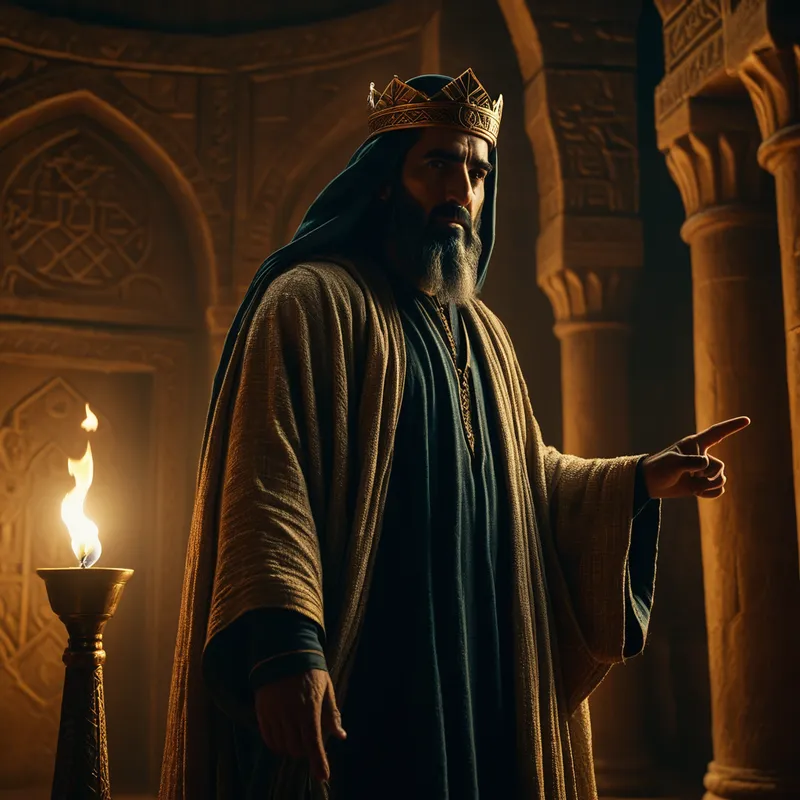
This myth is embedded in the Book of Samuel and the Book of Chronicles, texts that form the core of the Deuteronomistic history—a theological compilation reflecting on the rise and fall of the Israelite monarchy. It was a story told not merely as history, but as sacred cautionary tale, preserved by priestly and prophetic circles during or after the Babylonian Exile. In a culture where identity was covenantal, based on a relationship with Yahweh rather than imperial might, the myth served a critical societal function. It established a theological boundary for kingship: the ruler is not the owner of the people, but their shepherd under God. The census, a tool of state administration (taxation, conscription), is portrayed as inherently perilous when divorced from its sacred context, reflecting a deep cultural anxiety about the centralizing, quantifying power of the monarchy encroaching on the tribal, covenant-based identity of Israel.
Symbolic Architecture
At its heart, the myth is a profound exploration of the psychology of sovereignty and the sin of quantification. David, the archetypal Ruler, here embodies the shadow of that archetype: the tyrant who mistakes stewardship for ownership. The act of numbering is not neutral; it is an alchemical reduction of soul to statistic, of a living covenant to a cold resource.
To count a people is to forget their faces; to sum a nation is to silence its story.
The plague represents the inevitable return of the repressed sacred. The soul, when treated as a number, rebels in the form of a psychic epidemic—a collective affliction born of a leader's spiritual sickness. The pivotal moment at the threshing floor of Araunah is rich with symbolism. The threshing floor is where grain is separated from chaff, a place of judgment and harvest. Here, it becomes the site where divine wrath is separated from divine mercy through the king's acceptance of responsibility and his offering, which must cost him something. This establishes the core principle: transformation requires a tangible sacrifice of ego, not a cheap, symbolic gesture. The location’s future as the Temple foundation signifies that true, enduring structure (be it a nation, a self, or a society) must be built upon the ground where hubris was confronted and atonement was made.
The Dreamer's Resonance
When this myth stirs in the modern unconscious, it often manifests in dreams of overwhelming bureaucracy, endless lists, or being reduced to a number in a vast, impersonal system. The dreamer may find themselves frantically counting meaningless objects, filling out infinite forms, or watching loved ones dissolve into data points on a screen. Somatically, this can feel like a constriction in the chest, a numbness, or a profound anxiety of erasure.
Psychologically, this signals a process where the ego's "administrative self"—the part that seeks control through categorization, measurement, and optimization—has overreached. It has begun to "census" the inner population: quantifying self-worth via productivity metrics, reducing complex emotions to diagnostic labels, or mapping relationships as transactional networks. The ensuing "plague" in the dreamscape is the psyche's corrective: a depressive episode, a sudden loss, or a burst of irrational anger that shatters the sterile ledger. It is the Self’s way of halting the soul-count, forcing a confrontation with the cost of having traded depth for data, essence for efficiency.

Alchemical Translation
The individuation journey modeled here is the transmutation of the Ruler’s shadow from a counter of souls to a builder of sacred space. The initial stage is the inflation of the conscious ego, believing it can possess and comprehend the totality of its inner kingdom (the unconscious) through intellect and will (the census). This inevitably provokes a reaction from the Self (the LORD), which manifests as a crushing neurosis or life crisis (the plague) that levels the ego's pretensions.
The altar must be built on the very spot where your quantifying sword was stayed.
The alchemical work begins with David’s choice: to face the divine judgment directly rather than flee from it. This is the crucial acceptance of shadow and guilt. Then comes the purchase of the threshing floor—the conscious acquisition of the very place of one's failure and brokenness. One must own the ground of their humiliation. The final, essential operation is the offering that costs. For the modern individual, this is the concrete, often painful act that transmutes insight into change: making amends where it is difficult, sacrificing a cherished self-image, investing time and resources into inner work without guarantee of return. This costly offering is what stays the inner plague and establishes a new center. The former site of reduction (the census) becomes the foundation for the inner Temple—a lasting, integrated structure of consciousness where the sacred (the numinous Self) and the human (the ego) can commune. One ceases to be a manager of inventory and becomes a steward of mystery.
Associated Symbols
Explore related symbols from the CaleaDream lexicon: