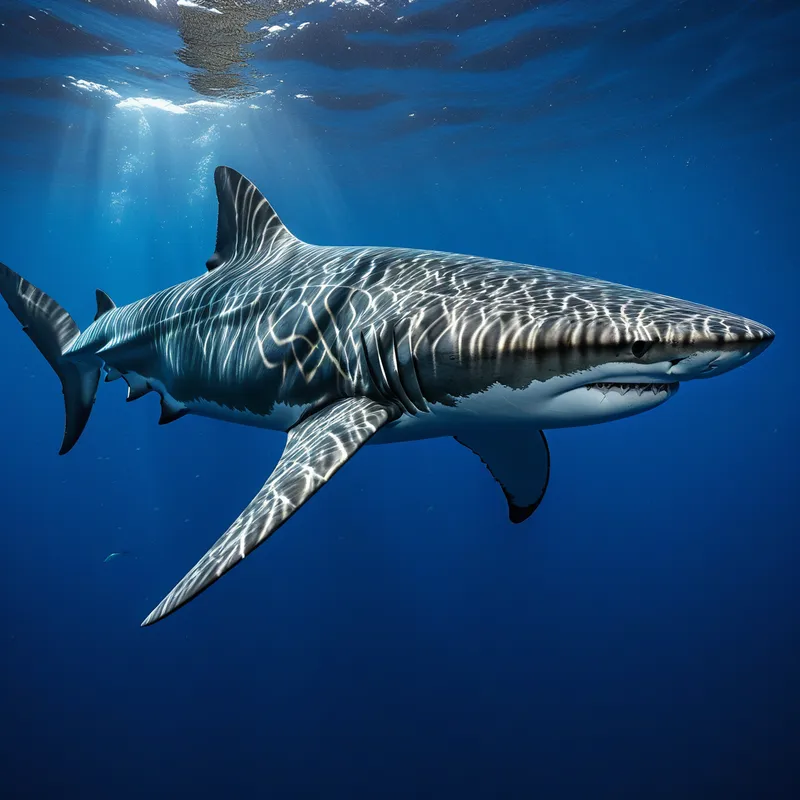
Kiha-nui-lulu-moku Shark Demigod Myth Meaning & Symbolism
A Hawaiian myth of a chief's son, born in shark form, who must navigate the treacherous waters between human and divine realms to claim his destiny.
The Tale of Kiha-nui-lulu-moku Shark Demigod
Listen. The story begins not on the sun-baked shore, but in the deep, blue-black silence of the sea, where the currents whisper secrets to the coral. In the land of Hawaiʻi, there lived a high chief and his wife, whose hearts ached for a child. Their prayers were carried on the salt wind to the gods of the deep. And the gods answered, but not in the way of human expectation.
The queen conceived, and her time came. But from her womb emerged not a crying babe, but a creature of the deep—a sleek, powerful shark. The midwives gasped; the chief’s face darkened with confusion and dread. This was Kiha-nui-lulu-moku, “the great shark with the restless movement.” In horror and following the harsh kapu, the father ordered the infant shark cast into the sea. The mother’s heart broke upon the rocks of this decree, but she could not defy the law.
The tiny shark was taken to the pounding surf at Hilo and set adrift. But a mother’s love is a current stronger than any tide. Secretly, she would go to the shore. She would call out to the deep, her voice a lullaby woven from grief and hope. And he would come—her son. He would swim in the shallows, and she would feed him poi and sweet potatoes, the foods of his human lineage. With each visit, he grew larger, more powerful, his intelligence gleaming in his dark eyes. He was a child of two worlds, nourished by land and sea, by human love and divine nature.
Years flowed like the Kai. Kiha-nui-lulu-moku became the terror and the guardian of the Hilo coast. To strangers, he was a monster. To his mother’s people, he was a sometimes-seen mystery. But a final, terrible test awaited. His human family embarked on a voyage, their canoe slicing through his domain. Not recognizing them, the great shark attacked, his primal nature surging. It was only when he tasted the unique scent of his own kin—his ohana—in the water that he stopped. Horror at what he had nearly done crashed over him. In that moment of agonizing recognition, the conflict of his dual nature reached its peak.
His mother, surviving the attack, called to him from the shattered canoe. At the sound of her voice, the great demigod was overcome. His destiny, long suspended between forms, crystallized. He could no longer live in the threshold. He led the broken canoe safely to shore, a silent, massive escort. On the beach, before his human family and his mortal mother, he beached himself. With a final, shuddering effort of will, the shark body was shed like a shadow. From it stepped forth a man—tall, strong, and radiant, fully realized. The shark skin hardened into stone, a lasting kino lau in the bay. Kiha-nui-lulu-moku had transformed, integrating his power into a human form, and walked among his people as a great chief, his oceanic strength now flowing in his bloodline.

Cultural Origins & Context
This myth belongs to the rich oral tradition of the Kanaka Maoli. It was not mere entertainment but a foundational narrative, preserved and recited by kahuna and storytellers. Stories of ʻaumakua, ancestral spirits who could manifest as animals like sharks, owls, or hawks, are central to Hawaiian spirituality. Kiha-nui-lulu-moku’s tale is a paramount example of this relationship.
The myth served multiple societal functions. It explained the origins of certain chiefly lines who claimed the shark as their ʻaumakua, legitimizing their authority through direct divine ancestry. It taught profound ecological ethics: the sharks of Hilo Bay were to be respected as potential kin and protectors, not merely feared as predators. Most importantly, it modeled a deep truth about identity. In a culture where genealogy (moʻokūʻauhau) is everything, the story asserts that one’s essence is not a single note but a chord—a complex harmony of ancestral forces, both human and non-human, that must be acknowledged and integrated.
Symbolic Architecture
At its heart, this is a myth of the rejected gift, the monstrous birth that contains the seed of destiny. Kiha-nui-lulu-moku represents the instinctual, powerful Self that emerges raw and unformed, clashing with the conscious order of the “father” (society, tradition, the ego). His initial rejection is the ego’s horror at the primal, unfiltered power of the unconscious.
The true self often first appears in a form the conscious world deems monstrous. Integration begins not with celebration, but with a mother’s secret nourishment.
The mother’s clandestine feedings are the crucial, nurturing connection to the unconscious. She represents the function of the psyche that can bridge the worlds—the anima or the holding environment—that sustains the nascent Self with cultural meaning (the poi) until it is strong enough to face its own paradox. The final, nearly tragic encounter with the family canoe is the inevitable crisis of integration. The unconscious power, acting autonomously, threatens to destroy the very personal life it is meant to strengthen. Only through conscious recognition—“this is my own flesh”—can the energy be transformed.
The Dreamer's Resonance
When this myth stirs in modern dreams, it speaks of a profound somatic and psychological process: the emergence of a powerful, instinctual identity that feels alien to one’s waking life. Dreaming of being, or encountering, a shapeshifting shark may signal a time of turbulent transformation where deep, ancestral patterns (family curses, innate talents, buried rage or power) are breaking surface.
The somatic feeling is often one of simultaneous power and isolation—being immensely strong in a foreign element. There may be dreams of being misunderstood, of causing unintended fear, or of finding a secret, nurturing source (a person, a practice, a creativity) that “feeds” this emerging aspect in private. The critical encounter—the “attack on the canoe”—manifests as a life event where one’s raw, unintegrated power inadvertently harms a relationship or project, forcing a moment of stark self-recognition. This is the painful but necessary catalyst that demands the dreamer “come ashore,” to embody and direct their primal nature consciously, rather than being driven by it.
Alchemical Translation
The alchemical journey of Kiha-nui-lulu-moku is a perfect map of psychic transmutation, or individuation. The process begins in the nigredo, the blackening: the dark sea of the unconscious and the “monstrous” birth—the depression, confusion, or crisis that initiates the journey. The casting out is the painful separation of the ego from its latent, greater Self.
The prima materia of the soul is often found in what has been rejected. The shark-child in the deep is unrefined gold.
The mother’s secret feedings are the albedo, the whitening: the slow, nourishing work of bringing consciousness to the unconscious material through reflection, therapy, art, or prayer. It is a private, sustaining dialogue. The attack on the canoe is the rubedo, the reddening: the fiery confrontation where the transforming Self clashes with the existing structure of the personality. It is a dangerous, passionate, and necessary conflict.
The final beaching and transformation is the citrinitas, the yellowing or revelation: the conscious integration. The shark does not die; it is transmuted. Its essence becomes the foundation (the stone) and its power is absorbed into a functional human form. For the modern individual, this translates to taking one’s raw, instinctual power—perhaps creativity, anger, sensitivity, or a non-conforming identity—and, through the crucible of recognition and responsibility, hardening it into a durable, skillful part of one’s character. One ceases to be possessed by the shark and learns to carry its streamlined strength and deep perception within a civilized life, becoming a guardian of one’s own depths and a guide for others.
Associated Symbols
Explore related symbols from the CaleaDream lexicon:
- Shark — The primal, instinctual Self in its raw, powerful, and often feared form; a guardian of deep psychological boundaries and ancestral memory.
- Ocean — The vast, unconscious mind from which the nascent Self emerges and within which the early stages of the psychic journey take place.
- Mother — The nurturing, bridging function of the psyche that sustains the connection between the conscious ego and the emerging unconscious contents with love and cultural meaning.
- Transformation — The core alchemical process of the myth, the irreversible change from one state of being to a higher, integrated one.
- Blood — The literal and symbolic tie of kinship and ancestry; the moment of recognition that halts destruction and initiates integration.
- Journey — The essential voyage from unconscious embodiment to conscious incarnation, fraught with peril and essential discovery.
- Shadow — The initially rejected, monstrous aspect of the self that holds immense power and must be reclaimed and integrated.
- Destiny — The inborn, divine pattern that unfolds through the conflict of dual natures, guiding the entity toward its fulfilled form.
- Ancestry — The powerful force of lineage and ʻaumakua that shapes identity, suggesting the Self is not created in a vacuum but flows from deep generational wells.
- Ritual — The repeated, sacred act of the mother feeding the shark, which sustains the connection between worlds and enables the transformation to proceed.
- Fear — The initial reaction of the conscious order (the father/chief) to the emergent, unfamiliar power of the deep Self.
- Rebirth — The final emergence of the man from the shark skin, representing the achievement of a new, whole level of being after a symbolic death of the old form.