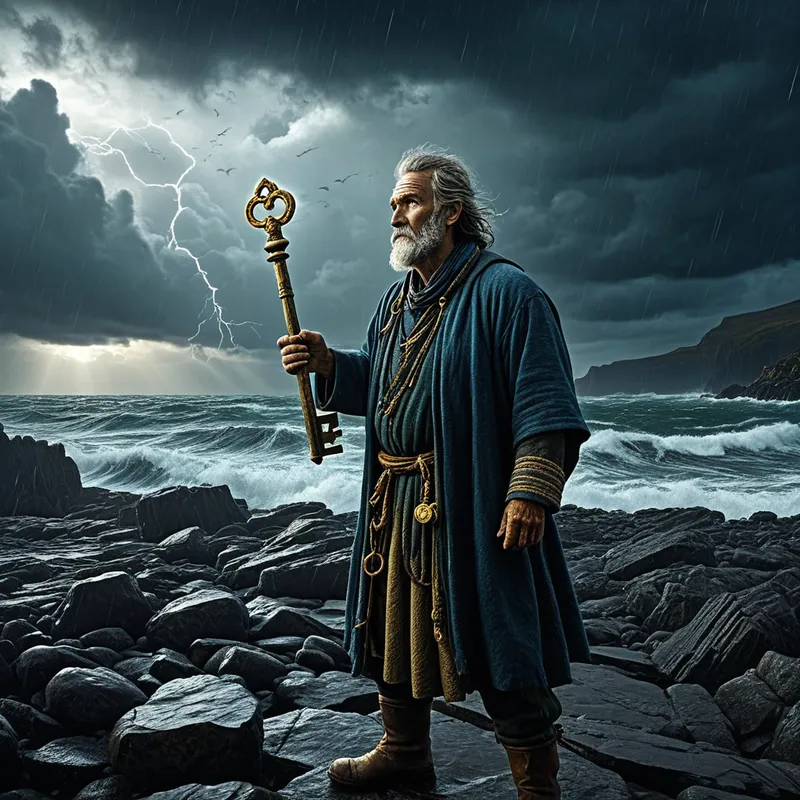
Keys to the Kingdom Myth Meaning & Symbolism
A mythic declaration of spiritual authority, where the keys to divine gates are entrusted to a flawed human, symbolizing the power of faith and inner transformation.
The Tale of Keys to the Kingdom
Listen, and hear a tale not of thrones in marble halls, but of a throne built on a storm-tossed sea. The air was thick with the salt of the Galilean lake and the scent of unwashed men who pulled nets heavy with the silver thrash of life. Among them was Simon, a man of tempestuous heart, whose faith could be a roaring gale one moment and a sinking stone the next.
They had come to a place where the earth met the divine whisper—the villages of Caesarea Philippi, where pagan grottoes bled cold water from the rock, said to be a gate to the underworld. There, amidst these old gods, the Rabbi posed a question that cut deeper than any fisherman’s knife: “Who do you say that I am?”
And Simon, his soul stirred from its depths, spoke not with learned theology, but with a certainty that erupted from his very bones. “You are the Christ, the Son of the living God.” The words hung in the air, a confession that seemed to silence the very streams.
The Rabbi’s eyes, which had seen into the hearts of kings and beggars alike, fixed upon Simon. A smile, both tender and terrible, touched his lips. “Blessed are you, Simon son of Jonah. For flesh and blood has not revealed this to you, but my Father in heaven.” The wind stilled. The disciples held their breath.
Then came the declaration, a pronouncement that would echo through centuries. “And I tell you, you are Peter, and on this rock I will build my ekklesia, and the gates of Hades will not overcome it.” He paused, letting the weight of the new name settle on the fisherman’s shoulders. “I will give you the keys of the kingdom of heaven. Whatever you bind on earth will be bound in heaven, and whatever you loose on earth will be loosed in heaven.”
In that moment, Simon was unmade and remade as Peter. No scepter was placed in his hand, no crown upon his head. Instead, into his calloused, imperfect palms were entrusted the Keys—not to a treasury of gold, but to the very gates that separate the mortal from the eternal, the bound from the free. The conflict was not yet with empires, but within the soul of the man who now bore their impossible weight, a man who would, before the next dawn broke, still deny he ever knew the key-bearer.
Cultural Origins & Context
This pivotal narrative is recorded in the Gospel of Matthew (16:13-20). Its setting is profoundly significant. Caesarea Philippi was a center for the worship of Pan and the emperor, a place of competing sovereignties. By placing this declaration here, the story asserts a new, spiritual authority directly against earthly and pagan powers.
The passage functioned as a foundational charter for the early Christian community. It established Peter as a foundational figure of authority and unity, a role that would later be heavily emphasized in the development of the papacy within Roman Catholicism. The “power of the keys” became doctrinal shorthand for the authority to teach, govern, and administer spiritual discipline—to “bind” (prohibit) and “loose” (permit) within the faith community. It was not merely a historical anecdote but a living mythos that shaped ecclesiastical structure, art, and liturgy for millennia, often depicted in iconography with Peter holding two crossed keys, one gold and one silver.
Symbolic Architecture
The myth’s power lies not in institutional authority alone, but in its profound psychological architecture. The keys are not given to a perfected angel, but to the most human of the disciples—impulsive, doubting, and fearful. This is the first key to understanding the symbol: authority is bestowed upon the flawed, conscious self, the ego, not for its perfection, but for its capacity to bear a transcendent truth.
The key does not unlock a door that is closed to you; it unlocks the door of your own perception, which you have closed to yourself.
The “rock” (Petra) is that irreducible core of insight, the spontaneous revelation that comes not from intellectual reasoning (“flesh and blood”) but from a deeper, intuitive connection with the Self (the “Father in heaven”). To build upon this rock is to found one’s identity and life on these moments of authentic, unmediated knowing.
The “gates of Hades” represent the pull of the unconscious, of death, despair, and dissolution. The promise is that the structure built on this inner rock can withstand these assaults. Binding and loosing then become the psychic acts of conscious discrimination—integrating or rejecting contents of the unconscious, making conscious choices that have profound inner consequences.
The Dreamer's Resonance
When this myth activates in the modern psyche, it often manifests in dreams of receiving a heavy object, a tool, or a code. One might dream of finding a strange, ornate key in a pocket, of being entrusted with a master key to an unknown building, or of struggling to turn a giant key in a rusted lock.
Somatically, this can feel like a pressure in the chest or palms—a weight of responsibility. Psychologically, it marks a critical threshold in the individuation process. The dreamer is being confronted with a new level of authority over their own inner life. The conflict is between the part that feels unworthy, the “Simon” who denies and fails, and the emerging “Peter” who must accept the mandate to govern the inner kingdom. It is the dream of the ego being tasked by the Self to become a responsible steward, to consciously “bind” destructive patterns and “loose” creative potential.

Alchemical Translation
The alchemical journey mirrored here is the transmutatio—the transformation of base lead into spiritual gold. Simon, the elemental, mercurial fisherman (the materia prima), is subjected to the fire of a profound question. His confession is the separatio, where the pure insight (Lapis Philosophorum) is separated from the dross of conventional opinion.
The bestowal of the new name and the keys is the coniunctio, the sacred marriage where the human personality is united with its divine purpose. Peter becomes the vessel, the “rock,” for a new, durable structure of consciousness.
The kingdom is not a place to which you go, but a state of being you unlock from within. The keys are the conscious acts of faith and choice that dissolve the barriers you yourself erected.
The ongoing work of binding and loosing is the endless circulatio of the opus. Each conscious decision to integrate a shadow aspect (bind a destructive impulse) or to free a repressed talent (loose a creative force) is a turn of the key. The kingdom of heaven, in psychological terms, is the realized Self—the integrated, sovereign totality of the psyche. The myth thus models the ultimate alchemy: the flawed, mortal individual accepting the terrifying and glorious authority to participate in the creation of their own wholeness.
Associated Symbols
Explore related symbols from the CaleaDream lexicon: