
Ken Arok and Ken Dedes Myth Meaning & Symbolism
The founding myth of Singhasari, where a low-born bandit's destiny is sealed by the vision of a sacred light, leading to kingship and a new cosmic order.
The Tale of Ken Arok and Ken Dedes
Listen, and hear the tale whispered by the lontar leaves, carried on the smoke of temple incense. It begins not in a palace, but in the wild, unforgiving margins. The earth of Tumapel was heavy with the scent of clove and impending rain. From this fertile chaos emerged Ken Arok, a child cast into the world without a known father, cradled by the womb of the earth itself. He was raised by a thief, his spirit forged in the harsh kiln of survival—a bandit, a gambler, a man of the shadows whose ambition burned brighter than any hearth fire.
His destiny unfolded on a forest path, as all great turnings do. He and his men lay in wait for travelers, their hearts hardened to plunder. Then came a procession: the palanquin of Ken Dedes, wife of the ruling Akuwu Tunggul Ametung. As she descended, a gust of wind lifted her kain. In that suspended moment, Ken Arok beheld not mere flesh, but a vision that stopped his breath and stilled the forest itself. A sacred, radiant light shone from between her thighs, a brilliance so pure it illuminated the very dirt at his feet. The priestly lore whispered to him in that instant: this was the sign of the Prajnaparamita, the woman whose womb would birth kings and empires. The bandit’s heart, once set on gold, was now seized by a cosmic imperative.
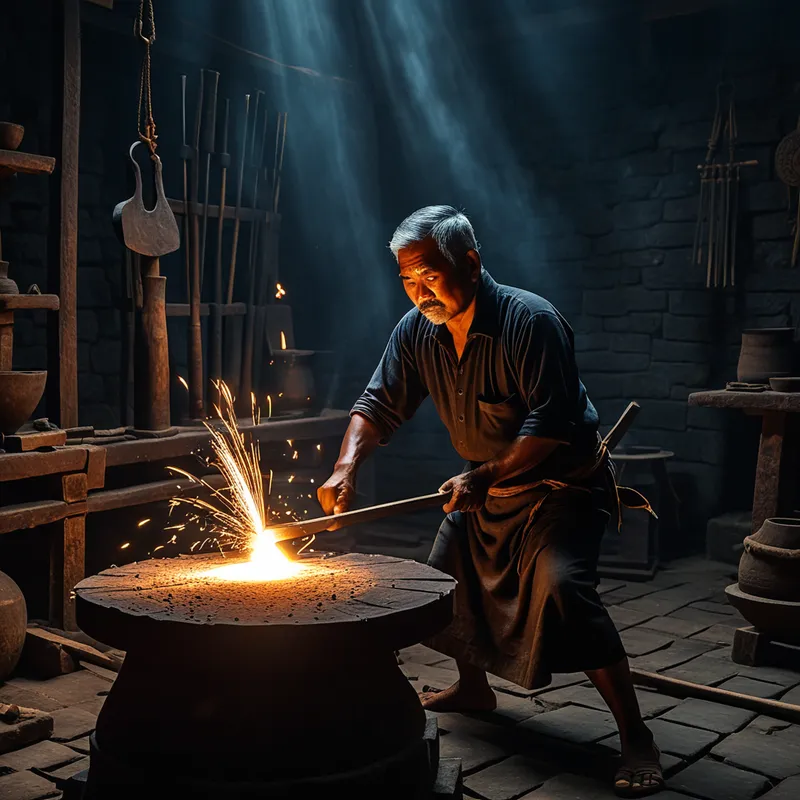
To possess this light, he must first possess the throne. The path was drenched in shadow. He sought out the legendary smith, Mpu Gandring, commissioning a keris of unparalleled power, a blade to cut through fate itself. Impatient for its completion, Ken Arok’s restless spirit turned to violence. He seized the unfinished keris and struck down the master smith. With his dying breath, Mpu Gandring uttered a terrible prophecy: the keris would claim seven lives, including Ken Arok’s own and those of his descendants.
The blade, now an entity of cursed destiny, fulfilled its first purpose. Ken Arok used it to slay Tunggul Ametung, taking both his throne and his wife, Ken Dedes. From their union sprang the line of kings. Ken Arok founded the kingdom of Singhasari, rising from the mud of his birth to the pinnacle of temporal and spiritual power. Yet, the keris slept in its sheath, its hunger unsated. The prophecy coiled around the throne like a serpent, waiting. Ken Arok’s own foster son, Anusapati, seeking vengeance for his true father Tunggul Ametung, would one day turn the same sacred blade against him, setting in motion the wheel of karma that would shape the destiny of Java for generations.
Cultural Origins & Context
This myth is the foundational narrative of the Singhasari and later Majapahit kingdoms, recorded in the 14th-century Pararaton and the Nagarakertagama. It is not mere history but a mandala of power, a story told to legitimize rule and explain the often-brutal mechanics of dynastic change. It functioned as a divine charter: sovereignty was not merely inherited by bloodline but was a volatile, sacred force (wahyu) that could descend upon the most unlikely vessel, provided he had the daring to seize it and the sacred woman to channel it.
Passed down through court poets and dalang (puppeteers), the tale served as a societal mirror. It acknowledged the violent origins of order while binding them to a cosmic framework of destiny and consequence. Ken Arok’s journey from orphan to king modeled a potent Javanese concept: that raw, amoral power (kesaktian) must be refined and legitimized through union with transcendent wisdom (Prajnaparamita). The myth thus provided a template for understanding leadership, karma, and the inseparable interplay of spiritual light and political shadow.
Symbolic Architecture
At its core, this is a myth of radical psychic alchemy. Ken Arok represents the ultimate Shadow—the orphaned, criminal, and utterly ambitious potential that civilization seeks to suppress. He is unformed primal energy, all hunger and will.
The hero is not born in the palace; he is forged in the wilderness of the unlived life.
Ken Dedes is not merely a woman, but the archetype of the Anima in its most sovereign form. Her sacred light is the lumen naturae—the light of nature and spirit that illuminates the path to wholeness. Her sight is the catalyst that transforms animal ambition into a divine vocation. The keris of Mpu Gandring symbolizes the forged instrument of consciousness itself—a focused, sharpened will capable of cutting through obstacles. Yet, forged in impatience and murder, it carries the curse of the unintegrated shadow: the tool that elevates you will also be the instrument of your undoing if its creation is tainted by unconsciousness.
The prophecy ensures the myth is no simple hero’s triumph. It is a profound lesson in cyclical karma and the price of sovereignty. Every act of creation (the kingdom) is built on an act of destruction (the murder), and the psychic energy expended returns, inevitably, to complete the circle.
The Dreamer's Resonance
When this myth pattern stirs in the modern soul, it often manifests in dreams of shocking revelation or untenable ambition. You may dream of discovering a hidden, radiant light in a mundane or even degraded setting—a glow from a crack in a city wall, a brilliant light emanating from a forgotten room. This is the dream-ego encountering its own "Ken Dedes moment": a vision of its highest potential or sacred purpose, often where it is least expected.
Somatically, this can feel like a sudden awakening in the pelvic bowl or solar plexus—a surge of energy and certainty. Conversely, dreams of being tasked with forging a crucial tool (a key, a weapon, a contract) but ruining it through haste or fear speak to the "Mpu Gandring" phase. The dreamer is attempting to craft the consciousness needed for their next step but is sabotaging it with old, impatient patterns. The psyche is working through the alchemy of transforming raw, perhaps shadowy, ambition (the bandit) into a legitimate, structured power (the king), and the dreams highlight where the process is stuck—at the moment of revelation, the act of creation, or the looming return of the repressed.

Alchemical Translation
The individuation journey modeled here is not a gentle awakening but a volcanic usurpation. It begins with the honest acknowledgment of the inner "Ken Arok"—the ambitious, ruthless, survival-driven part of ourselves that exists outside polite society’s rules. This shadow is not to be exterminated, but seen and given a direction. Its chaotic energy is the prima materia, the base matter of the great work.
The encounter with the inner "Ken Dedes"—the illuminating, sacred feminine principle of wisdom and legitimacy—is the coniunctio, the sacred marriage. It is the moment when raw drive is infused with meaning and purpose. The light does not cleanse the shadow; it reveals the throne upon which the integrated self must sit.
Sovereignty of the Self is claimed, not given. It is seized from the tyrannical ruler of our own outdated psyche—the Tunggul Ametung of old habits and identities.
Forging the "keris" is the discipline of crafting a conscious will and a focused persona capable of holding this new, powerful identity. The curse of the prophecy is the critical lesson: if this new self is built on the murder of essential parts of our past (repression, denial), or if it is forged in haste without integrating the lessons of the masters we overthrow (our parents, our teachers, our past selves), it will carry a fatal flaw. The new consciousness will eventually be turned against us by the unacknowledged children of our past actions—our guilt, our shame, our unresolved grief (Anusapati).
True psychic transmutation requires not just the daring to seize the light and the throne, but the wisdom to accept the full karmic cycle of one's actions, thereby transforming the cursed blade into a sacred heirloom of the soul's complex history.
Associated Symbols
Explore related symbols from the CaleaDream lexicon:
- Light — The divine radiance from Ken Dedes represents revealed destiny, transcendent wisdom, and the illuminating moment that transforms base ambition into sacred purpose.
- Shadow — Ken Arok begins as the embodiment of the psychological Shadow—the orphaned, criminal, and potent unconscious force that must be integrated to claim sovereignty.
- Knight — Ken Arok’s journey is that of the Knight in service to a transcendent feminine principle (Ken Dedes), his quest to secure her light legitimizing his raw power.
- Destiny — The entire narrative is driven by a fixed yet paradoxically earned fate, where personal action and cosmic prophecy are inextricably woven together.
- Blood — Symbolizes both the violent foundation of the new kingdom and the cursed lineage, the inescapable karma passed through generations via the keris.
- Ritual — The forging of the keris by Mpu Gandring is a sacred ritual of creation, while Ken Arok’s impatience corrupts it, turning rite into curse.
- Stone — Represents the unformed, rough potential of Ken Arok and the hard, unforgiving reality of the throne and the karmic law that governs it.
- Mountain — The ascent of Ken Arok from the lowlands of his birth to the peak of royal power, symbolizing the arduous climb of individuation.
- Fire — The transformative, ambitious, and destructive energy that fuels Ken Arok’s rise and the forging of the fateful keris.
- Order — The kingdom of Singhasari represents the new cosmic and political Order born from Chaos, a structure built upon a foundational act of violence.
- Death — The necessary sacrifice (of Tunggul Ametung, of Mpu Gandring, eventually of Ken Arok) that fertilizes the birth of a new cycle of power and consciousness.
- Root — The luminous roots of Ken Dedes’s sacred nature, connecting the sovereign throne to the fertile, dark earth from which Ken Arok originally sprang.