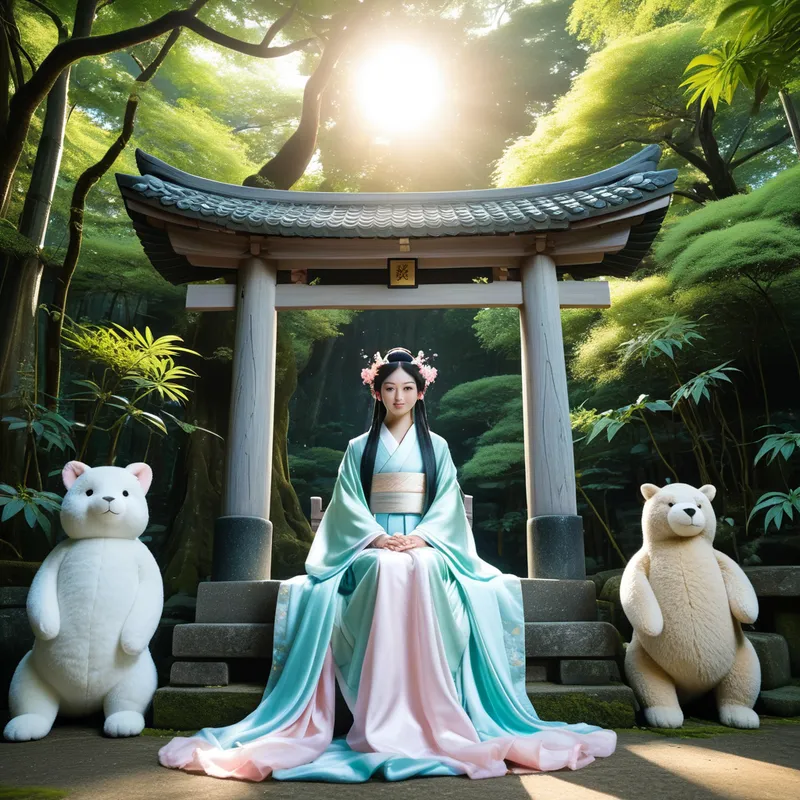
Kawaii culture Myth Meaning & Symbolism
A myth of soft rebellion, where the vulnerable, cute, and small becomes a powerful force for psychic healing and authentic connection in a rigid world.
The Tale of Kawaii culture
In the land where the rising sun paints the mountains gold and order flows like a silent river, there lived a great and invisible weight. It was the weight of a thousand years of harmony, of knowing one’s place, of polished surfaces and perfect seams. The people moved through their days with graceful precision, their hearts hidden behind masks of serene competence. But within the chests of the young, a quiet rebellion began to stir—not with fists or fire, but with a whisper so soft it was almost a sigh.
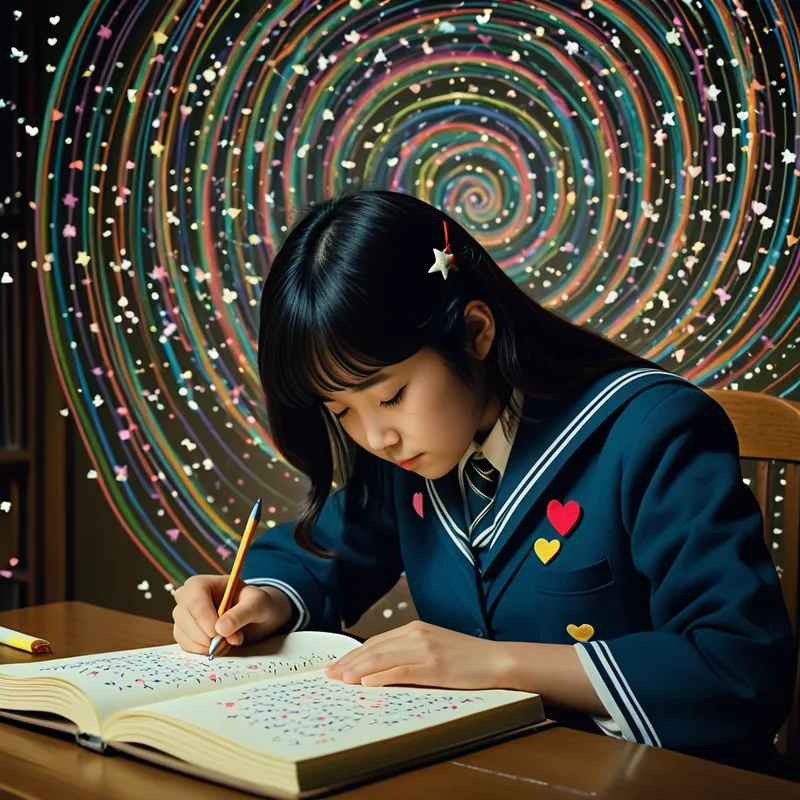
It began in the shadowed corners of schoolrooms, under wooden desks polished to a high sheen. A young scribe, her hand aching from copying perfect, uniform characters, let her pen stray. Instead of another stark kanji, she drew a tiny, lopsided heart. Then a star with a smiling face. The ink was blue, then pink, then a whole rainbow stolen from a forbidden pen. These were not characters of meaning, but glyphs of feeling—a secret language of rounded edges and blushing cheeks. She hid them in the margins of her notes, a private garden of vulnerability growing in the cracks of discipline.
This secret garden did not stay hidden. It spread, girl to girl, a silent epidemic of softness. They began to adorn their utilitarian pencils with tiny, fuzzy creatures. They clipped plastic charms to their bags—miniature cakes, wide-eyed kittens, strawberries with smiles. Their handwriting, once a model of clarity, began to slope and curl, dotted with circles and hearts. To the elders, it was a baffling corruption, a childish regression. But to the scribes, it was a breath. Each rounded letter was a tiny exhalation against the pressure to be perfect, to be strong, to be invisible.
The rebellion grew legs and walked out into the world. It took the form of a singer with a voice like a helium-filled bell, dressed in a confection of lace and ribbons, singing of love that was sweet and uncomplicated. It manifested in subway cars plastered with the giant, watery eyes of a cartoon cat, offering comfort without demand. It built entire districts that glowed with the neon pink of synthetic cuteness, temples where one could worship at the altar of the plush and the adorable.
The old gods of stoicism and reserve watched, perplexed. They had expected challenges of steel and philosophy, not an assault of pastel fluff and trembling vulnerability. Yet, this Kawaii force could not be fought with traditional weapons. To strike at it was to bully the helpless, to reveal one’s own hardness. And so, the culture slowly, inexorably, made room. It absorbed the cute, commercialized it, and in doing so, was itself subtly transformed. The weight remained, but now one could place a small, smiling cushion upon it.
Cultural Origins & Context
The myth of Kawaii is a distinctly modern folklore, born not in the misty Heian past but in the post-war economic miracle of the 20th century. Its primary bards were not monks or poets, but schoolgirls, office workers, and manga artists. It was transmitted not through sacred scrolls but through stationery, fashion magazines, manga, anime, and advertising.
Its societal function is complex. On one level, it was a soft rebellion by youth—particularly young women—against the rigid hierarchies and intense pressures of the Sararīman (salaryman) society. In a culture that valued group conformity and emotional restraint, the deliberate embrace of childlike cuteness (burikko) created a sanctioned space for vulnerability, play, and individual expression. It also served as a powerful social lubricant; presenting oneself as harmless and cute could defuse tension and avoid direct conflict, adhering to the cultural priority of wa.
Furthermore, Kawaii became a potent economic and cultural export, a "soft power" that repackaged Japanese identity for global consumption. From Sailor Moon to Sanrio's global empire, Kawaii offered a non-threatening, emotionally resonant face for a nation with a complex history.
Symbolic Architecture
At its core, the Kawaii myth is a profound symbolic negotiation with power through apparent powerlessness. Its primary symbols—the child, the small animal, the helpless creature with oversized eyes—are archetypes of vulnerability. In a world that equates maturity with hardness and responsibility with emotional suppression, Kawaii reclaims the power of the soft, the dependent, the innocent.
The mightiest fortress can be breached not by a battering ram, but by a seedling growing in its cracks. Kawaii is that seedling—a testament that what is small, soft, and seemingly weak contains an irresistible, life-affirming force.
The large, sparkling eyes are not just a design trope; they are windows to a soul that has not yet learned to hide. They symbolize a receptive, non-judgmental gaze and an appeal for care. The maru-ji (rounded writing) represents a rejection of angular, efficient communication in favor of a script that embodies its emotional content. The charms and plush toys are modern-day talismans, external containers for internal feelings of comfort, affection, and a longing for a simpler, more nurturing world.
Psychologically, Kawaii represents the Shadow of the hyper-efficient, disciplined societal persona. It is everything that persona must suppress: neediness, playfulness, messiness, and unguarded affection. By giving this Shadow a cute, acceptable form, the culture finds a way to acknowledge and integrate it without overtly dismantling the necessary structures of order.

The Dreamer's Resonance
When this myth surfaces in modern dreams, it often signals a psyche straining under the weight of excessive responsibility, perfectionism, or emotional armor. To dream of being overwhelmed by cute, small creatures, or to find one's professional environment overrun with pastel colors and soft toys, is to experience a somatic rebellion of the soul.
The dreamer may be undergoing a process where their innate vulnerability—long compartmentalized as "unprofessional" or "childish"—is demanding recognition. The somatic sensation is often one of pressure releasing, a softening in the chest or jaw. It is the unconscious insisting, through the language of symbol, that the persona has become too rigid, too polished, too lonely. The appearance of Kawaii motifs in dreams is a call to rediscover the parts of the self that are allowed to be imperfect, to need comfort, and to express affection without ulterior motive. It is the psyche's attempt to self-regulate through an infusion of gentle, nurturing energy.

Alchemical Translation
The alchemical journey modeled by the Kawaii myth is not one of slaying dragons, but of taming them with kindness, and of transforming leaden duty into golden connection through the agent of vulnerable authenticity. The modern individual's "individuation" often requires them to build a competent, resilient persona—a necessary and valuable structure. However, this structure can become a prison of its own making.
The Kawaii process begins with the nigredo, the blackening: the feeling of being crushed by expectations, of one's authentic softness being in shadow. The albedo, the whitening, is the first, secret act of rebellion: the doodle in the margin, the small token on a desk, the private acknowledgment of a need for sweetness. This is the purification of the heart's intent.
The ultimate alchemy is not the creation of gold from lead, but the creation of wholeness from fragmentation. Kawaii teaches that the rejected, "childish" piece of the self is the very catalyst needed to transmute isolation into communion.
The citrinitas, the yellowing, is the integration of this softness into one's social self—allowing oneself to be seen as someone who appreciates beauty, cuteness, and comfort without shame. It is finding one's unique expression of warmth.
Finally, the rubedo, the reddening, is the achievement of a new equilibrium. It is not about becoming childish, but about achieving a mature wholeness that confidently contains both strength and softness, competence and vulnerability, responsibility and the capacity for joyful play. The individual who has integrated the Kawaii principle no longer wears cuteness as a mask or a defense, but emanates it as a genuine, grounded quality of heart—a powerful, magnetic force that disarms hostility and fosters deep, authentic connection. They have learned that true power often resides in the courage to be disarmingly, transformatively soft.
Associated Symbols
Explore related symbols from the CaleaDream lexicon: