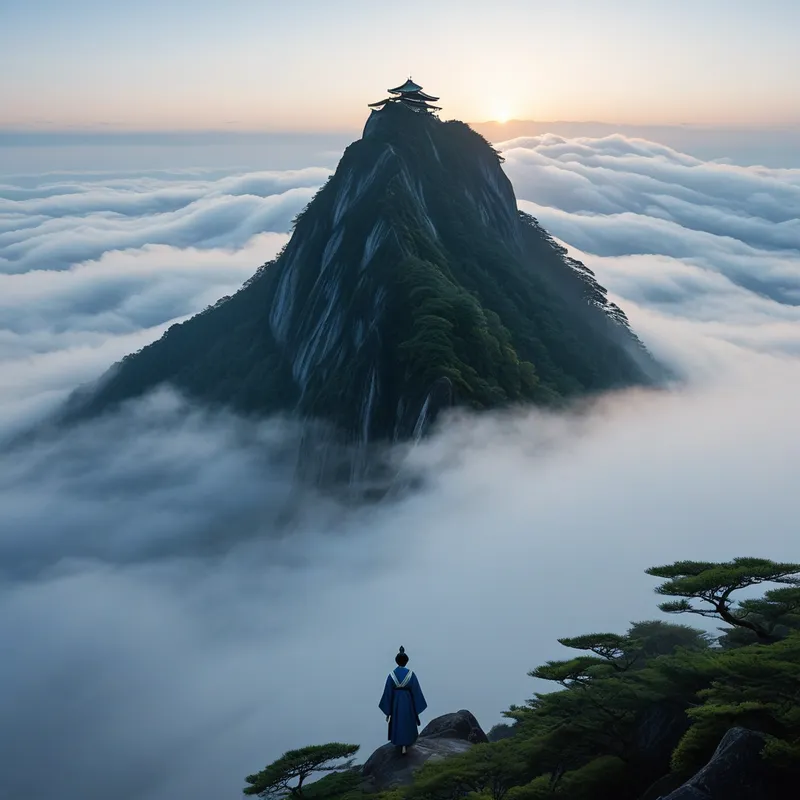
Kasumi Myth Meaning & Symbolism
A tale of the kami of mist, born from the breath of the mountain, who teaches the profound wisdom found in impermanence and veiled perception.
The Tale of Kasumi
Listen, and let the mountain speak. In the age when the world was still whispering its first secrets, the great peaks of the land slept deeply, their shoulders heavy with primeval forest. Among them was a mountain so serene, its silence was a song. It did not roar with fire or tremble with quakes; it breathed. And with each exhalation at the pale hour between night and day, it sent forth its breath—a sigh of cool vapor that coiled around its pine-clad ribs.
This breath was not empty air. It was the spirit kami, born of the mountain’s deep dreaming. They named her Kasumi. She had no form one could grasp, yet she was all form. She was the veil over the sun, the blurring of the distant peak, the damp kiss on the spider’s web at dawn. She lived in the space between seeing and not-seeing, knowing and not-knowing.
For an age, she danced her silent dance, weaving between the cedars, cradling the valleys in her soft arms. The creatures of the mountain knew her not as a thing to fear, but as a gentle transition, a moment of pause. The hunter, bow in hand, would stop as she descended, his path obscured, his intention softened. In her presence, the chase was forgotten; he would simply sit and listen to the droplets form on leaves.
But a change stirred in the lowlands. Humans, with their clear eyes and sharp boundaries, began to climb. They sought timber, stone, and dominion. They saw the mountain as a thing to be mapped, its resources tallied. A young woodcutter, bold and sure, ventured higher than any before, his axe sharp, his resolve clearer than the noonday sky. He sought the heartwood of the oldest tree, a prize to cement his name.
He found his ancient giant, a cedar whose roots were tales themselves. As he raised his axe, the mountain held its breath. And then, it exhaled.
Kasumi descended not as a gentle veil, but as a profound, luminous blindness. A wall of white, sound-absorbing mist flowed from the forest depths, swallowing the tree, the man, the very concept of up and down. The world vanished. The bite of his axe, the goal in his mind—all dissolved into a cool, featureless now. He stumbled, disoriented, his certainty drowned in fog. Hours passed, or perhaps moments; time, too, had lost its edge.
Just as a primal fear began to whisper in his ear, a shape coalesced. Not a shape of flesh, but of density and intention within the mist. A presence, vast and gentle, regarding him. He felt a question, not in words, but in the settling of moisture on his skin: What do you seek, when you cannot see the thing you seek?
Lost, he dropped his axe. And in that release, his other senses awoke. He heard the water drip, a thousand tiny bells. He smelled the petrichor and decay, the scent of life and death intertwined. He felt the cool, living air on his face. The mist, Kasumi herself, was not an obstacle, but a medium—a different way of knowing.
When the mist finally thinned, retreating like a tide back into the mountain’s mouth, the woodcutter stood before the ancient cedar. His axe lay at his feet, but his hands did not reach for it. He bowed, deep and slow, to the tree, to the mountain, to the lingering trace of vapor in the air. He descended, not with timber, but with a silence in his heart that was fuller than any shout. And from that day, the first pilgrims walked that path not to take, but to be, briefly, lost in the transformative breath of the mountain.

Cultural Origins & Context
The figure of Kasumi is less a singular, codified myth from a specific text like the Kojiki or Nihon Shoki, and more a pervasive atmospheric archetype woven into the fabric of Shinto and Japanese folk belief. She emerges from the animistic heart of Shinto, where natural phenomena—mountains, rivers, rocks, and weather—are imbued with spirit, or kami. Kasumi is the kami of the transitional, the liminal state itself.
Her stories were passed down not by court scribes, but by mountain villagers, woodcutters, and pilgrims—those who lived intimately with the caprices of the weather. In a culture that deeply values subtlety, indirectness (haragei), and the beauty of the ephemeral (mono no aware), mist is not merely meteorological. It is a teacher. It functioned in folklore as a narrative device for encountering the sacred unexpectedly, for the suspension of human will, and for lessons in humility. Encounters with mist-spirits often served as moral correctives, pulling humans out of their narrow, goal-oriented consciousness and into a more holistic, respectful relationship with a world that is alive and sentient.
Symbolic Architecture
Kasumi represents the veil in all its profound ambiguity. She is not a solid barrier, but a permeable one. She does not destroy the landscape, but transforms our relationship to it.
The mist does not hide the truth; it reveals that truth is not only what is seen, but also what is felt in the absence of sight.
Psychologically, she symbolizes the necessary obscuration that precedes new understanding. Our ego, like the woodcutter, operates with clear goals and sharp distinctions. Kasumi is the arrival of the unconscious—a soft, enveloping force that dissolves those rigid boundaries. The "axe" of our conscious intention is rendered useless, forcing a regression, a return to a more primal, sensory state of being. In this fog, the differentiated world (the tree as a target) fades, and the unified field of experience (the mountain as a living being) emerges.
She is the spirit of the liminal, the betwixt-and-between. Dawn, twilight, the shore, the doorway—these are her domains. She governs the moment when one state of mind ends and another has not yet begun, a space ripe with both anxiety and potential.

The Dreamer's Resonance
To dream of such a mist is to be in a somatic state of psychic reorientation. The dreamer is not typically in terror (that would be a nightmare of storms or darkness); instead, there is a quiet, profound disorientation. You may dream of walking a familiar street that becomes shrouded, of looking for someone whose form keeps dissolving, or of being in a room where the walls softly fade into gray.
This is the psyche's Kasumi moment. It signals that the dreamer's conscious direction has become too rigid, too focused on a singular "tree" at the expense of the "mountain." The mist arrives to dissolve that fixation. The somatic feeling—the cool dampness, the loss of visual anchor—mirrors the psychological process of releasing a conscious complex. The dream is initiating a necessary pause, a surrender of ego-driven navigation. It invites the dreamer to stop striving and simply sense: to listen for the internal drips and echoes, to feel the emotional atmosphere, to accept being lost as the precondition for being found anew.

Alchemical Translation
The alchemical journey mirrored in Kasumi's myth is the process of solutio—the dissolution. In alchemy, matter must be dissolved back into its primal, chaotic state (massa confusa) before it can be reconstituted into a higher, more integrated form (the philosopher's stone). The woodcutter's clear, solar consciousness is dissolved in the lunar, watery embrace of the mist.
The goal is not to cleave the world to your will, but to let the world soften you into a new shape.
For the modern individual, this translates to the courage to embrace confusion. Our culture prizes clarity, goals, and five-year plans—the sharp axe. Kasumi's wisdom arrives when we hit a wall of "fog": depression, burnout, a sudden loss of meaning, a creative block. The instinct is to fight through it, to swing our axe harder. The myth instructs us to do the opposite: to drop the tool. To allow the dissolution.
This is the heart of psychic transmutation. In the fog, the old identity (the successful woodcutter) dissolves. What remains is the bare, sensing human, open to impressions from the deeper Self (the mountain). The resolution is not a new, better axe, but a bow—a gesture of reverence and connection to a reality larger and more intelligent than our personal agenda. The individuated Self that emerges is not sharper, but more permeable, more capable of holding mystery, ambiguity, and the beautiful, fleeting nature of all things. One becomes, in a sense, a conscious part of the mist—able to navigate the veiled realms within and without, knowing that true sight often begins when the eyes rest.
Associated Symbols
Explore related symbols from the CaleaDream lexicon: