Kashima and Kadori Deities Myth Meaning & Symbolism
A Shinto myth where the deity Kashima uses a mighty stone to pin down the restless earth kami, Kadori, preventing catastrophic earthquakes and chaos.
The Tale of Kashima and Kadori Deities
Listen, and hear the tale of the foundation of the land, a story whispered by the wind in the sacred groves and felt in the deep, silent tremors of the earth.
In the age when the world was still young and raw, the land of Ashihara no Nakatsukuni was a restless place. Beneath the mountains and plains slept a mighty and turbulent kami known as Kadori. Some say it took the form of a giant catfish, others a great serpent of stone and soil. Its nature was not evil, but primal and untamed. When Kadori stirred in its slumber, the earth would shudder, mountains would groan, rivers would change course, and the homes of humans would crumble to dust. It was the embodiment of the land’s raw, foundational power—necessary, yet chaotic and destructive.
The people cried out in their fear, their prayers rising like smoke to the Takamagahara. The heavenly kami heard their lament. In their wisdom, they did not seek to destroy Kadori, for to destroy the earth-kami would be to destroy the land itself. Instead, they chose to impose order upon this chaos, to calm the tremors so life could take root.
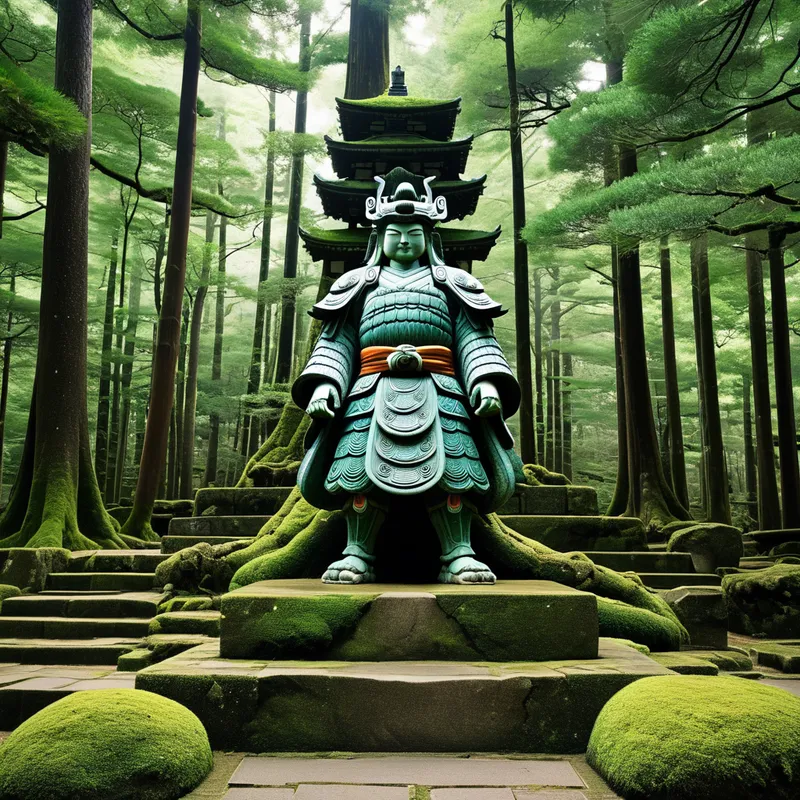
The task fell to the mighty and steadfast Kashima-no-kami. He descended from the high plain, his presence like a calm, firm mountain. He journeyed to the place where the restless energy of Kadori was most potent, a region that would become known as Kashima. There, in a sacred grove of ancient trees, he found the pulsing heart of the disturbance.
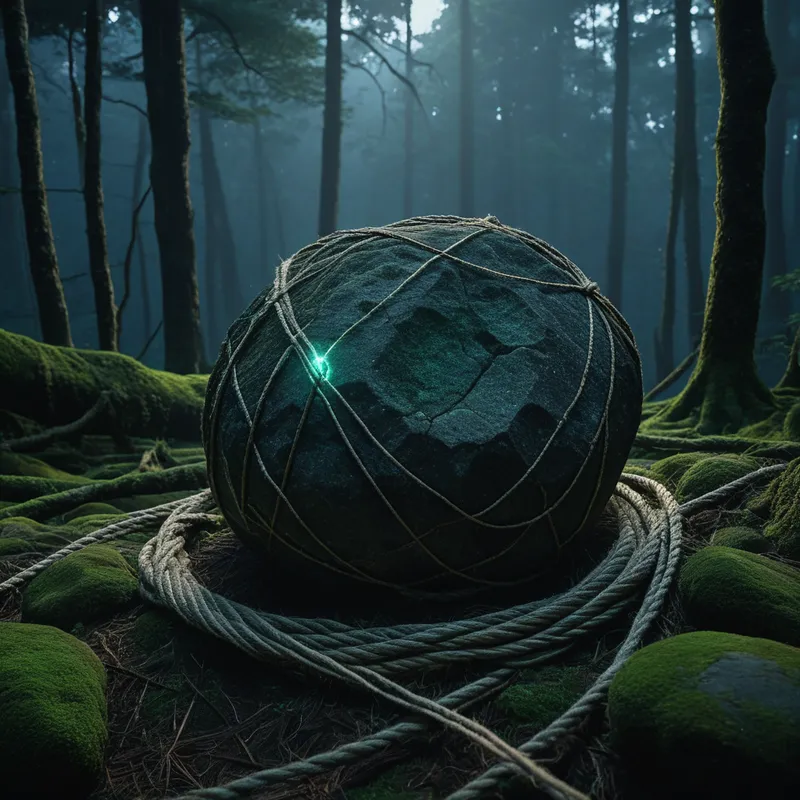
Kashima did not draw a sword. He did not summon a storm. His solution was one of profound, immovable weight. From the very substance of the earth and heaven, he summoned or discovered a colossal stone—the Kaname-ishi. This was no ordinary rock; it was a stone of divine authority, a focal point of celestial order.
With immense strength and unwavering intent, Kashima drove the Kaname-ishi down, down, through soil and bedrock, to pin the head—or the vital spirit—of the great Kadori. The earth roared in protest. The sky darkened. But Kashima held firm, a deity of resolve becoming one with the stone and the soil. He did not kill; he restrained. He did not conquer; he established foundation.
The tremors subsided. The land grew still, not dead, but peacefully dormant. The chaotic energy was channeled, held in check by the sacred weight of the stone and the enduring vigil of the kami. Kashima became the eternal guardian, his spirit forever linked to that place, ensuring the Kaname-ishi never loosens its hold. And so, the people could build, plant, and live, upon an earth made stable by this divine covenant of restraint.
Cultural Origins & Context
This myth originates from the Shinto tradition, deeply intertwined with Japan’s geological reality as a land of frequent earthquakes. It is most strongly associated with the Kashima Shrine in Ibaraki Prefecture, where the actual Kaname-ishi is enshrined. The tale is part of aetiological folklore, explaining the cause of earthquakes (the stirring of Kadori) and the reason a specific location (Kashima) is spiritually charged to prevent them.
The myth was passed down orally and through shrine traditions long before being recorded in early texts like the Fudoki and later collections. Its tellers were likely shrine priests and storytellers who served a crucial societal function: providing a cosmological explanation for natural disasters that framed them not as arbitrary punishments, but as interactions with conscious, if unruly, natural forces. It reinforced the Shinto worldview of a world alive with kami, where humanity’s role is to live in respectful harmony, supported by the benevolent intervention of greater deities who maintain the crucial balance.
Symbolic Architecture
At its core, this is a myth about the imposition of benevolent order onto necessary chaos. Kadori is not a villain; it is the raw, chthonic power of the Earth itself—the seismic forces that also create mountains and islands. It represents the unconscious, instinctual, and foundational energies of both the land and the psyche: powerful, creative, but potentially destructive if left entirely unchecked.
The true foundation is not the absence of force, but the sacred restraint of it.
Kashima represents the principle of conscious order, authority, and stabilization. His tool, the Kaname-ishi (the pivotal stone), is a profound symbol. It is the keystone, the fixed point around which a system coheres. Psychologically, it represents the ego’s necessary function of integrating and tempering the overwhelming power of the unconscious. The myth beautifully illustrates that the goal is not eradication, but relationship—a dynamic tension where primal energy is acknowledged, respected, and safely anchored.
The shimenawa ropes that often surround the sacred stone in depictions further this symbolism, marking the boundary between the wild, sacred power and the human world of order.
The Dreamer's Resonance
When this myth pattern stirs in the modern Dream, it often signals a profound process of internal stabilization. The dreamer may be experiencing life events or internal emotions that feel seismic—foundational shifts, uncontrollable rage, deep anxiety, or creative surges that threaten to overwhelm.
Dreams of cracking earth, trembling buildings, or struggling with a powerful, buried beast mirror the stirring of Kadori. It is the psyche’s raw material demanding recognition. Conversely, dreams of finding a crucial stone, reinforcing a foundation, or a calm, authoritative figure imposing calm speak to the emergent Kashima function. The somatic experience can be one of deep pressure, a feeling of being “pinned down” by responsibility, or conversely, a profound relief when a stabilizing insight is found.
This dream-myth process is the psyche working to establish a new, more resilient foundation. It is the Self organizing a confrontation between chaotic, transformative energy and the structuring principle needed to harness that energy for growth, rather than destruction.
Alchemical Translation
The alchemical journey modeled here is the transmutation of chaotic potential into structured power—a cornerstone of individuation. The initial state is the prima materia: the unruly, unconscious force (Kadori) that causes inner “earthquakes” of emotion, compulsion, or crisis.
The Kashima archetype within us is the capacity for conscious, disciplined action. The “work” is not to fight the unconscious until it is obliterated, but to find our personal Kaname-ishi—the pivotal insight, the committed practice, the core value, or the therapeutic intervention that can “pin down” and safely anchor this chaos.
Individuation is the act of becoming the Kashima to your own Kadori—the guardian who respects the power they restrain.
This creates a sacred inner Shinto Shrine where the dynamic tension between instinct and order becomes generative. The stabilized energy of Kadori becomes the very foundation upon which we build our identity, our creativity, and our resilience. The myth teaches that true strength lies not in the absence of inner turbulence, but in the sacred, ongoing act of holding a conscious relationship with it. The stone must hold, and we must be the deity who ensures it does.
Associated Symbols
Explore related symbols from the CaleaDream lexicon:
- Stone — The Kaname-ishi itself, representing eternal stability, divine authority, and the pivotal point of consciousness that anchors chaotic forces.
- Earth — The domain of Kadori, symbolizing the foundational, material, and instinctual layers of the psyche and the physical world in its raw, potent state.
- Mountain — Representing Kashima’s unwavering, immovable nature and the lofty principle of order that looks over and stabilizes the plains of existence.
- Chaos — Embodied by the restless stirring of Kadori, the necessary primal disorder that precedes and underlies all creation and transformation.
- Order — The principle enacted by Kashima, the celestial structure imposed to make the world habitable and the psyche functional.
- Tie — Symbolizing the sacred bond and dynamic tension between Kashima and Kadori, the restraint that is also a relationship and a covenant.
- Shinto Shrine — The sacred space (like Kashima Shrine) that is established as a direct result of this myth, a place where this balance is honored and maintained through ritual.
- Root — The deep, hidden, and primal source of power (Kadori) that must be addressed and anchored for healthy growth to occur above.
- Fear — The human response to the unstabilized power of Kadori, the emotion that motivates the prayer for and acceptance of divine order.
- Foundation — The ultimate result of the myth, the stable ground—both literal and psychological—created by the successful restraint of chaotic energy.
- Ritual — The ongoing human practices at shrines like Kashima that re-enact and reinforce this divine stabilization in the community’s life.
- Guardian — The eternal role of Kashima, representing the part of the self tasked with vigilant protection of hard-won inner stability.