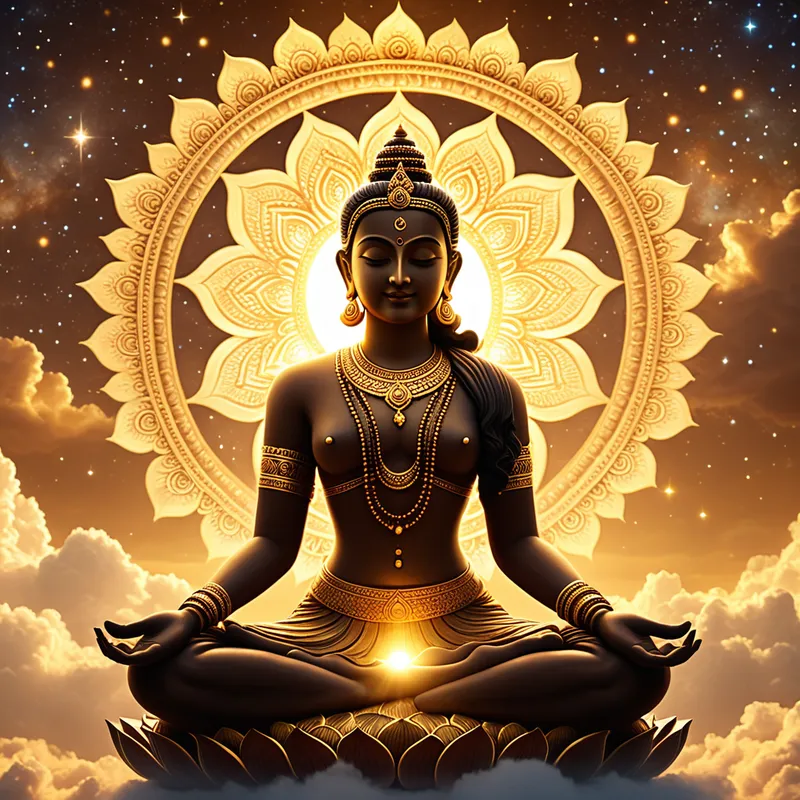
Karuna Myth Meaning & Symbolism
The story of the divine principle of compassion, born from the tears of the gods, teaching that true empathy arises from the alchemical heart of shared suffering.
The Tale of Karuna
In the age when the worlds were still young and the breath of the gods was the wind, there existed a silence in the heart of the cosmos. It was not a peaceful silence, but a hollow one. The Dharma wheel turned, the sun chariot raced, and the great dance of creation and destruction played on—yet a profound ache echoed through the halls of the heavens. The gods, in their splendor, watched the mortal realm. They saw the ceaseless cycle: the joy of birth, the struggle of life, the agony of loss, the terror of death. They saw how beings, trapped in the web of their own Karma, inflicted suffering upon themselves and each other, blind to their shared essence.
One day, as the great preserver Vishnu reclined upon the serpent Ananta Shesha in the milky ocean, a sigh escaped his lips. It was not a sigh of weariness, but of profound, unbearable witnessing. From his eyes, a tear formed. It was not a tear of sorrow for himself, but a tear of the sorrow of all that is. It held the salt of every ocean, the ache of every parting, the loneliness of every soul. This tear, heavy with the weight of the world, fell.
It did not fall into the ocean. It fell through the layers of reality, through the celestial realms, through the very fabric of time and space. As it fell, it was seen by the mother of the universe, Devi. Her heart, the source of all fierce love, trembled. From her own eyes, a cascade of tears joined the first, each one a galaxy of empathy. The great destroyer and transformer, Shiva, deep in meditation upon the icy peaks of Kailasha, felt the tremor in the cosmic rhythm. A single, crystal tear of perfect understanding rolled down his cheek, cool and clear.
These tears, from the eyes of the supreme witnesses, converged in the liminal space between compassion and action. They did not dissipate. They coalesced. They swirled with the energy of pure, unattached feeling—the agony of the other felt as one's own, yet without the collapse into despair. From this luminous vortex of shared suffering, a new presence was born. Not a god of power or a goddess of wealth, but a radiant, androgynous principle of being. Its name was Karuna. It had no weapon but a gaze that dissolved isolation. It had no mantra but the silent recognition of "I am in you, and you are in me." Its very presence was a balm, a resonance that did not seek to fix the unfixable, but to hold it in infinite, tender regard. Where Karuna walked, the hardness of hearts softened, not into weakness, but into boundless strength. The great ache of the cosmos had found its own healing echo.

Cultural Origins & Context
The principle of Karuna is not confined to a single Puranic tale but is the lifeblood of the entire Dharma tradition. Its roots are deepest in the fertile soil of Buddhism, where it is one of the four Brahmaviharas, or "divine abidings," essential for liberation. In the broader Hindu ethos, Karuna is the active expression of the fundamental truth of Brahman—that the same consciousness resides in all. It is the emotional and ethical corollary to the philosophical statement "Tat Tvam Asi" (Thou art That).
This mythic personification, as told by sages and poets, served a crucial societal function. In a culture with a complex social hierarchy and the inescapable reality of Karma, Karuna acted as the essential counterbalance. It taught that while actions have consequences, no being is beyond the reach of empathetic understanding. It was transmitted not just through scripture, but through the exemplary lives of saints like Mirabai and through the daily practice of Seva. Karuna was the glue that held the cosmic and the communal together, insisting that spiritual realization is barren if it does not water the parched roots of another's suffering.
Symbolic Architecture
At its core, the myth of Karuna is an alchemical map of how consciousness metabolizes suffering. The tears of the gods are not symbols of divine pity or impotence. They represent the moment when pure awareness (Chit) fully contacts the raw datum of experience (Anubhava), including its pain, without the filters of judgment or separation.
Karuna is not the opposite of suffering; it is the luminous space that suffering creates when it is fully allowed, when it cracks open the shell of the separate self.
The birth of Karuna from convergent tears is critical. One god's sorrow is merely personal grief. The combined tears of the trinity—the preserver, the mother, the transformer—signify a cosmic, objective recognition of the condition of existence. Karuna is therefore transpersonal. It is the psyche's innate capacity to transform the leaden, isolating weight of "my pain" into the golden, connective awareness of "the pain." The figure of Karuna is androgynous because true compassion transcends gender; it is a fundamental quality of being. It holds the masculine principle of witnessing clarity and the feminine principle of nurturing containment in perfect balance.

The Dreamer's Resonance
When this myth stirs in the modern unconscious, it often manifests not as a clear image of a deity, but as a profound somatic and emotional sequence in dreams. You may dream of holding a crying stranger, feeling their sobs vibrate in your own chest. You may dream of a relentless, cold rain that suddenly turns warm and nourishing. You may find yourself in a dream-hospital, not as a patient, but as a presence that simply sits with the injured, your hands glowing with a quiet, non-invasive light.
These dreams signal a psychological process of emotional integration. The psyche is attempting to metabolize a reservoir of pain—your own or that which you have absorbed from others—that has been held in isolation. The dream is practicing Karuna on itself. The "tears" in the dream are the psyche's own pressurized empathy seeking release and transformation. It is the Self beginning to relate to its own contents with compassion rather than judgment, moving from a stance of internal conflict ("this pain shouldn't be here") to one of internal hospitality ("this pain, too, belongs").

Alchemical Translation
For the individual on the path of individuation, the myth of Karuna models the ultimate psychic transmutation: the turning of suffering into the cornerstone of connection. Our personal wounds, our private griefs, our secret shames—these are our "tears." The modern temptation is to dismiss them (spiritual bypassing), be overwhelmed by them (identification), or project them onto others (blame). The alchemy of Karuna invites a fourth, revolutionary option: to gather these tears with conscious awareness and let them coalesce into a new faculty of the soul.
The goal is not to become a flawless healer for others, but to allow your own endured fractures to become the very apertures through which the light of understanding enters and exits.
This process begins with witnessing (Vishnu's tear): seeing your own pain clearly, without denial. It deepens with embracing (Devi's tears): allowing the emotional reality of the pain with a mother's fierce, loving hold. It is completed with transmuting (Shiva's tear): the meditative, cool awareness that this pain is not your ultimate identity, but a passing weather in the vast sky of consciousness. From this threefold process, your innate Karuna is born—not as a sentimental feeling, but as an unshakeable inner orientation. You stop asking, "How can I get rid of my suffering?" and begin to ask, "How can this suffering, once fully met, deepen my capacity to meet the world?" Your compassion becomes grounded, resilient, and wise, because it is forged in the fires of your own authentic experience. You become, in your own humble human way, a vessel through which the cosmic tear finds its way back to its source as a blessing.
Associated Symbols
Explore related symbols from the CaleaDream lexicon: