
Karna's Kavacha Myth Meaning & Symbolism
A warrior born with divine golden armor is tricked into giving it away, sacrificing his invincibility to fulfill a fatal promise of charity.
The Tale of Karna's Kavacha
Hear now the tale of a birth that shook the heavens, a gift that became a curse, and a promise that sealed a fate. Before the great war, before the dice were cast, there was a child born of the sun.
The air in the chamber was thick with the scent of incense and the silent awe of the divine. Surya, lord of light, had blessed his son. And so, the infant did not enter the world naked and wailing, but adorned. From his very flesh, fused to his skin, gleamed the Kavacha and Kundala—armor and earrings of pure, celestial gold. This was no mere metal; it was a living part of him, a covenant from his father. It made him invincible. No weapon of earth or heaven could pierce that radiant sheath. His mother, the princess Kunti, filled with fear and secret shame, placed the radiant child in a basket and set him upon the river. The current carried the sun’s own son away, his golden light dimming beneath the reeds.
The boy was found and raised as Suta, a charioteer’s son, though a king’s fire burned in his heart. He grew into the warrior Karna, peerless in archery, boundless in generosity. Yet, a shadow clung to him—the whisper of unknown origins, the scorn of princes for his lowly station. His only unwavering companions were his supreme skill, his fierce loyalty, and the divine armor that hummed against his chest, a constant, secret reminder of a destiny he could not name.
The wheels of fate turned toward the cataclysmic war of Kurukshetra. The gods themselves took sides. Indra, lord of the heavens, foresaw the threat. He saw Karna, invincible, standing as an unbreakable shield for the wrong side. His son, Arjuna, could never prevail while the Kavacha lived.
So, Indra descended. Not in thunder and lightning, but in the meek guise of an old, weary Brahmin. He found Karna at his morning prayers by the river, the first rays of the sun glinting off the golden armor. “O renowned philanthropist,” the Brahmin said, his voice thin but piercing. “I have come to beg of you your Kavacha and Kundala. It is for a sacred rite. Your fame for charity is boundless; will you grant this to a poor old man?”
The world held its breath. Karna knew. The sun in the sky, his father Surya, had warned him in a dream that Indra would come to beg his armor. He knew this was a trick, a theft disguised as charity, designed to strip him of his invincibility. He looked at the pleading Brahmin, then at the sun rising over the water. To refuse a Brahmin’s request, especially one made during his sacred prayers, would shatter the very virtue that defined him—his Danaveerata.
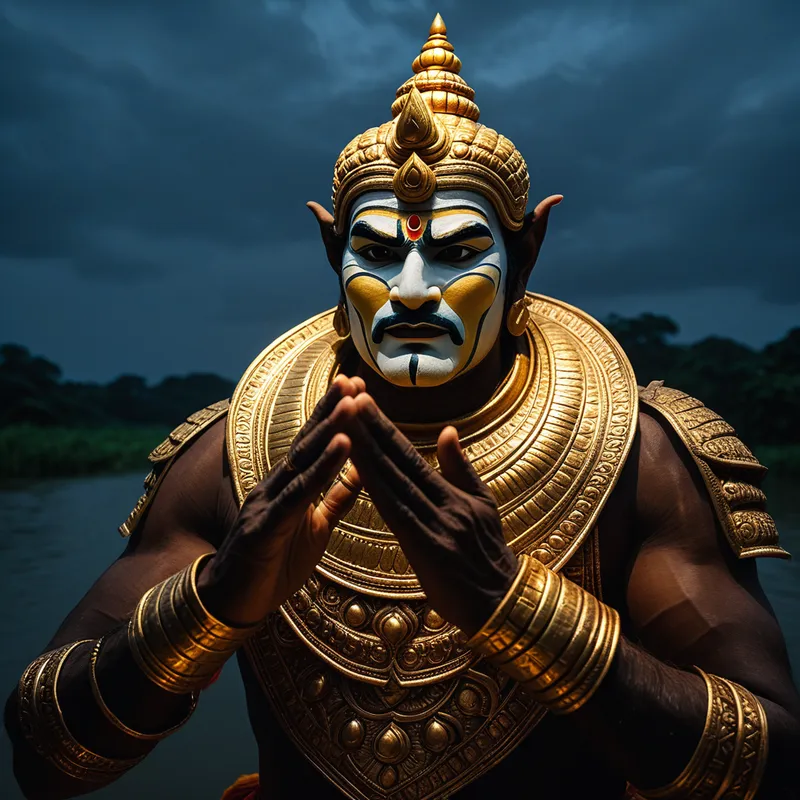
A profound stillness settled upon him. He did not rage against the deceit. He did not bargain. A tragic smile touched his lips. “So be it,” he said. And there, on the banks of the river, he began to peel the divine armor from his own body. It was not removed like plate mail; it was excised. The legend says he took a blade and cut the living gold from his flesh. Blood, gold, and sunlight mingled as he handed the still-glowing, dripping Kavacha and Kundala to the disguised god. He gave away his birthright, his protection, his guaranteed destiny. He sacrificed his invincibility to keep his word. Indra, stunned and shamed by such monumental integrity, granted him a mighty spear in return—a weapon that could kill any one being, but only once. The trade was made. The invincible warrior was now mortal. The path to his death on the eighteenth day of the great war was laid, stone by golden stone, by his own unwavering hand.
Cultural Origins & Context
This myth is a pivotal episode from the Mahabharata, an epic of staggering complexity composed over centuries, likely between 400 BCE and 400 CE. It was not merely literature but smriti (that which is remembered), a vast cultural repository of philosophy, law, and cosmology, transmitted orally by bards and scholars long before being codified.
The tale of Karna’s Kavacha functions as a crucial narrative hinge. It is the moment the cosmic balance of the impending war tips. Within the epic’s intricate dharmic debate, Karna’s act sits at a profound crossroads. It underscores the tension between svadharma (personal duty) and sanatana dharma (universal order). His loyalty to his friend Duryodhana is personal; his vow of charity is a personal code. Yet, by enabling his own death, he inadvertently serves the larger cosmic purpose of the Krishna-led Pandava victory. The story was told to explore the agonizing complexities of right action, the price of integrity, and how the greatest strengths of a hero often contain the seed of their tragedy.
Symbolic Architecture
The Kavacha is not simply armor; it is a profound symbol of inborn, authentic identity. It is the divine gift, the innate talent, the core truth of the self we are born with. Fused to his skin, it represents an intrinsic, un-earned power—his solar brilliance, his royal lineage, his essential nature.
To be born with a gift is also to be born with a vulnerability. The very thing that makes you unique and powerful becomes the target of the world, and often, of your own conscience.
The act of removal is the central alchemical image. Karna is not robbed; he surrenders it. This represents the ultimate sacrifice of the ego’s defenses. We all possess a “Kavacha”—a persona, a talent, a source of pride we believe makes us invincible. The myth asks: What happens when your deepest virtue (here, charity) demands you sacrifice your primary protection? It is the archetypal moment of moving from being powerful to being authentic, even if authenticity leads to vulnerability and death.
Indra, the king of gods, represents the “establishment” or the overarching collective order that feels threatened by an unassailable individual power (Karna supporting the “wrong” side). His trickery symbolizes how the systems of the world—fate, society, cosmic law—conspire to level the field, often through appealing to our own highest ideals.

The Dreamer's Resonance
When this myth stirs in the modern psyche, it may manifest in dreams of losing a protective shell: dreaming your skin is turning transparent, that a vital piece of jewelry is stolen, or that you are willingly handing over a cherished heirloom to a shadowy figure. Somatically, one might feel a literal tightness in the chest—a “heart armor.”
This dream pattern signals a profound psychological process: the conscious, painful dismantling of a long-held defense mechanism. The “Kavacha” in the dreamer’s life could be intellectual arrogance, emotional detachment, a curated identity on social media, or a reliance on a specific skill that has shielded them from true engagement. The “Indra” figure is the inner voice of a deeper Self, or life circumstances, that forces a crisis. The dream reveals the psyche preparing to trade the safety of invulnerability for the risky, bloody, but authentic state of being truly seen and touchable. It is the dream of the ego’s necessary wounding.

Alchemical Translation
The alchemical journey modeled here is not about gaining something, but about surrendering the very thing you believed was your core strength to achieve a higher integration. It is the stage of mortificatio—the sacred dissolution.
Individuation often requires the sacrifice of the “perfect” defense to make room for the “whole” but vulnerable self.
Karna’s process is a brutal map for psychic transmutation. First, there is Recognition of the Gift: We must identify our “Kavacha”—what innate armor have we relied on? Is it our rationality, our charm, our independence? Second, comes the Divine Warning: Life, through failures or synchronicities (Surya’s dream), hints that this armor is becoming a prison, isolating us from our fate. Third, the Trickster’s Request: A crisis emerges, often from an unexpected quarter, appealing to our highest value (duty, love, integrity), demanding we lay down our defense. Finally, the Bloody Excision: The conscious, agonizing choice to peel away the armor. This is not a gentle removal; it feels like ripping out a part of the soul. It leaves one raw, mortal, and exposed.
But the alchemy is in the exchange. Indra gives the Vasavi Shakti spear—a focused, potent, but single-use power. Psychologically, this is the clarity and decisive force that comes after the defenses are down. When we are no longer hiding behind our invincibility, our energy is no longer diffused in maintaining a shield. It can be focused into one potent, truthful action—the ability to speak a final truth, to set a definitive boundary, to make the choice that ends an old pattern. Karna dies, but he dies having fulfilled his complex dharma completely, having integrated his roles as loyal friend, generous king, and surrendered son. The mortal death of the ego-bound hero is the birth of the legend—the integrated self that lives on in meaning, not in invulnerability.
Associated Symbols
Explore related symbols from the CaleaDream lexicon: