
Kappa Myth Meaning & Symbolism
A capricious water spirit of Japanese lore, the Kappa embodies the untamed psyche, teaching balance through trickery, challenge, and the sacredness of a bow.
The Tale of Kappa
Listen, and hear the whisper of the reeds, the chuckle of the hidden stream. In the deep, green heart of old Japan, where sunlight dapples the water and shadows lie long, dwells the Kappa. It is a creature of the in-between, born of the river’s mud and the turtle’s ancient lineage. Its skin is slick and verdant as pond scum, its back armored with a shell. A sharp beak hides in its face, and upon its crown rests a most peculiar dish, a hollow brimming with the very life-water of its being.
They are not evil, these river-folk, but they are capricious as a summer storm. Children who wander too close to the bank might feel a cold, webbed hand close around an ankle, pulling them into the deep, dark world beneath the lily pads. They delight in mischief, stealing the ripe cucumbers from village gardens—a food they crave above all else. Some say they seek a darker prize: the mythical shirikodama, a jewel-like organ believed to reside within a human’s anus, which the Kappa would extract through that very orifice, leaving the victim an empty shell.
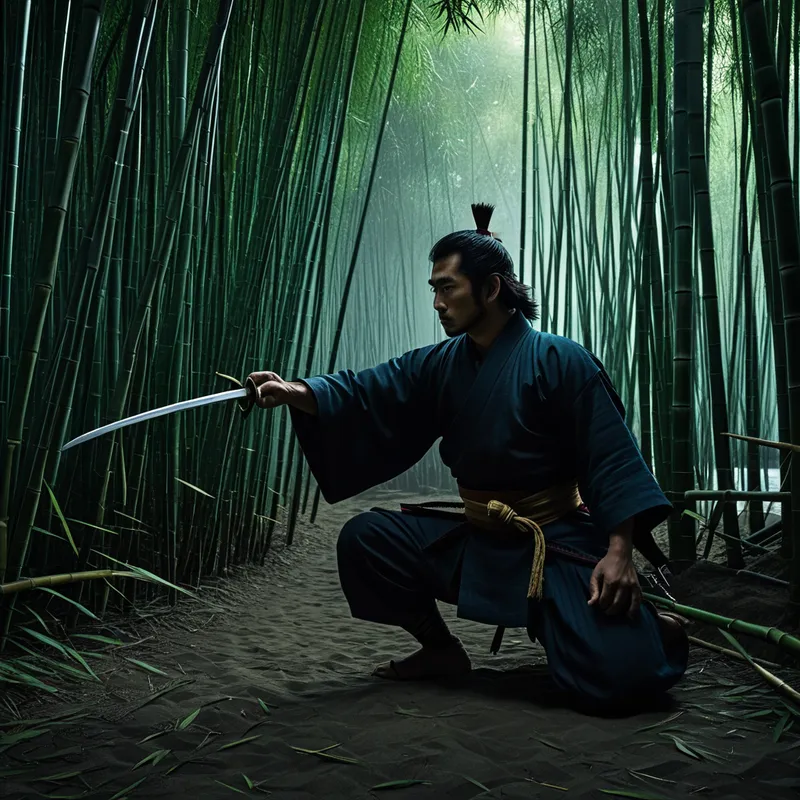
Yet, for all its terror, the Kappa is bound by a law older than the mountains: the sacredness of the bow. Its very life-force, the water in the dish upon its head, is its vulnerability. If you encounter one, you must bow deeply, with respect. The Kappa’s compulsion to return the courtesy is absolute. As it bows, the life-water will spill from its crown onto the earth. Robbed of its strength, the creature becomes helpless, a prisoner of its own ingrained ritual. In that moment of spilled water and forced humility, a bargain can be struck. Return its water, and it must swear a binding oath—to never harm the villagers again, to protect the children, to share its knowledge of bone-setting and medicine. The trickster, mastered by the very formality it mocks, is transformed. From a lurking terror, it becomes a grudging guardian, a strange and powerful ally bound by a promise and a bow.
Cultural Origins & Context
The Kappa’s story flows from the essential relationship between early Japanese agrarian society and the water that sustained it. Rivers were life-givers, providing irrigation for rice paddies, but they were also life-takers, capable of sudden, drowning floods. The Kappa myth personified this dual nature. It served as a natural “cautionary tale” told by elders to children, a vivid reason to respect the dangerous beauty of rivers, streams, and deep ponds.
These tales were part of a vast oral tradition of Kaidan and Bakemono tales, shared around hearths and in communal spaces. The Kappa was a fixture of local folklore, with its characteristics varying from region to region, its name sometimes changing to Kawatarō or Gawappa. Its depiction wasn't monolithic; in some stories, it was purely malevolent, in others, merely mischievous, and in a few, even wise. This variability shows its role as a flexible narrative tool, used to explain drownings, livestock disappearances, or even to account for the discovery of unusual riverbank phenomena. It was a story that rooted the unknown and the fearful in a tangible, if bizarre, form, making the unpredictable environment psychologically manageable.
Symbolic Architecture
The Kappa is a masterful symbol of the untamed, instinctual layer of the psyche—what Carl Jung termed the Shadow. It dwells not in the deep ocean of the collective unconscious, but in the shallower, more personal streams and swamps of our repressed impulses: our mischievousness, our crude humor, our latent aggression, and our raw, biological drives.
The Shadow is not the enemy to be slain, but the wild neighbor to be greeted with profound courtesy. Ignore it, and it will pull you under. Confront it with empty ritual, and it will mock you. But bow to it with true recognition, and its power becomes yours.
Its physical form is a symbolic map. The water-filled dish (sara) on its head represents the vessel of its life-force and consciousness. This is not a protected, internalized mind but an exposed, communal one—vulnerable to the social contract, to etiquette. The compulsion to bow and spill this water signifies that even the most primal, autonomous instinct is subject to a higher, ordering principle: reciprocity and respect. The stolen cucumbers and the pursuit of the shirikodama symbolize its hunger for vitality and its parasitic relationship with human energy when left unintegrated. It seeks to consume our essence because it has not been granted its own rightful place.
The Dreamer's Resonance
To dream of a Kappa is to dream of an encounter with a potent, amphibious aspect of one’s own Shadow. The setting is crucial: a murky pond in a familiar park, a flooded basement, a slow-moving river through a dream-city. The water represents the emotional and instinctual unconscious.
The somatic feeling is often one of being watched from just below the surface, a chill of apprehension mixed with curiosity. You may dream of being pulled gently but insistently toward the water, not with violence, but with a seductive, alien allure. This is the pull of an unlived life, a repressed talent, or a crude honesty you have been too “civilized” to express. Alternatively, you may find yourself in the position of the villager, facing the creature. The act of bowing in the dream—if you can perform it—is a profound psychological movement. It is the ego relinquishing its superiority and acknowledging the power and reality of this instinctual self. The spilling of the water can feel like a release of tension, a humbling, or a moment of vulnerability that precedes a new pact. The dream-Kappa that transforms from a threat into a curious guide signifies the beginning of Shadow integration, where raw instinct begins to inform, rather than sabotage, conscious life.

Alchemical Translation
The myth of the Kappa models a precise alchemy for the modern psyche: the transmutation of a chaotic, draining complex into a source of strength and wisdom through conscious engagement. The process begins with Confrontation. We must venture to the “riverbank”—the edge of our awareness—where our capricious impulses live. Denial (“There’s nothing in the water”) ensures we will be pulled under by unexpected outbursts or passive-aggressive behaviors.
The crucial operation is the Ritual of Recognition: the bow. This is not a fight, nor a surrender, but a sacred etiquette extended to the Shadow. Psychologically, this is active imagination, journaling, or therapeutic dialogue where we say to our anger, our laziness, our vulgarity, “I see you. You are part of me.” This act “spills the water”—it disarms the complex by robbing it of its autonomous, hidden power. The life-force (libido) that was locked in compulsive, shadowy behavior is now available.
Integration is the art of catching the spilled water of the Shadow and returning it, not to the wild creature, but to the newly formed vessel of the whole self.
Finally, we arrive at the Binding Pact. When we return the water—when we consciously give a channel to that instinctual energy—we forge a new agreement. The crude strength of the Kappa becomes the resilience of the turtle’s shell. Its trickster nature becomes creative problem-solving. Its knowledge of the deep becomes intuitive insight. The myth teaches that our deepest vulnerabilities—our compulsions, our shameful desires—hold the very water of life. The journey is not to destroy the Kappa, but to learn its etiquette, spill its water, and in doing so, invite the trickster to become the guardian of our own depths.
Associated Symbols
Explore related symbols from the CaleaDream lexicon: