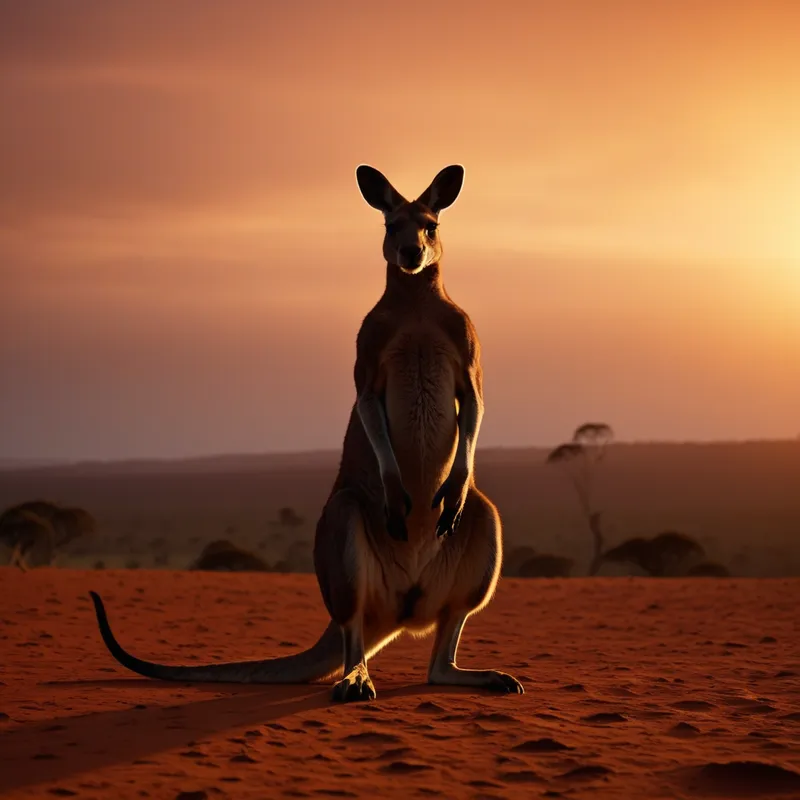
Kangaroo Ancestors Myth Meaning & Symbolism
In the Dreaming, the First Kangaroo's great journey and sacrifice shaped the land, teaching the laws of balance and the price of becoming.
The Tale of Kangaroo Ancestors
In the time before time, when the world was soft and unformed, the Dreaming breathed life into the First Ones. Among them was Marlu, the Great Kangaroo. His body was not yet as we know it; he was a spirit of immense power and restless energy, a pulse of life waiting for its shape.
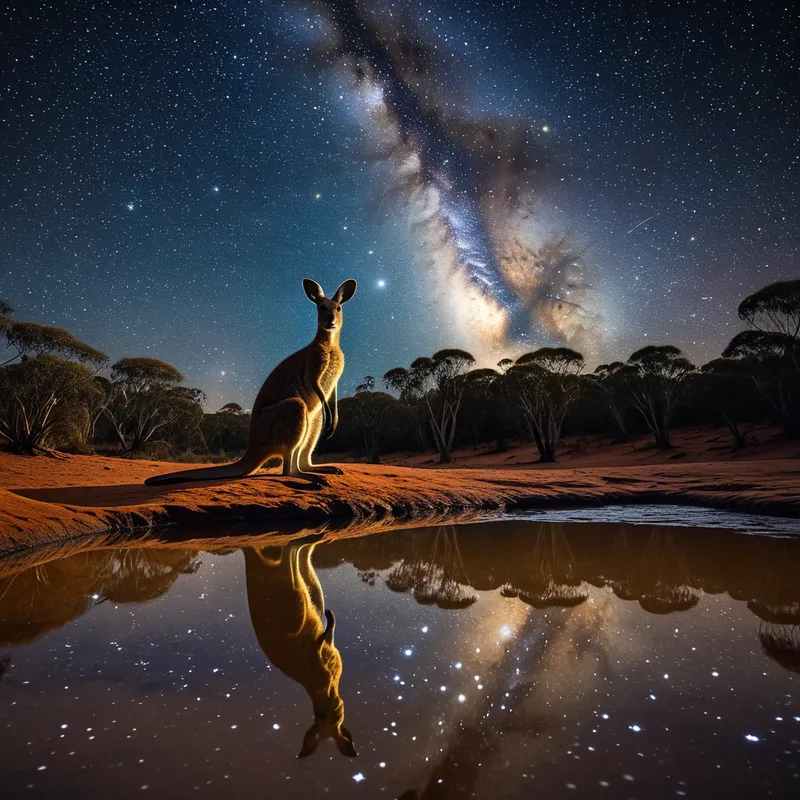
The land was a flat, featureless plain, silent but for the whispering of the Ancestors. Marlu felt a terrible itch in his powerful hind legs, a compulsion to move that was the Dreaming culture.") itself calling him into being. With a first, thunderous thrust, he launched himself forward. Where his feet struck the soft earth, great depressions formed, filling instantly with sweet, clear water. These became the first waterholes, lifeblood of the parched world. His tail, dragging behind him, scored deep grooves into the earth, carving the first creek beds and river courses.
But the journey was not one of simple creation. It was a trial. The sun, newly awakened, beat down with a fierce heat. Thirst, a concept unknown, became Marlu’s constant companion. His powerful legs grew heavy, his breath came in ragged gasps that stirred the first winds. He sought the water he had made, but it was always behind him, a memory in the land. The longing shaped him, hollowing his sides, stretching his form, teaching his body the rhythm of lean endurance.
Then came the confrontation with Wati Nyiru, the Morning Star man, a hunter spirit of cunning and desire. In some tellings, a great chase ensued across the nascent landscape. In others, a pact was forged. In the pivotal moment, exhausted and at his limit, Marlu faced a choice: to continue his boundless, chaotic leaping and risk scattering his essence to the winds, or to make a sacrifice to the order of the Dreaming.
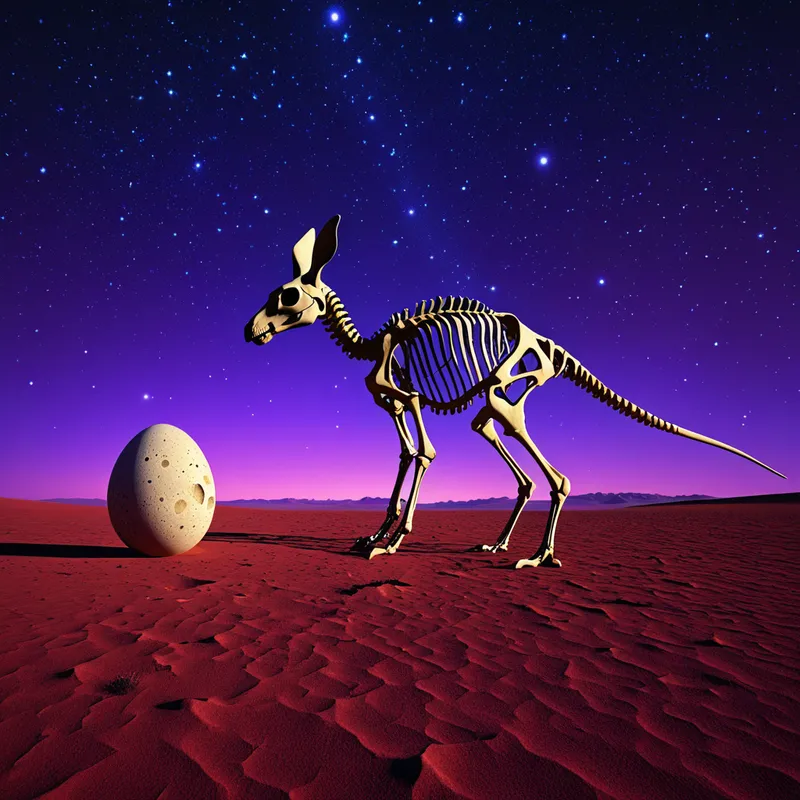
With a final, deliberate act, Marlu ceased his frantic travel. He gathered his remaining strength and, in a specific, sacred place, he gave of his own substance. From his body came the final shaping of the kangaroo form—the pouch, the specific structure of the foot, the set of the head. He implanted his life-pattern into the land itself. Then, he laid down, his body sinking into the earth, becoming a part of the terrain—a rocky outcrop, a range of hills, his spirit dissolving into the songlines he had etched. He did not die; he became. He transformed from a wandering creator-spirit into the eternal, fixed template for all kangaroos to come, and into the living geography that would sustain them.
Cultural Origins & Context
This narrative belongs to the profound spiritual framework of the Dreaming (or Tjukurrpa), the foundational concept of many Aboriginal Australian cultures. It is not a "story" in the Western sense of fiction, but a sacred, living truth that explains the origin of natural species, landforms, and social law.
The myth of the Kangaroo Ancestor is particularly significant among desert peoples, such as the Pitjantjatjara and Arrernte, where the kangaroo is not just a food source but a cosmological actor. It was and is passed down through intricate oral traditions—song cycles, dances, ceremonies, and rock art. Elders and knowledge custodians recount the journey along specific songlines, physically walking the paths Marlu took, singing the country into being anew with each performance. Its societal function is multifaceted: it is a map, a legal charter explaining the ownership and ecology of the land, a moral lesson on endurance and sacrifice, and a ritual bridge connecting the present community to the eternal creative past.
Symbolic Architecture
At its core, the myth is a masterful depiction of the process by which potential becomes actuality, and chaos becomes sacred order. Marlu begins as restless, undifferentiated creative energy. His journey is the process of taking form through action and encounter.
The Ancestor does not simply traverse the land; he argues with it, and in the debate, both are defined.
The itch in the legs symbolizes divine imperative, the unstoppable urge of life to manifest and move. The creation of waterholes and rivers represents the fundamental truth that life’s journey itself creates the resources for sustenance, often only in retrospect. The thirst and exhaustion are not punishments, but essential teachers that carve the soul and the body, creating the vessel capable of holding spirit. The confrontation or pact with Wati Nyiru introduces the "other"—the hunter, the trickster, the force of desire and pursuit. This external pressure forces differentiation and decision.
The ultimate sacrifice—ceasing the journey to become the template—is the most profound symbol. It represents the transition from the heroic, individual act of creation to the establishment of eternal law and pattern. Marlu exchanges his boundless, personal mobility for the fixed, generative immortality of the archetype. He becomes the law of kangaroo-ness, ensuring the survival of his children by becoming the land that nourishes them.
The Dreamer's Resonance
When this mythic pattern stirs in the modern dreamer, it often manifests as dreams of relentless, urgent travel across vast, ambiguous landscapes. One might dream of powerful legs that cannot stop moving, of searching for water in a desert of one’s own making, or of being pursued by an enigmatic, star-like figure.
Somatically, this can correlate with feelings of restless legs, anxiety, or a deep, unquenchable "thirst" in life—a sense of striving without a clear destination. Psychologically, this is the process of the primal journey phase of individuation. The ego is compelled out of its soft, undifferentiated state by an inner imperative (the Dreaming). It acts, creates, and exhausts itself, learning its own limits and capacities through friction with the world (the sun, the thirst, the hunter). The dream signals that the psyche is engaged in the hard, necessary work of giving form to its innate potential, often feeling the weariness and isolation of the pathfinder.
Alchemical Translation
The alchemy of the Kangaroo Ancestor models the complete cycle of psychic transmutation. The prima materia is the restless, creative spirit (Marlu in the unformed world). The calcinatio is the scorching journey under the sun, the burning away of aimless energy to reveal the core will. The solutio is the encounter with thirst and the hunter—a dissolution of the old, solitary identity through confrontation with the "other" and the limits of the self.
The sacrifice is not a loss, but the final, willing solidification of the Philosopher's Stone—the point where the spirit becomes its own eternal vessel.
The pivotal sacrifice is the coagulatio: the spirit willingly "cools" and solidifies into a definite form. In our psychic process, this is the moment we cease endless seeking and commit to a structure—a vocation, a relationship, a core identity, a creative work. We give up the fantasy of infinite possibility to become the template for something real and generative. Our personal journey (the songline) becomes etched into our being, transforming from a path we walk to the foundational law of our inner landscape. We become, like Marlu, both the creature and the country—the individual living according to the deep, ancestral laws of their own true nature, thereby nourishing the life that springs from them. The chase ends not in capture, but in a sacred, stationary becoming.
Associated Symbols
Explore related symbols from the CaleaDream lexicon: