Kanaloa's Waves Myth Meaning & Symbolism
A myth of the primal ocean god Kanaloa, whose chaotic waves are calmed by divine order, symbolizing the integration of the unconscious into consciousness.
The Tale of Kanaloa's Waves
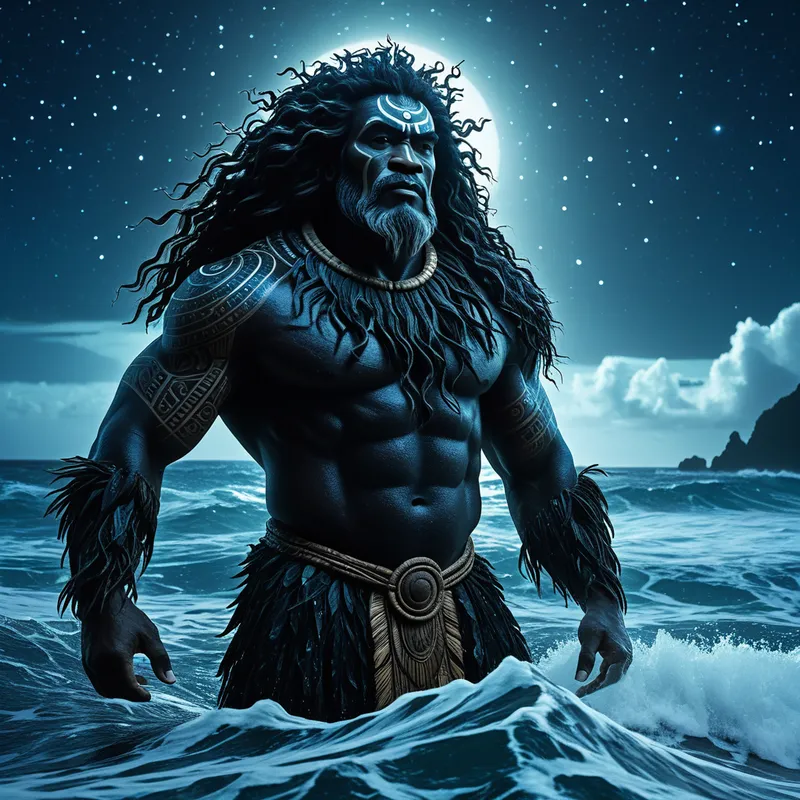
In the time before time, when the world was only a whispered promise in the dark, there was the endless, breathing sea. And the sea was not water, but the dreaming culture.") body of Kanaloa. He was the deep, the abyss, the source of all life and the final darkness that would one day receive it back. His thoughts were currents, his breath the tides, and his dreams took form as waves—not the gentle rollers that kiss the shore, but great, world-spanning mountains of water, born from the chaos of his unfathomable soul.
The sky, Rangi, wept to see such formless power. The earth, Papa, trembled beneath it. And the other gods, the children of this first pair, knew no peace. They could not walk upon the waters, could not fish in its depths, could not guide their great waʻa across its face, for Kanaloa’s waves were a willful, churning realm of pure potential and pure destruction. They were the song of the void, beautiful and terrifying.
Then Kāne, the bringer of light and form, stood at the boundary where sea meets land. He did not raise a weapon, for one cannot fight the ocean. Instead, he raised his voice in a karakia, a chant that was not a command, but a conversation. He chanted of boundaries, of rhythm, of the sacred space where the wave must crest and fall. He chanted of the path of the sun across the water, a golden road of order. He chanted of the need for a womb that was not a tomb, for a pathway between islands, for a rhythm to the chaos so that life could find its way.
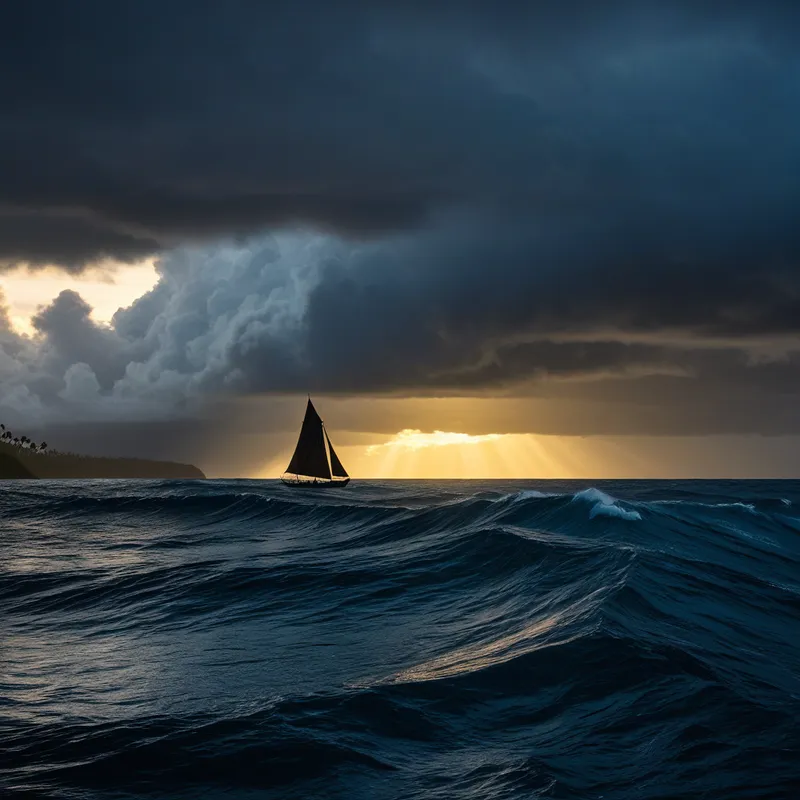
And Kanaloa, in the profound depths, listened. The chant of Kāne did not still his heart—for the deep must always dream—but it gave his dreams a new pattern. The chaotic surges began to slow, to find a pulse. The monstrous waves softened into swells, the swells into a rhythm that could be read by a skilled navigator who knew the language of the sea. Kāne had not conquered the deep; he had offered it a sacred covenant. From that day, the waves of Kanaloa held a dual nature: the peaceful, predictable roll that carried the voyagers, and the sleeping, stormy power beneath, a reminder of the primal chaos that is the source and end of all things. The ocean was no longer just a barrier; it was the pathway, the great Ara Moana, the Ocean Road, born from the marriage of deep potential and conscious form.
Cultural Origins & Context
This narrative is not a single, codified myth from one text, but a tapestry woven from the broader cosmological understanding of many Polynesian cultures, particularly those of Hawaiʻi and the Society Islands. Kanaloa is a complex, sometimes enigmatic figure, often paired with Kāne as complementary forces. While specific "myths of Kanaloa's waves" are less common than cycles about Māui or the separation of Rangi and Papa, the conceptual struggle between the formless, generative sea and the ordering principle of the gods is fundamental.
The story was not merely entertainment; it was a vital piece of navigational and existential wisdom, passed down through kahuna and master navigators, ʻōpiʻo hōkūleʻa. To understand Kanaloa was to understand the ocean itself—its bounty and its peril, its predictable pathways and its sudden, annihilating rages. The myth functioned as a psychological map for living on and with a force infinitely greater than oneself. It encoded the respect (kapu) required to venture onto Kanaloa's domain and the knowledge that human order is a temporary, sacred agreement with a fundamentally wild universe.
Symbolic Architecture
At its core, this myth is about the relationship between the Unformed and the Formed, the Deep and the Surface. Kanaloa represents the primordial unconscious—the source of all life, creativity, and psychic energy, but also of shadow, dissolution, and non-being. His waves are the raw, undifferentiated contents of the psyche: emotions, instincts, and archetypal potentials that, in their pure state, are chaotic and overwhelming.
The unconscious is not a cellar to be cleaned, but an ocean to be navigated. Its storms are not punishments, but the raw language of a deeper self.
Kāne represents the principle of consciousness, differentiation, and light. He does not destroy the ocean but establishes a dialogue with it. His karakia is the act of conscious attention, the application of pattern, meaning, and rhythm to chaotic inner experience. The resulting "calm" is not the absence of the deep, but the establishment of a functional relationship between ego-consciousness (the voyager) and the unconscious (the sea). The Ara Moana is the symbolic birth of the ego-Self axis, the navigable channel between the personal and the transpersonal.
The Dreamer's Resonance
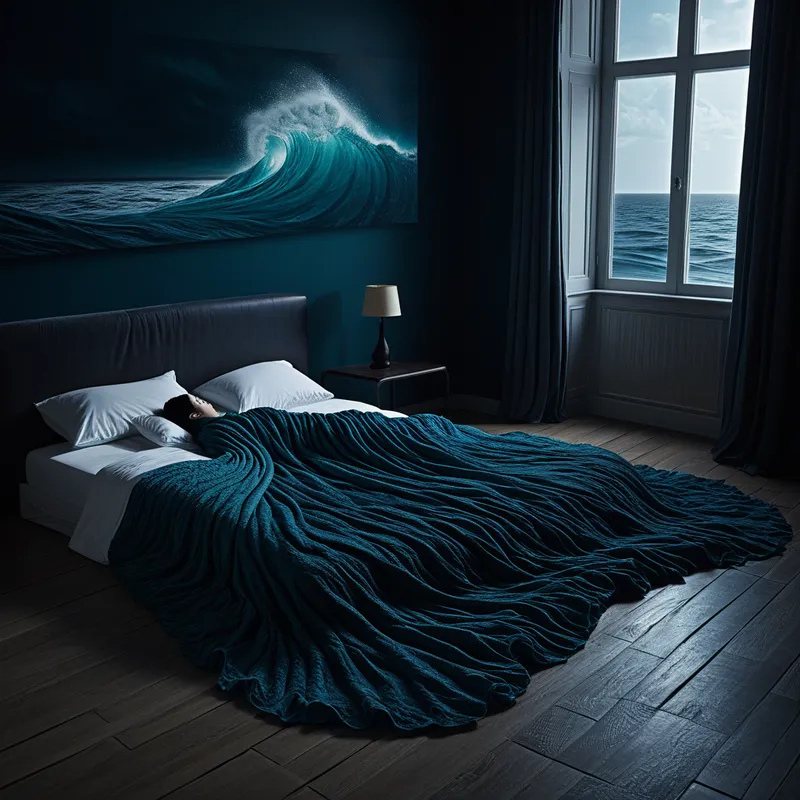
When this mythic pattern stirs in the modern dreamer, it often manifests as dreams of vast, awe-inspiring, or terrifying oceans. To dream of being on a small boat in towering waves speaks to feeling overwhelmed by emotional or instinctual material rising from the unconscious. The dream-ego is the voyager, and the sea is the totality of the psyche it does not control.
Conversely, dreams of peacefully navigating by wave patterns, or of finding a sudden, calm path through a storm, signal a somatic and psychological process of integration. The dreamer is learning the "language" of their own depths. They are not fighting the feeling, but learning its rhythm. This is the process of developing what Polynesian navigators called kilo—an intuitive, embodied knowing that comes from profound observation and relationship, not intellectual control. The body in such dreams may feel both the terror of the abyss and a strange, resonant peace, embodying the myth's central truth: one can be in relationship with immense power without being destroyed by it.
Alchemical Translation
The alchemical process modeled here is the coniunctio oppositorum—the sacred marriage of opposites. The "lead" of the prima materia is the chaotic, undirected power of the unconscious (Kanaloa's primal waves). The "gold" is the realized, navigable life, where that immense energy is harnessed for creativity, depth, and journey (the Ara Moana).
For the modern individual, the myth maps the path of psychic transmutation or individuation. First, one must confront the "Kanaloa state": the periods of depression, creative block, explosive anger, or existential dread that feel like formless, churning chaos. This is not a flaw, but the raw material.
The goal is not to calm the sea forever, but to build a canoe sturdy enough to sail upon it, and to learn the stars that guide the way.
The "chant of Kāne" is the work of consciousness: therapy, art, ritual, meditation, or any disciplined practice that names, contains, and gives rhythm to the inner chaos. It is the act of building a sturdy waʻa of the ego—not an impervious fortress, but a resilient vessel designed for journeying on the depths, not in spite of them. The triumph is not the elimination of the shadow or the unconscious, but the hard-won ability to set sail upon it. One becomes, in the deepest sense, a navigator of one own soul, respecting the god of the deep while following the stars of one's own purpose, forever journeying on the sacred road born from their eternal conversation.
Associated Symbols
Explore related symbols from the CaleaDream lexicon: