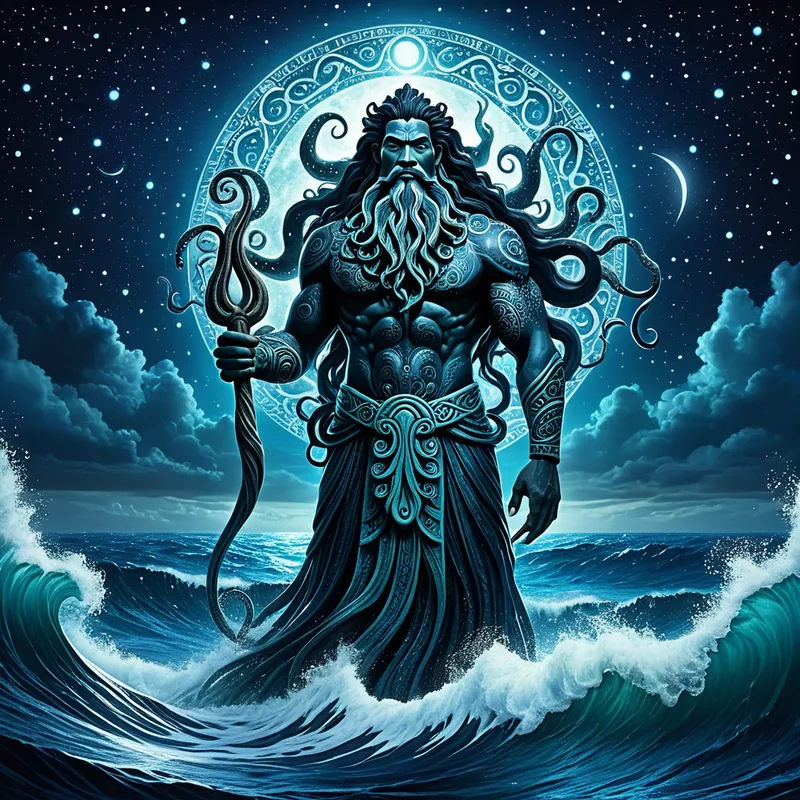
Kanaloa Myth Meaning & Symbolism
The myth of Kanaloa, god of the deep ocean, explores the confrontation with the primal, formless unconscious and the necessity of embracing the shadow.
The Tale of Kanaloa
Listen, and let the salt-wind carry you back. Before the great migrations, when the world was a chorus of whispers between sky and sea, there existed the deep. Not the friendly, sun-dappled lagoon, but the true deep—the Moana-nui-ākea that yawned beneath the foundations of the world. And in that black, pressure-crushing silence, Kanaloa stirred.
He was not born; he was. While his brother, Kāne, pulled the sun from his forehead and painted the forests green, Kanaloa remained in the womb of the world. His body was the cold abyss, his breath the slow, crushing currents, his thoughts the creatures that pulsed with their own light in the eternal night. He was the keeper of all that was hidden, all that was formless and potent before form.
The people of the bright world knew of him in the pull of the riptide, in the sudden squall that blotted out the stars, in the strange, beautiful horrors that sometimes washed ashore. They knew his name was whispered not in prayers for bounty, but in respect for the immense, unknowable power that held up their islands from below. He was the counter-weight to Kāne’s light, the necessary darkness that gave the light its meaning.
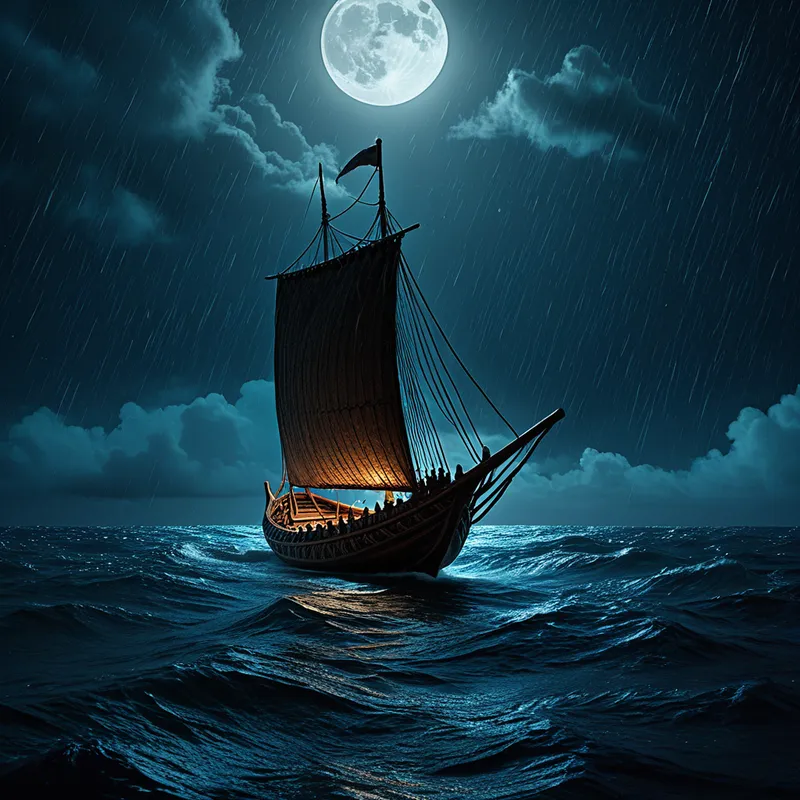
One telling speaks of a time when the balance was forgotten. The people, proud in their canoes, believed they had mastered the sea. They took without offering, sailed without reverence, their songs full of arrogance, not gratitude. And the ocean grew still—a mirror too perfect, a silence too deep. Then, from the heart of that stillness, Kanaloa announced himself. Not with a storm, but with an absence. The familiar stars vanished. The guiding currents died. The world was enveloped in a tangible, moist darkness that was not of the sky, but rose from the depths. It was the darkness of the源头, the primal chaos before the first word.
In that profound dark, the people felt not an attack, but a presence—vast, intelligent, and utterly indifferent to their schemes. They felt the truth of their smallness. They remembered the stories. In the blackness, they offered not pleas, but recognition. They chanted the old names of the deep, acknowledged the Po from which even the gods emerged. And as they did, the darkness receded, not as a threat departing, but as a presence satisfied, sinking back into its realm. The stars returned, brighter. The currents flowed, truer. Order was not restored by force, but by the remembered embrace of its opposite.
Cultural Origins & Context
The figure of Kanaloa is central to the Kumulipo, the great Hawaiian creation chant that traces lineage from the primordial darkness to the living present. He is not a demon or a mere god of calamity, but one of the four primary akua who presided over the foundational domains of existence. His stories were not casual tales but moʻolelo of profound theological and navigational import.
Transmitted by kahuna and master navigators, the knowledge of Kanaloa served a critical societal function. For a people whose universe was the ocean, understanding the deep was a matter of survival and wisdom. Kanaloa represented the ultimate "there be dragons" on their mental charts—the acknowledgment of the limits of human knowledge and control. He was the god invoked to understand madness, illness, and the unknown, for these were seen as currents from his dark, psychic seas breaking into the conscious world. His myth enforced humility, ecological reciprocity, and the psychological necessity of acknowledging the vast, unconscious underpinnings of conscious life.
Symbolic Architecture
Kanaloa is the archetypal symbol of the Deep Unconscious. He is not the personal shadow of repressed traits, but the collective, impersonal, primordial substrate from which consciousness itself emerges. Where Kāne is the principle of differentiation, creation, and "yes," Kanaloa is the principle of dissolution, potential, and the silent "and yet."
The ocean’s surface reflects the sun, but its depths generate the life that sustains the world. So too does the conscious mind rely on the unfathomable fertility of the unconscious.
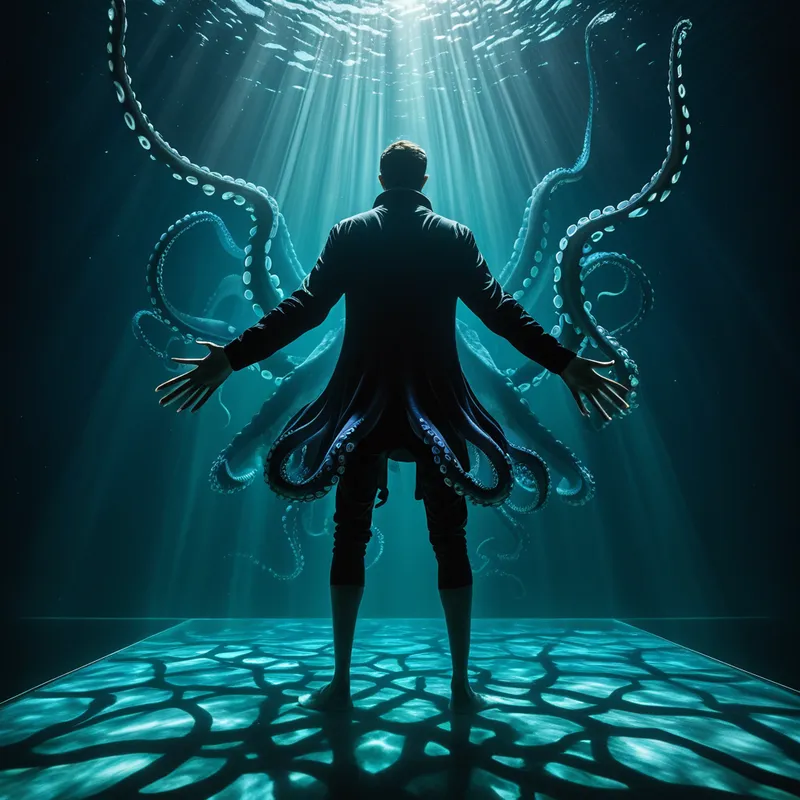
His association with the squid and the octopus—creatures of fluid intelligence, shape-shifting, and ink-clouds that obscure—perfectly captures his nature. He is the intelligence of the formless, the knowing that exists before thought takes shape. He is the necessary partner in the cosmic duality: without the restraining, containing depth of Kanaloa, the creative energy of Kāne would be formless explosion; without Kāne’s light, Kanaloa’s depth would be sterile, eternal night. Their tension is the engine of the world.
The Dreamer's Resonance
When the pattern of Kanaloa stirs in the modern psyche, it manifests in dreams of profound, often terrifying, depth. This is not a dream of being chased, but of being immersed. You may dream of standing on a shore as a wave of impossible, starless black water rises to meet the sky, not with violence, but with slow, inevitable engulfment. You may dream of diving into a cave pool that descends forever, or of your own reflection in a mirror dissolving into a school of dark, silvery fish that swim into the glass.
Somatically, this process feels like a dissolution of ego-boundaries. It can accompany life phases where old identities are crumbling—after great loss, before a creative breakthrough, or during deep therapy. The psychological process is one of regression in service of the Self: a necessary, frightening journey back into the undifferentiated psychic material from which a new, more authentic consciousness can be formed. The fear is not of an enemy, but of the loss of the familiar self to the vast, impersonal creative matrix.
Alchemical Translation
The alchemical work modeled by Kanaloa is the nigredo—the blackening, the descent into the primal matter. In the individuation process, this is the confrontation with the contents of the personal and collective unconscious that have been ignored or feared. It is the "dark night of the soul" where light and guidance seem utterly absent.
To sail the ocean of consciousness, one must first acknowledge the abyss that buoys the boat. Wholeness is not achieved by staying in the sun, but by making peace with the tide that pulls you toward the dark.
The myth teaches that this descent is not a punishment, but a recalibration. The arrogant, one-sided conscious mind (the boastful voyagers) must be humbled by an encounter with its immense, silent counterpart. The goal is not to conquer the deep, but to be recognized by it—to establish a respectful relationship. The psychic transmutation occurs when we stop projecting our fear onto the darkness and instead learn its language: the language of dream, symbol, intuition, and somatic wisdom. We integrate Kanaloa not by bringing light into the dark, but by allowing the dark its rightful, creative place in our psychic ecology. The individual who has done this work carries a profound calm, a depth of being. They have met the god of the deep and returned, not with a trophy, but with the quiet knowledge that they are, and always have been, a part of that vast, dark, and endlessly generative sea.
Associated Symbols
Explore related symbols from the CaleaDream lexicon: