Kami of Mist Myth Meaning & Symbolism
A myth of a formless kami who dwells in mountain mists, revealing hidden paths and truths only to those who surrender to uncertainty.
The Tale of Kami of Mist
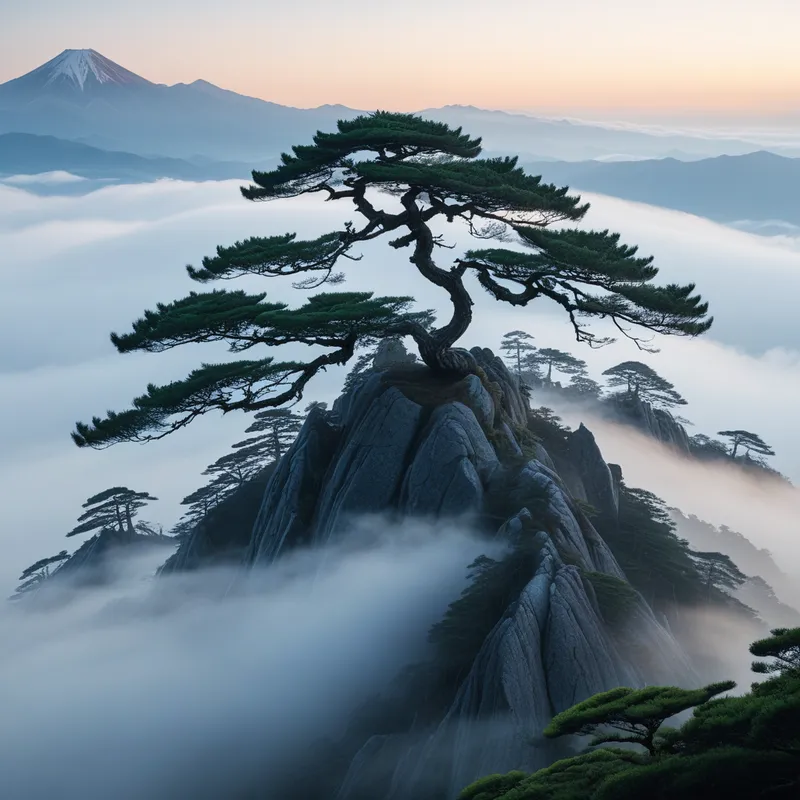
Listen, and let the veil between worlds grow thin. In the high, sacred places where the shoulders of the mountains meet the belly of the sky, there dwells a presence older than temples, quieter than prayer. It is the Kami of Mist.
It has no name carved in wood, no fixed form in the shintai. Its body is the breath of the earth itself—the cool exhalation of deep forests, the sigh of river valleys at dawn, the silent, creeping embrace that fills the spaces between ancient cedar trunks. It does not command; it obscures. It does not speak; it envelops.
Once, a seeker of truth, a scholar weary of dusty scrolls, climbed the holy slopes of Yama. He sought a direct audience with the divine, a clear sign, an unambiguous answer to the turmoil in his heart. The path was steep but clear under the sun. Then, as he entered a sacred grove where the stones were worn smooth by centuries of devotion, the world changed.
The air grew cool and heavy. From the mossy earth and the dense canopy, a soft, luminous whiteness began to rise. It was not a storm, but a gentle drowning. The path vanished. The familiar shapes of trees became ghosts, then shadows, then nothing at all. The scholar stood still, his heart pounding a rhythm of panic. His quest for clarity had led him into the heart of utter obscurity. He called out, but his voice was swallowed by the muffling silence of the mist.
Hours passed, or perhaps moments—time, too, had lost its form. Just as despair began to root in his chest, a subtle shift occurred. The mist before him seemed to gather, to take on a gentle sentience. It was not a shape, but a presence. A profound calm emanated from it, a silence deeper than the absence of sound. Without words, a knowing settled upon him: You sought a path, but you are standing on one. You sought an answer, but you must become the question.
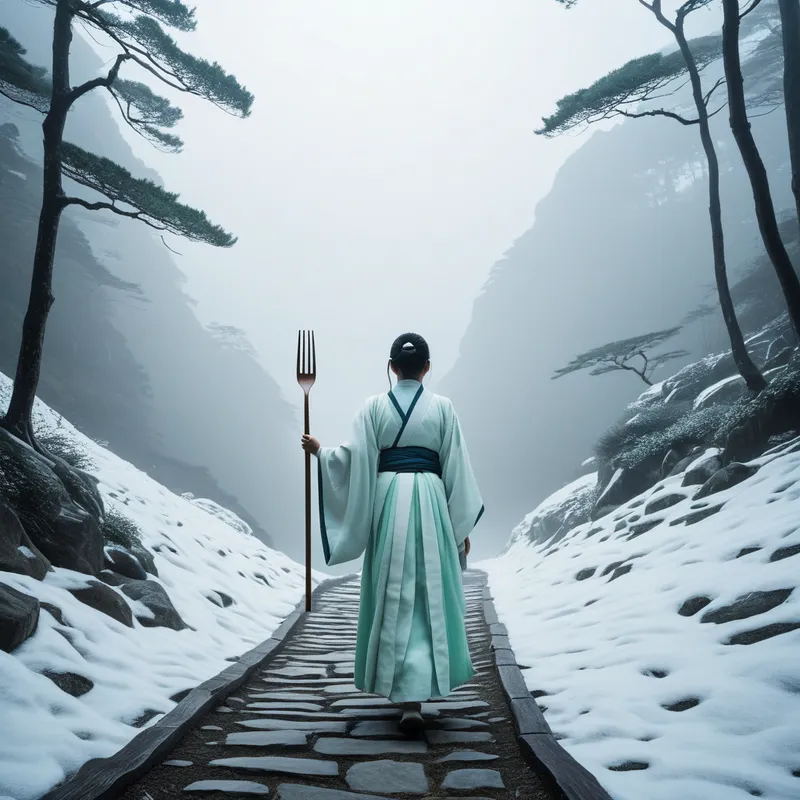
Guided by this wordless intuition, the scholar took a step forward, not knowing if it was forward at all. The mist parted just enough to reveal a single stepping stone, slick with dew. Then another. He surrendered his need to see the summit, his desire for a destination. He moved with the mist, not against it, feeling his way through a world of pure, soft potential. And in that surrender, he saw not with his eyes, but with his spirit. He perceived the hidden shimenawa around an invisible rock, the subtle energy of a place where a thousand prayers had soaked into the soil. The mist did not hide the path; it was the path, and it revealed a truth more profound than any sunlit vista: that wisdom is not found in the clearing, but in the courage to walk, sightless, through the cloud.
Cultural Origins & Context
The figure of the Kami of Mist is not the protagonist of a single, codified epic like those in the Kojiki or Nihon Shoki. Instead, it emerges from the animistic heart of Shinto, the “way of the kami.” This is a kami of phenomenon and experience, belonging to the vast category of yaoyorozu no kami—the eight million myriad kami that inhabit all things.
Its stories were passed down not by court historians, but by mountain ascetics (yamabushi), pilgrims, and villagers living in the shadow of sacred peaks. For them, mist was not merely weather; it was a palpable manifestation of the mountain’s spirit, a temporary sacred space (himorogi) that descended to earth. It marked a liminal time—dawn or dusk—and a liminal space where the boundary between the human world (Utsushiyo) and the hidden world of the kami (Kakuriyo) grew permeable. The myth functioned as a teaching story about navigating uncertainty, respecting the unknowable aspects of nature, and understanding that the kami’s power is often in concealment and revelation, not in brute force.
Symbolic Architecture
The Kami of Mist is the ultimate symbol of the liminal—the threshold state where one reality dissolves and another has not yet formed. It represents the necessary obscurity that precedes revelation.
The truth that can be seen clearly in full sun is often only surface truth. The deeper mysteries require the veiling of the familiar to be perceived.
Psychologically, the mist symbolizes the clouding of conscious understanding—doubt, confusion, depression, or the dissolution of old identities. The kami itself is the archetypal spirit of this process; it is not a monster to be slain, but a guide to be followed through disorientation. The lost path is the ego’s planned trajectory. The revealed stepping stones are intuitions, synchronicities, and inner knowings that emerge only when the ego’s frantic navigation ceases. The conflict is not against the mist, but against the seeker’s own resistance to not-knowing. The resolution is a paradigm shift: from seeking light to learning to see in the grey.

The Dreamer’s Resonance
When this myth pattern stirs in the modern psyche, it often manifests in dreams of being lost in fog, wandering through featureless white landscapes, or searching for a way forward in a suddenly unfamiliar environment (like one’s own home turned alien). This is the somatic signature of a psychological process of de-structuring.
The dreamer is not necessarily in danger, but they are in transition. The conscious mind’s maps have failed. This can accompany life shifts—career changes, the end of a relationship, a spiritual crisis, or any profound internal reorganization where old certainties evaporate. The anxiety in the dream mirrors the ego’s terror at losing control. Yet, if the dreamer can recall a feeling of eerie calm within the mist, or the emergence of a subtle, non-visual guidance, it signals the activation of a deeper, more intuitive layer of the psyche—the Self, operating like the kami, guiding through obscurity. The process is one of moving from cognitive knowing to embodied sensing.

Alchemical Translation
The myth of the Kami of Mist is a precise alchemical manual for psychic transmutation, modeling the individuation process. The first stage, nigredo (the blackening), is represented by the scholar’s despair in the blinding whiteness—the dissolution of the ego’s plans. The mist is the massa confusa, the chaotic prima materia essential for transformation.
The ego must be dissolved in the waters of uncertainty before the gold of the Self can be precipitated.
The journey through the mist is the albedo (the whitening), the purification not by fire, but by surrender. By giving up the demand for clarity (“I must see the summit”), the individual aligns with a transpersonal guidance system. Each step onto a revealed stone is a small act of faith in the unconscious, a moment of synchronicity. The final revelation—perceiving the sacred in the obscured landscape—is the rubedo (the reddening), the culmination. The seeker returns not with a trophy, but with a new mode of perception. They have internalized the kami’s essence. They have learned that the path to the center of the Self is not lit by the blinding sun of consciousness alone, but is often walked in the creative, fertile twilight of the unconscious, guided by the gentle, formless wisdom that knows the way precisely because it is the way itself.
Associated Symbols
Explore related symbols from the CaleaDream lexicon: