Kami Myth Meaning & Symbolism
The sacred, animating presence in all things, from mountain to river to ancestor, weaving the visible and invisible worlds into a single, living cosmos.
The Tale of Kami
In the beginning, there was only a formless, silent sea, a chaos of drifting brine. Then, from the purest heights of the High Plain of Heaven, the first stirrings of consciousness emerged. They were not gods as you might imagine, throned and separate, but sacred presences, the Kami, born from the very substance of potential itself.
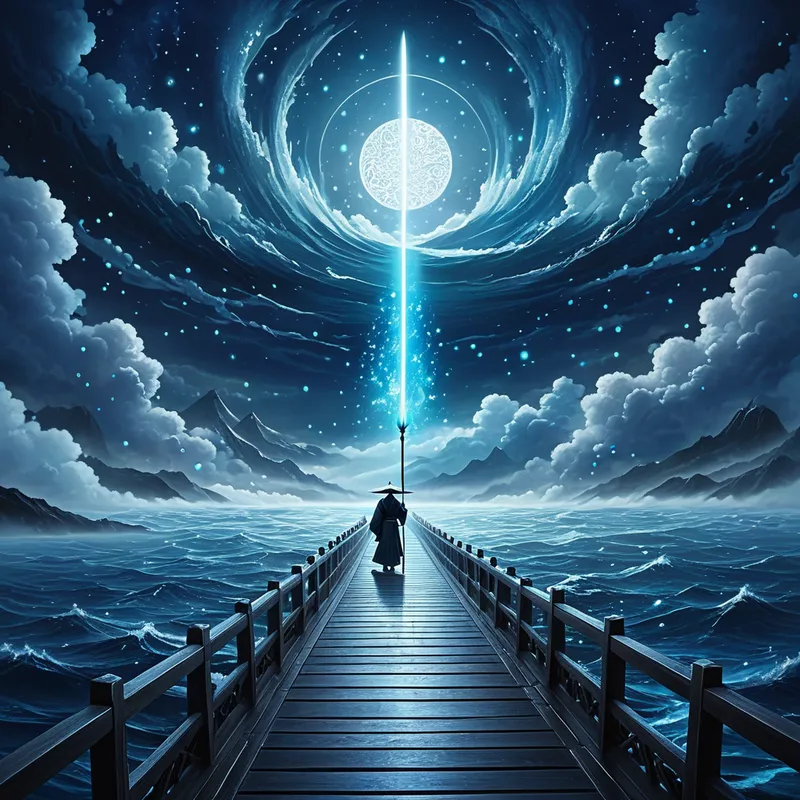
Among them, two were given a solemn charge: Izanagi-no-Mikoto and Izanami-no-Mikoto. They stood upon the Ame-no-ukihashi, the Floating Bridge of Heaven, and looked down into the swirling grey abyss. Izanagi plunged his magnificent spear, Ame-no-nuboko, into the waters below. When he lifted it, the brine that dripped from its tip coagulated and formed an island—Onogoro. This was the first solid ground, born from the churning of the primordial deep.
Descending to this newborn land, Izanagi and Izanami performed the ritual of union, circling the heavenly pillar. From their sacred marriage, the eight great islands of Japan were born, and then the myriad Kami of the natural world: the Kami of the wind, Shinatsuhiko; of the mountains, the seas, the trees, and the rocks. Life flowed from them in a sacred procession. But in giving birth to the Kami of fire, Kagutsuchi, Izanami was burned terribly and descended to the land of the dead, Yomi-no-kuni.
Blinded by grief, Izanagi journeyed into the foul darkness of Yomi to retrieve her. He found her in the shadows, but she warned him not to look upon her. He lit a tooth of his comb as a torch. The flame revealed her body, once beautiful, now swollen and rotting, host to the eight Thunders of putrefaction. Horrified, Izanagi fled. Humiliated and enraged, Izanami and the hags of Yomi gave chase. He threw his headdress, which became grapes to delay them, then his comb, which became bamboo shoots. Finally, at the boundary of the living world, he pushed a massive boulder to seal the entrance, forever separating the realms of life and death.
Purifying himself in the river, the waters of his ablutions themselves birthed more Kami. From the washing of his left eye was born Amaterasu-Ōmikami, the radiant sun. From his right eye came Tsukuyomi-no-Mikoto, the moon. From his nose came Susanoo-no-Mikoto, the wild storm. Thus, from an act of purification after profound contamination, the great luminaries of the cosmos came into being. Amaterasu, in her divine light, would come to rule the Plain of Heaven, and her lineage would become the heart of the land and its people.
Cultural Origins & Context
This foundational narrative is recorded in Japan's oldest chronicles, the Kojiki (712 CE) and the Nihon Shoki (720 CE). These texts were not mere storybooks but political and cosmological documents, crafted to establish the divine ancestry of the imperial line, tracing it back to Amaterasu. The myths were preserved and performed by ritual specialists, likely within an oral tradition long before they were written.
The concept of Kami, however, far predates these texts and permeates the indigenous spiritual tradition of Shinto. Kami are not distant, omnipotent deities but the sacred, animating essence found in remarkable aspects of nature (a majestic waterfall, an ancient tree), powerful forces (wind, rain), influential ancestors, and even exceptional human beings. The myth of Izanagi and Izanami provided a sacred charter for this worldview, explaining the very birth of the land as a Kami act and establishing the rituals of purification (harae) and respect that maintain harmony between the human and Kami worlds. Its societal function was to root the community, its rulers, and its daily practices in a sacred, living cosmos.
Symbolic Architecture
The myth is a profound map of psychic and cosmic differentiation. The initial chaos represents the undifferentiated unconscious. The act of stirring the brine with the spear is the first conscious intervention, the archetypal creative act that brings form from formlessness, ego-consciousness from the primal sea.
The birth of the world is not an explosion, but a coagulation—a gentle gathering of essence into form.
The tragic separation of Izanagi and Izanami symbolizes the necessary, painful split between life and death, light and shadow, the known and the unknown. Izanagi's flight from Yomi is not cowardice, but the instinct of consciousness to flee the full, terrifying reality of decay and the unconscious shadow. The sealed boulder represents the necessary boundary that allows life to proceed, though it creates a fundamental existential rift.
Most crucially, the purification scene models a core psychological truth: transformation often follows a profound encounter with the shadow. Izanagi's defilement by death leads to an ablution that births the celestial order—the Sun (consciousness, clarity, the ruling principle), the Moon (reflection, the cyclical unconscious), and the Storm (raw, untamed emotion and chaos). The Kami are not invented; they are revealed through the process of cleansing and integration.
The Dreamer's Resonance
When this myth stirs in the modern psyche, it often manifests in dreams of profound interconnection with nature, or its terrifying opposite—alienation from it. One might dream of a forest where every leaf whispers a name, or a mountain that holds a beating heart of stone. This is the psyche reaching for the experience of Kami, the anima mundi or world soul, sensing the sacred aliveness in all things.
Conversely, dreams of being pursued through a decaying, twilight landscape echo Izanagi's flight from Yomi. This somatic experience of contamination and terror often surfaces during life transitions involving loss, illness, or the confrontation with one's own mortality or "rotten" aspects—shame, guilt, or repressed trauma. The dream is the psyche's journey into its own underworld, and the crucial task, mirrored in the myth, is not to stay there, but to return and seek purification. The dreamer is undergoing the process of confronting what has been sealed away, not to dwell in it, but to be fundamentally changed by the encounter.
Alchemical Translation
For the individual on the path of individuation, the myth of Kami offers a non-dualistic model of psychic transmutation. The goal is not to ascend to a distant heaven, but to recognize the sacred (kami-no-michi) immanent in the very fabric of existence, including one's own being. The alchemical work involves several stages:
First, the Stirring of the Brine: Engaging consciously with the chaotic, formless material of one's inner life—the moods, impulses, and potentials—and committing to giving them form through creative or introspective action.
Second, the Descent to Yomi: The courageous, often reluctant, confrontation with the personal and collective shadow—the "rotting" aspects of one's history, relationships, and psyche that one has tried to seal away with the boulder of denial.
The luminous Self is not born in spite of the encounter with decay, but directly from its waters.
Third, the Great Purification: This is the critical, integrative phase. It is the psychological equivalent of harae—not a simple washing away, but a transformative process where the energy and insight gained from the shadow encounter are consciously integrated. From this ablution, one's own central luminaries are born: a more stable, radiant consciousness (one's personal Amaterasu), a deeper capacity for reflection (Tsukuyomi), and an acknowledged, vital relationship with one's passionate, stormy emotions (Susanoo).
Finally, the myth leads to a state of ongoing Kami Recognition. The individuated individual does not become a Kami, but learns to perceive the Kami-nature in the world and within. The mountain is not just a mountain; it is a presence. The creative act is not just production; it is a co-creation with the sacred. The ancestor is not just a memory; they are a living influence. This is the alchemical gold: the transformation of ordinary perception into a participatory, reverent dialogue with a universe that is, in its essence, alive, interconnected, and profoundly meaningful.
Associated Symbols
Explore related symbols from the CaleaDream lexicon: