Kamapua'a the Pig God Myth Meaning & Symbolism
A shape-shifting demigod of wild fertility, Kamapua'a's epic conflict and union with the volcano goddess Pele embody the primal reconciliation of chaos and order.
The Tale of Kamapua'a the Pig God
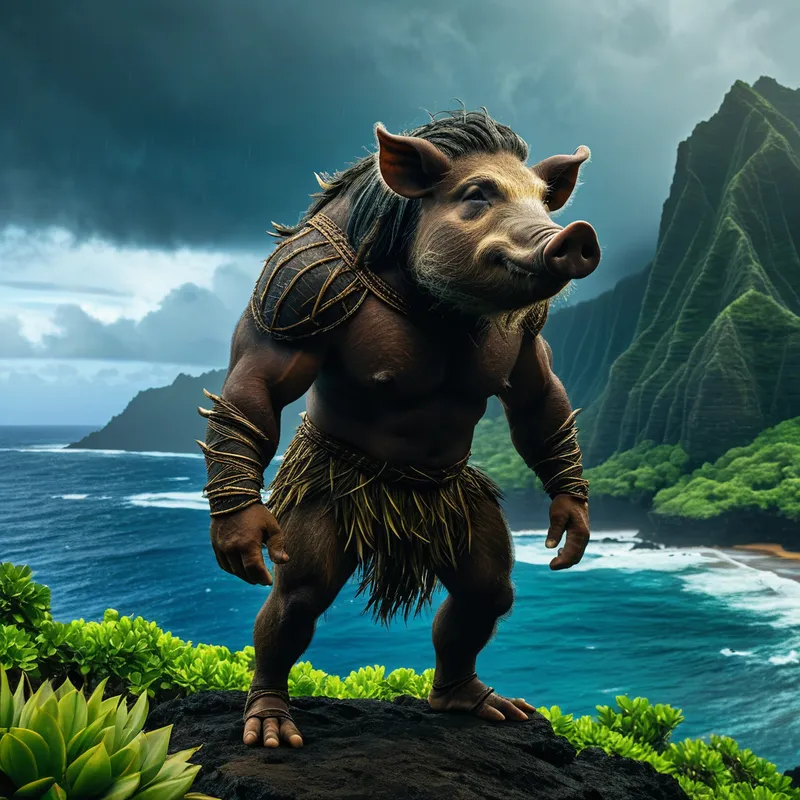
Listen, and hear the story born from the mist of the ʻāina. In the deep green folds of Oʻahu, a child was born of strange portent. His name was Kamapuaʻa—the puaʻa child. From his first breath, he was other. He could be a man of striking, rugged form, or at will, shed his skin and become the great boar, rooting through the forest, a force of unbridled appetite and strength. His was the power of the wild earth: where he trod, ʻuala sprouted instantly; where he slept, the ferns grew thick and deep. He was the god of the lowland, the profuse, the damp, and the fertile.
But his wildness knew no law. He devoured the crops of the people, uprooted their fields, and his appetites were as vast as the sea. The chiefs of Oʻahu raised their armies against him, but Kamapuaʻa was cunning. He would become the boar, goring through ranks, or shift into the form of a giant fish to escape to sea, or become a cloak of morning fog, intangible and everywhere. He was chaos embodied, a trickster of the green world.
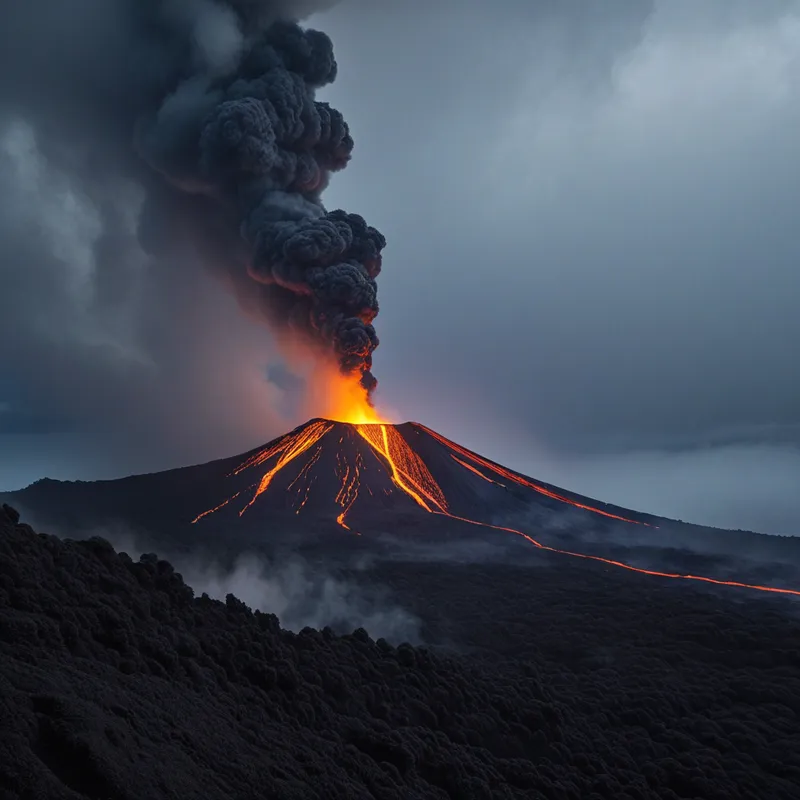
His legend grew until it reached the ears of the one force in all the islands that could match his primal power: Pele. She who dwells in the fiery heart of Hawaiʻi, whose hair is lava and whose anger is eruption. To her, Kamapuaʻa was an affront—the unruly, water-blessed fertility that opposed her purifying, creating fire. She vowed to destroy him.
The great conflict began on the slopes of her domain. Pele sent her brothers, warriors of flame, and called forth rivers of molten rock to scorch the land Kamapuaʻa loved. He met her not with brute force alone, but with the essence of his being. As Pele’s fire flowed down the mountain, Kamapuaʻa called upon the gods of the sea and sky. He became the torrential rain. He became the hundred thousand ʻākūʻakū plants, springing up to halt the lava’s flow. He became the dense, soaking fog that smothered the flame.
Their battle was the world’s oldest argument: Fire against Water. Order against Chaos. The high, dry volcanic plain against the low, wet, fecund valley. The clash steamed and thundered across the land, a stalemate of cosmic proportions.
Yet, from this titanic struggle emerged not annihilation, but a strange, potent truce. Exhausted, recognizing in each other a complementary and equally formidable divine power, they ceased their war. In some tellings, they even wed. Pele retained her dominion over the high volcanic lands, the places of creation and destruction. Kamapuaʻa was given rule over the lush, watered windward slopes and the lowlands—the realms of growth, abundance, and procreation. Where they met, the land became especially fertile, a testament to their union. The wild pig-god was tempered, his energies channeled, not by defeat, but by the recognition of his eternal counterpart.
Cultural Origins & Context
This is not merely a story of gods, but a moʻolelo woven into the very geography and social structure of old Hawaiʻi. Passed down through generations of kāhuna and skilled storytellers, the epic of Kamapuaʻa served multiple vital functions. It was an kumulipo for the varied ecosystems of the islands, explaining why certain plants thrived in specific zones and why the windward sides of volcanoes are so lush.
Societally, Kamapuaʻa was often associated with the common people, the makaʻāinana, who worked the land. His rebellious nature against the chiefly orders (represented by those who sought to curb him) and his connection to the prolific ʻuala made him a folk hero of fertility and resilience. Conversely, his eventual accord with Pele, a primary deity of the chiefly class, reinforced the necessary balance between the ruling and working strata, between the untamed wilderness and human cultivation. The myth was a map of ecological and social relationships, teaching the necessity of respecting both the wild, generative forces and the transformative, structuring ones.
Symbolic Architecture
Kamapuaʻa is the archetypal embodiment of the Shadow in its most potent, fecund form. He is not evil, but untamed—the raw libido, the instinctual drives, the prolific and often inconvenient life force that precedes and undergirds civilization. His pig nature symbolizes rooting, digging, and a connection to the ʻāina that is both destructive and miraculously creative.
The greatest fertility often wears the face of the beast. To deny it is to starve the soul; to let it rule unchecked is to be devoured by it.
Pele represents the opposing principle: the transformative fire of consciousness, will, and culture. She is the force that clears the ground, defines boundaries, and creates new forms through cataclysm. Their epic battle is the internal and external conflict between these two fundamental poles of existence. The myth does not champion one over the other but insists on their necessary, dynamic tension. The resolution—division of domains and symbolic union—models a psychic state where instinct is not eradicated but related to, where raw life force is acknowledged, respected, and given its proper place in the ecology of the self.
The Dreamer's Resonance
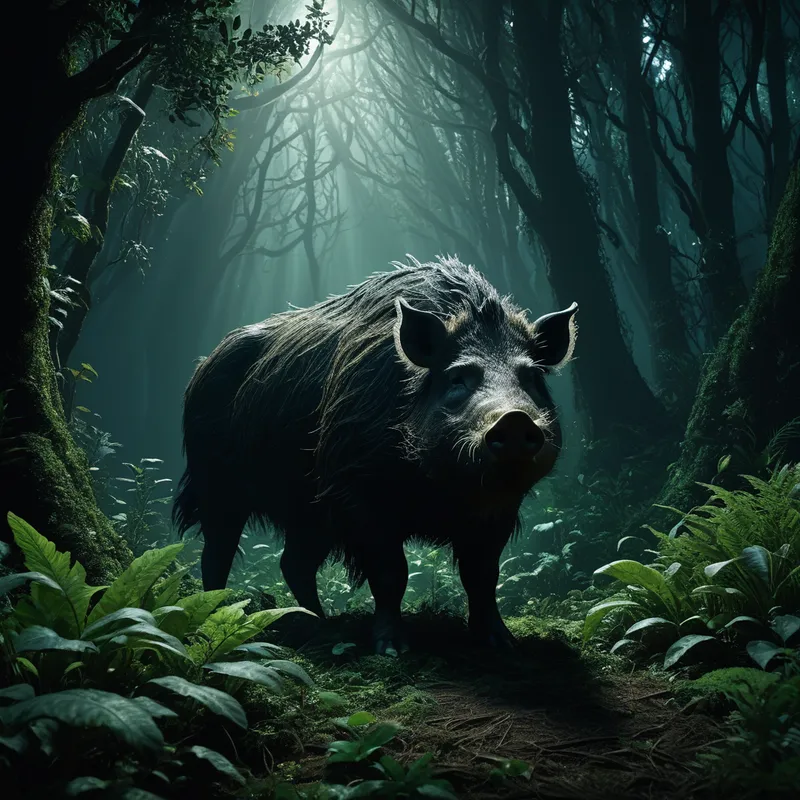
When the energy of Kamapuaʻa stirs in the modern moeʻuhane, it manifests as dreams of overwhelming, unchecked growth. One might dream of jungles invading a house, of fantastical gardens sprouting from one’s body, or of a powerful, compelling animal—often a boar or a creature of the earth—that is both terrifying and fascinating. There may be somatic sensations of sinking into mud, of being rooted, or of a surging, physical vitality.
Psychologically, this signals an uprising of the instinctual self. It is the psyche’s demand that the dreamer attend to long-neglected primal needs: creativity, sexuality, physical health, or a connection to nature. The “Kamapuaʻa complex” arises when the conscious personality has become too arid, too controlled, too identified with the “Pele” aspect of will and order. The dream is an eruption of the fertile shadow, a necessary chaos that seeks not to destroy the self, but to make it whole again by reintroducing its wild, generative half.
Alchemical Translation
The individuation process modeled by Kamapuaʻa’s saga is not one of slaying the beast, but of wedding it. The modern journey begins in a state of identification with one pole: we may be all rigid order and scorched-earth will (Pele), or we may be adrift in unmediated impulse and chaotic emotion (Kamapuaʻa). The conflict is inevitable and necessary.
The first alchemical stage is recognitio—seeing the opposing force not as a mere enemy, but as a divine counterpart. For the over-civilized individual, this means confronting the shameful, “swinish” parts of themselves—their appetites, their anger, their need for pleasure and dirt and growth. For the chaotic individual, it means facing the need for structure, discipline, and conscious direction.
The goal is not a bland compromise, but a sacred geography of the soul, where fire and water create a habitable, fertile world between them.
The final stage is coniunctio oppositorum—the conjunction of opposites. This is the truce, the division of domains, the symbolic marriage. Psychically, it translates to the establishment of a dynamic inner agreement. The conscious ego (Pele’s realm) agrees to acknowledge and provide space for the instinctual self. The instincts (Kamapuaʻa’s realm) agree to be channeled into life-giving, rather than purely destructive, forms. The result is a personality that can both create with fierce will and nurture with profound fertility. One becomes like the windward slope of the volcano: a place where the fire of spirit meets the waters of life, producing unparalleled abundance and depth.
Associated Symbols
Explore related symbols from the CaleaDream lexicon:
- Earth — The primary domain of Kamapua'a, representing the raw, fertile, and sustaining foundation from which all instinctual life and abundance springs.
- Forest — The wild, untamed realm of Kamapua'a's power, symbolizing the unconscious mind in its state of prolific, unstructured growth and hidden potential.
- Water — The elemental force Kamapua'a commands against Pele's fire, representing emotion, the unconscious, fertility, and the life-giving, adaptive power of the soul.
- Fire — The elemental force of Pele, representing transformation, will, consciousness, and the purifying/destructive power necessary for new creation.
- Fertility — The core gift and essence of Kamapua'a, symbolizing unchecked creative power, proliferation, and the instinctual drive for life and growth.
- Shadow — Kamapua'a embodies the archetypal Shadow, the untamed, instinctual, and often rejected aspects of the self that hold immense creative power.
- Transformation — The entire myth is an engine of transformation, depicting the alchemical change that occurs when primal opposites engage and reconcile.
- Trickster — Kamapua'a's primary archetype, using cunning, shape-shifting, and rule-breaking to challenge rigid order and introduce necessary chaos.
- Union of Opposites — The central theme of the myth's resolution, where fire and water, chaos and order, male and female principles find a dynamic balance.
- Journey — Kamapua'a's epic movement from unchecked wildness to reconciled divinity maps the internal journey of confronting and integrating the shadow.
- Rain — Kamapua'a's weapon and blessing, symbolizing the nourishing, softening, and life-giving aspect of the unconscious that quenches the arid ego.
- Kama — Echoing the root of his name, this symbolizes desire, attachment, and the generative urge that drives both creation and conflict.