Kamadeva's Arrows Myth Meaning & Symbolism
The god of desire is incinerated for awakening love in Shiva, then resurrected, symbolizing desire's destructive and redemptive power in the soul's alchemy.
The Tale of Kamadeva's Arrows
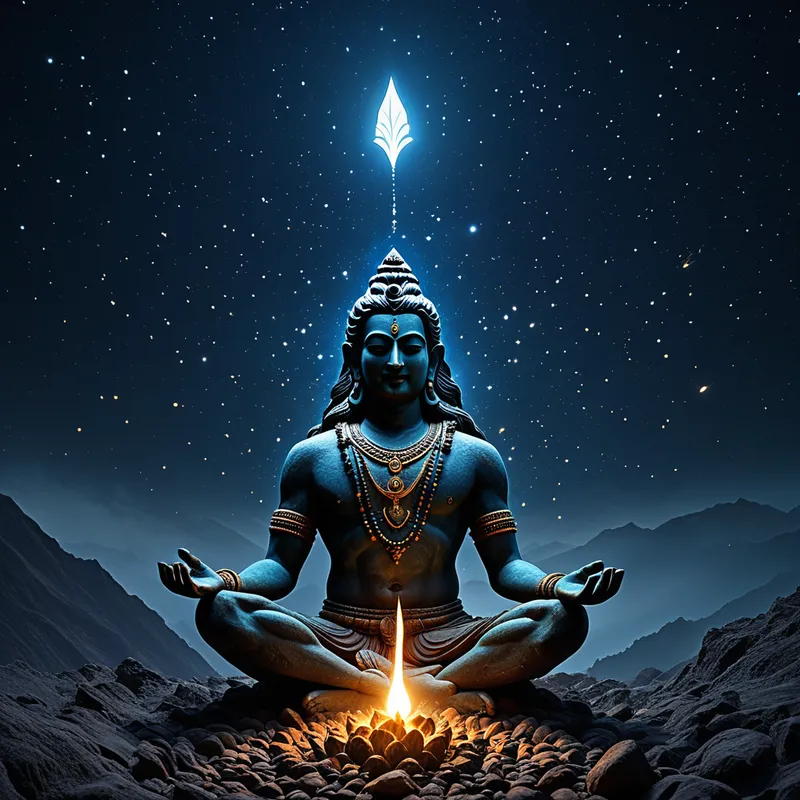
Listen, and let the fragrance of celestial blossoms carry you back to the dawn of an age. The cosmos was out of balance. A great demon, Taraka, had won a boon: he could only be slain by a son born of Shiva. But Shiva, the great Yogi, was lost in the fathomless depths of meditation. His grief for his first wife, Sati, had turned his heart to ice and his consciousness to stone. He sat upon the icy peaks of Mount Kailash, unmoving, his third eye closed, the world of passion and attachment a distant murmur beneath the eternal silence of his samadhi.
The gods trembled. Without Shiva’s passion, without the spark of creation, the universe would succumb to the demon’s tyranny. They convened in the hall of Indra, their celestial light dimmed by worry. Their eyes turned, as one, to the one being who could stir the still waters of the Absolute. They turned to Kamadeva.
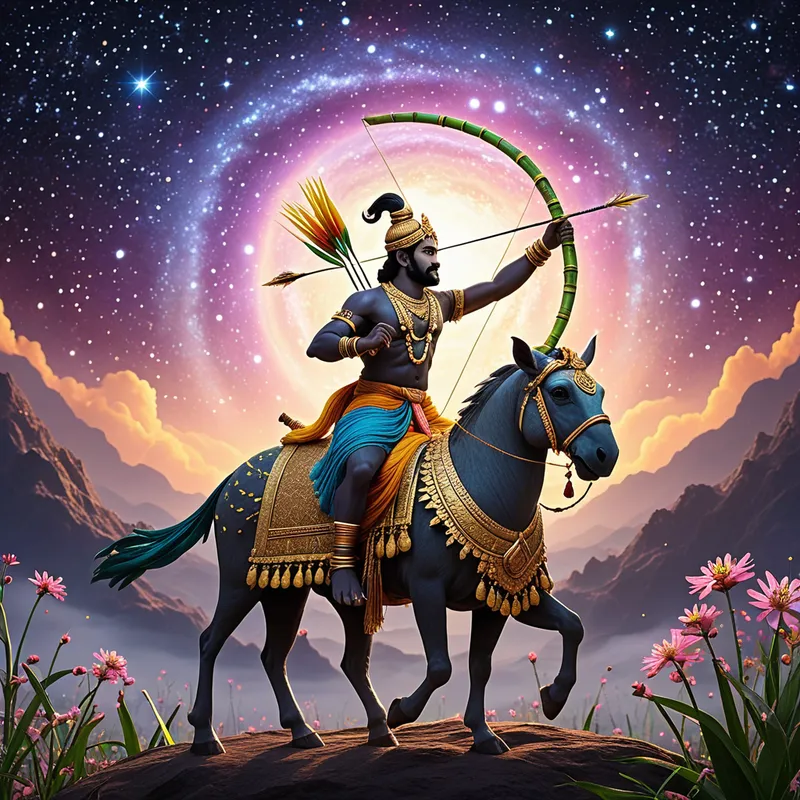
Kamadeva, the embodiment of longing itself. He who rides upon a parrot, whose bow is made of sugarcane, whose bowstring is a line of humming bees, and whose arrows are tipped with five intoxicating flowers. His very presence was spring incarnate; a glance from him could make the Himalayas bloom. His consort, Rati, clung to him, her eyes wide with a foreboding as deep as her love. The task was suicide. To disturb Shiva’s meditation was to invoke a fire that could consume all of existence.
Yet, for the sake of the worlds, Kamadeva consented. On a day when the air was thick with the perfume of longing, he approached the silent slopes of Kailash. Shiva sat, a statue of perfect austerity, smeared with ashes, serpents as his ornaments, the crescent moon cool upon his brow. Around him, the very air was frozen in reverence. Taking a deep breath that carried the scent of a thousand distant gardens, Kamadeva notched an arrow. He chose the lotus, the flower of infatuation that blooms in the murky waters of the heart. He drew his bow of sugarcane, the string of bees vibrating with a silent, potent hum.
He let the arrow fly.
It cut through the sterile silence, a streak of perfumed light. It found its mark, piercing the heart of the world’s great ascetic. In that instant, the universe held its breath. Shiva’s eyes fluttered open. Not the calm, detached gaze of the Yogi, but the blazing, furious eyes of the Destroyer. His meditation, his perfect equilibrium, had been shattered. The ice around his heart did not melt; it exploded into vapor. He looked, and he saw Kamadeva, the agent of this profound disturbance, this invasion of his sacred solitude.
A sound like the cracking of a thousand universes filled the void. From the center of Shiva’s forehead, his third eye blazed open. A column of pure, incinerating fire—the fire of tapas, of concentrated cosmic power—erupted and engulfed the beautiful god of desire. There was no scream, only a brilliant, terrible flash. Kamadeva, the form of desire, was reduced to ashes in an instant. The fragrance of spring was replaced by the acrid smell of annihilation. Rati’s wail echoed through the heavens, a sound of pure, desolate love.
But the arrow had done its work. Shiva’s gaze, now restless, fell upon Parvati, who had been performing austerities nearby to win him as her husband. Seeing her devotion, feeling the strange, new agitation in his own spirit, the seed of attraction took root. The universe had its spark. Yet, it was a world now bereft of Kamadeva, a world where desire itself had been annihilated. Rati pleaded with Shiva, for a world without longing is a world without life, without art, without progeny, without the pull of souls toward one another. Moved by her devotion and recognizing the necessity of the force he had destroyed, Shiva granted a boon. Kamadeva would be resurrected. But not as he was. He would live again, yet he would be ananga—the bodiless one. Desire would henceforth be an invisible force, felt in the heart but unseen by the eye, a pervasive, intangible power that moves all things.
Cultural Origins & Context
The myth of Kamadeva’s incineration and resurrection is primarily found in the Puranas, particularly the Shiva Purana and the Kalidasa's Kumarasambhava. It is a foundational narrative within the Shaiva (devotees of Shiva) tradition, but its themes resonate across the vast tapestry of Hindu thought. The story was not merely entertainment; it was a theological and philosophical discourse performed and recounted by bards, priests, and scholars.
Its societal function was multifaceted. On one level, it explained the nature of kama (desire) as a necessary, yet dangerous, cosmic principle. It established Shiva as the supreme ascetic, whose power is so absolute that even the god of desire is subordinate to his will. For the householder, it validated the place of desire and marital love within the cosmic order, sanctified by the eventual union of Shiva and Parvati. For the ascetic, it served as a potent warning and an ideal: the perfect yogi can incinerate desire itself. The myth thus served as a bridge between the path of renunciation (sannyasa) and the path of worldly duty (dharma), holding the tension between them in a single, dramatic story.
Symbolic Architecture
At its core, this myth is a profound map of the psyche’s relationship with Eros—not merely sexual love, but the fundamental principle of attraction, connection, and creative yearning.
Kamadeva represents the raw, instinctual force of desire. His weapons are not of violence but of seduction: sugarcane (sweetness), bees (buzzing, persistent attention), and flowers (beauty, fragility, blossoming). He is the psychic energy that compels beings out of isolation and into relationship, the catalyst for all movement, creation, and engagement with life.
Shiva represents the transcendent Self, the aspect of consciousness that seeks absolute unity, stillness, and dissolution of all separate, desiring egos. His meditation is the state of pure being, prior to and untouched by the dualities of attraction and aversion. The third eye is the eye of wisdom and annihilation—not of destruction for its own sake, but of the dissolution of illusion. It sees through the form of desire to its potentially binding nature.
The arrow that wounds the god is also the spark that resurrects the world. The same force that disturbs our peace is the one that stirs us to create.
The incineration symbolizes the necessary, often brutal, confrontation between the ego’s desires and the Self’s demand for wholeness. To move toward individuation, the personal, grasping form of desire (Kamadeva as a separate deity) must be sacrificed. It is the “dark night of the soul” where all that we thought we wanted is burned away in the fire of a deeper truth.
The resurrection as Ananga, the bodiless one, is the crucial alchemical stage. Desire is not eliminated; it is transmuted. It is no longer a foreign god attacking us, but an invisible, pervasive energy within the unified field of the psyche. It becomes the libido in the Jungian sense—the general life force that fuels not just personal romance, but creativity, spiritual seeking, and the connecting principle of the universe itself.

The Dreamer's Resonance
When this myth patterns a modern dream, it speaks of a profound psychic initiation. To dream of being struck by an unseen arrow, followed by a sense of burning or disintegration, is not necessarily about literal romantic love. It signals that a core, perhaps dormant, part of the dreamer’s being—their capacity for deep passion, creative fire, or soulful connection—has been activated by an encounter, an idea, or an inner calling.
The somatic experience might be one of sudden, piercing insight (the arrow) followed by anxiety, feverishness, or a feeling of being “burned out” (Shiva’s fire). The dreamer may feel their old, stable identity—perhaps a persona of cool competence, emotional detachment, or rigid control—being threatened or dissolved by this new, compelling energy. They are in the space between Kamadeva’s arrow and his resurrection, where the form of their old desires is ash, but the new, integrated form has not yet taken shape. The dream is the psyche’s dramatic enactment of this critical, destabilizing, and ultimately creative process.

Alchemical Translation
The journey of Kamadeva models the individuation process with startling clarity. It begins with a state of imbalance: the conscious attitude (the gods/ego) is powerless against a looming, monolithic problem (the demon Taraka/neurosis, stagnation). The solution lies in engaging a powerful, instinctual force from the unconscious (Kamadeva/desire, libido).
The conscious ego’s attempt to use this force leads to a catastrophic confrontation with the Self (Shiva). The personal, willful, grasping mode of desire is annihilated. This is the painful but essential stage of nigredo, the blackening, where the ego’s plans are incinerated. The individual may feel they have lost their passion, their motivation, their very spark for life. It is a spiritual crisis.
Individuation is not the killing of desire, but the marriage of desire and consciousness. The bodiless god is the symbol of love that is free of possession, a creative current flowing through a surrendered self.
The resolution is not a return to the previous state, but a transmutation. Through the devotion of the feeling function (Rati, who represents the heart’s fidelity to love itself), a reconciliation is brokered. The boon of Shiva is the grace of the Self. Desire is reborn, not as a personal whim, but as ananga—as the invisible, guiding impulse of the libido aligned with the deeper purpose of the Self. The individual no longer has desires that control them; they are a vessel for a creative, connecting force that moves through them. The union of Shiva and Parvati that follows symbolizes the sacred marriage (hieros gamos) within the psyche: the conscious mind (Shiva as awareness) is now wedded to the anima (Parvati as embodied, devoted power), and from this union, the divine child—the new, integrated consciousness—is born.
Thus, Kamadeva’s arrows are not merely about falling in love. They are about being struck by the archetypal force that compels us out of isolation, through the fire of our own resistance, and into a more profound, creative, and connected state of being. We are all, at times, both the target of the arrow and the source of the fire that transforms it.
Associated Symbols
Explore related symbols from the CaleaDream lexicon: