Kali's Night Myth Meaning & Symbolism
The goddess Kali, born from fury, defeats a demon but loses herself in a dance of destruction until Shiva intervenes, restoring cosmic balance.
The Tale of Kali's Night
Listen, and let the veil between worlds grow thin. The air was not air, but the hot, metallic breath of fear. The earth trembled not from quakes, but from the marching of a legion born of arrogance. The demon-king Shumbha, drunk on stolen power, had cast the gods from their celestial thrones. His brother Nishumbha laughed, a sound like grinding stones, as their armies, the asuras, painted the heavens black with their banners.
The gods, broken and radiant with despair, fled to the mountain peaks where the snow meets the silence of eternity. There, they gathered before the primordial parents, Vishnu and Devi. From their collective anguish—a searing, concentrated fury—a terrible light began to coalesce. It was not the light of dawn, but of ending. From the brows of the gods, their rage physically distilled, streamed forth a river of liquid fire. This cosmic wrath pooled, swirled, and took form.
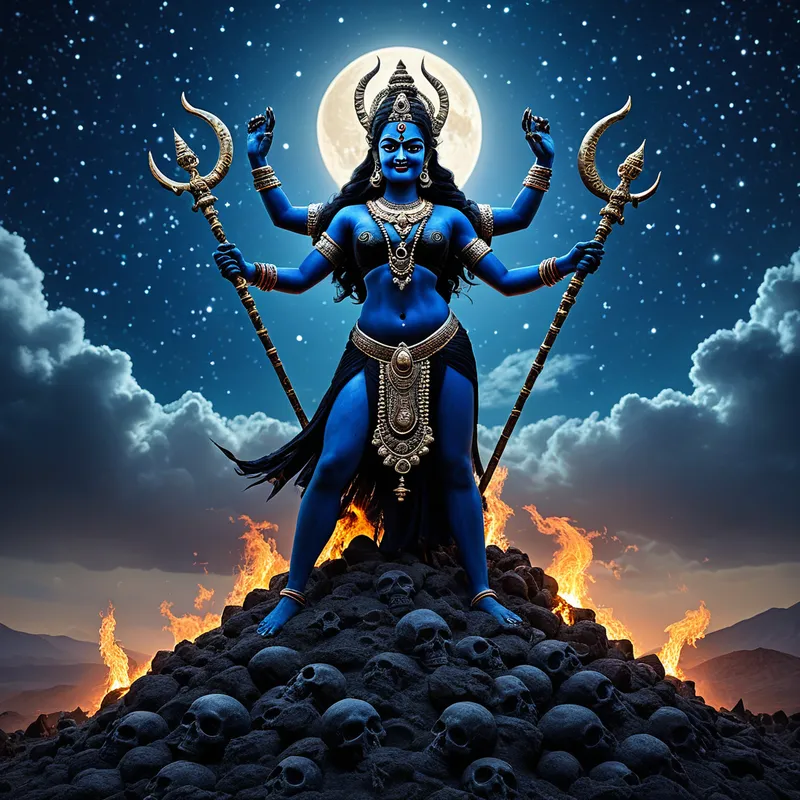
She emerged. Not born, but unleashed. Her skin was the blue-black of a midnight sky moments before the storm. Her eyes held the void and the forge of stars. Her hair, wild and free, flowed like a river of darkness. Around her neck hung a garland of fifty-one skulls, each a fallen ego. In her many hands she held the khanda, the trident, a severed head, and a bowl to catch the blood of the arrogant. This was Kali, the Dark Mother, the Power of Time.
Her roar was the shattering of universes. She descended upon the battlefield, and where she danced, the world unmade itself. She did not fight the asura army; she consumed it. With a grace that was terrifying, she whirled, and with each movement, a thousand demons ceased to be. She sought out Shumbha and Nishumbha. The battle was not a contest; it was a revelation. She defeated Nishumbha, then turned her gaze to Shumbha. In his final, futile attack, the demon king assumed a million forms—beasts, warriors, elements. Kali, laughing a laugh that echoed in the marrow of creation, simply opened her mouth and drank the cosmos of his illusions, swallowing him whole.
But the dance did not stop. The fury, once awakened, knew no enemy left to slay. It turned upon the world itself. The earth ran red. The heavens wept ash. Kali’s ecstatic, destructive dance threatened to unravel the very fabric of reality, to burn the cosmic order back to the primordial soup from which it sprang.
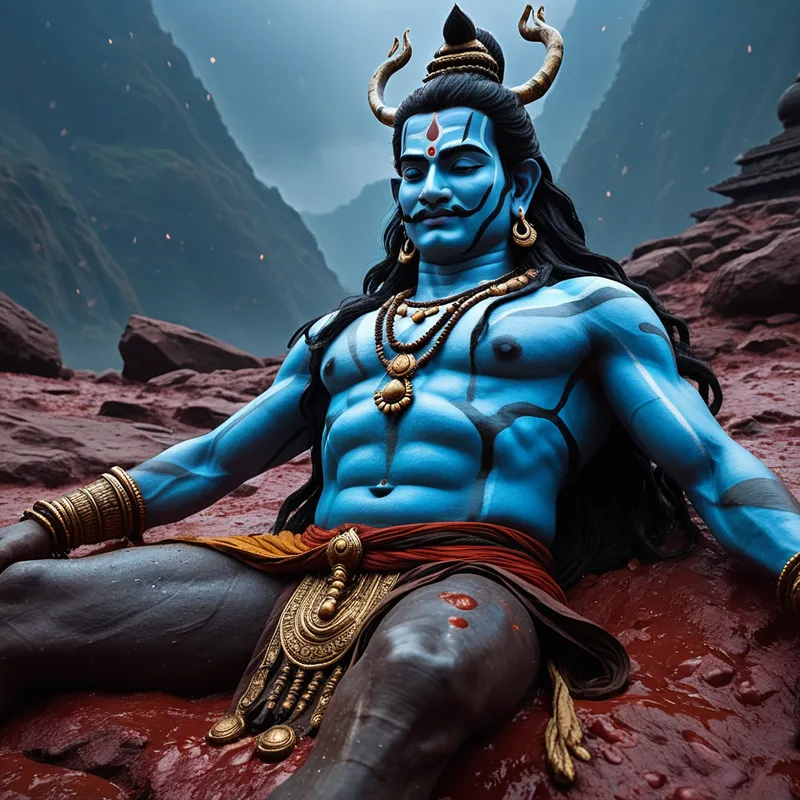
The gods, who had summoned her, now cowered from their own salvation. They turned in desperation to the one being who understood both absolute stillness and absolute dissolution: Shiva, the great ascetic. Shiva saw not a monster, but his own beloved consort, lost in the intoxicating wine of her own limitless power. He did not raise a weapon. He did not chant a mantra. With infinite compassion, he walked onto the blood-soaked field and lay down among the dead, directly in the path of her catastrophic dance.
Kali, lost in the whirlwind of her being, did not see him—until her foot came to rest upon his still, silent chest. The contact was an electric shock to the cosmos. She looked down. She saw her lord, her other half, the still point to her turning world, lying beneath her. In that instant, the rage shattered. The wild dance halted. Her tongue, which had been lolling in fierce delight, snapped back into her mouth in a gesture of sudden, profound shame and awareness. The night of destruction ended. In the sudden, ringing silence, Kali stood transformed, the protector once more, her fury re-assimilated into the calm of divine consciousness. The long night was over; balance was restored, not through force, but through love’s ultimate sacrifice: becoming the ground for the other’s awakening.
Cultural Origins & Context
The myth of Kali’s Night is woven into the fabric of the Devi Mahatmya, a seminal text within the Shakta tradition, which dates to roughly the 5th-6th century CE. This was not a story told merely for entertainment; it was a liturgical and philosophical cornerstone, recited during the festival of Navaratri. Its societal function was multifaceted. For the collective, it explained the necessity of divine intervention against forces of chaos (adharma) and affirmed the Goddess as the ultimate, sovereign power (Shakti) behind all cosmic functions, even the terrifying ones.
For the individual devotee, the story served as a profound map of the psyche. It was transmitted by priests and storytellers not to induce fear of a bloodthirsty goddess, but to initiate the listener into a radical theological truth: the Divine is not only the benevolent creator and sustainer but also the terrifying dissolver. To worship Kali was to acknowledge the full spectrum of existence—life, death, creation, destruction—as sacred. Her myth provided a container for humanity’s deepest fears of chaos, violence, and the feminine power that exists beyond societal control, transforming that fear into a source of awe and, ultimately, liberation.
Symbolic Architecture
Kali represents the unbound, raw power of nature and psyche—the Shadow in its most potent, archetypal form. She is not evil; she is necessary. She is the force that dismantles structures that have become corrupt, rigid, or outgrown their purpose, whether they are demonic armies, inflated egos, or outmoded ways of being.
Kali is the psychological truth that before integration must come disintegration; before healing must come the ruthless excision of the diseased tissue.
The demons Shumbha and Nishumbha symbolize the tyranny of the usurping ego—the aspects of consciousness that claim absolute authority, denying their dependence on the deeper, often darker, wellsprings of life (the Goddess). Kali’s subsequent rampage represents a critical danger in any profound transformation: the liberated power, once activated, can become autonomous and self-perpetuating, threatening to destroy the very psyche it sought to save. This is the revolution that consumes its own children, the therapy that shatters the patient.
Shiva’s act is the masterstroke of the myth’s symbolism. He represents pure, witnessing consciousness—the Atman or the transcendent function of the psyche. He does not oppose Kali; he receives her. By becoming the ground of her dance, he provides the container her boundless energy lacks. His prone body is the ultimate symbol of conscious surrender, not as weakness, but as the strongest possible act: the ego’s willingness to die, to be trampled, so that the whole Self may be realized.
The Dreamer's Resonance
When this myth stirs in the modern dreamer, it signals a profound encounter with the autonomous, transformative complexes of the deep unconscious. To dream of a boundless, chaotic, yet magnetically powerful feminine force—whether as a specific figure, a storm, or a consuming black wave—is to dream of Kali’s energy erupting into one’s psychic life.
The somatic experience is key. The dreamer may awaken with a racing heart, a sense of awe and terror, or the visceral memory of a power both terrifying and exhilarating. Psychologically, this indicates that a long-repressed aspect of the Self—perhaps rage, grief, wild creativity, or primal instinct—has broken its chains and is now active. The dreamer is in the "battlefield" phase. The old, rigid structures of the personality (the "demons" of over-control, perfectionism, or false personas) are being violently dismantled. The danger, mirrored in the myth, is that this process can feel endless and self-destructive, leading to fears of madness or complete dissolution. The dream is the psyche’s dramatic enactment of this critical, chaotic, yet ultimately purposive phase of death-and-rebirth.
Alchemical Translation
The alchemy of Kali’s Night models the individuation journey’s most harrowing and essential transit: the nigredo, or blackening, where the prima materia of the soul is dissolved in its own shadow. The modern individual’s "Shumbha" is the complex of accumulated identities, defenses, and pride that must be overthrown for growth to occur. We must, in a sense, summon our own "Kali"—confront the repressed fury, the denied desires, the unacknowledged grief. This is the "night" of therapy, the dark night of the soul, the crisis that feels like it will destroy us.
The pivotal transformation is not the slaying of the demon, but the moment Kali steps on Shiva. This is the alchemical coniunctio, the sacred marriage of opposites. Psychologically, it is the moment the ego (Shiva) stops fleeing or fighting the unconscious power (Kali) and instead offers itself—its identity, its control—as a sacrifice to that power. It is saying, "Here I am. Do your work. I will not run."
The triumph is not in controlling the darkness, but in having the courage to lie down before it, to be vulnerable to its transformative tread.
From this conscious surrender, the albedo (whitening) emerges. The chaotic energy is integrated, not expelled. The furious goddess becomes the protective mother; the terrifying shadow becomes a source of immense strength and creativity. The individual does not return to who they were before the "night." They are remade. They now carry within them both the stillness of Shiva and the transformative power of Kali, a living embodiment of the balance that holds chaos and order, destruction and creation, in a sacred, dynamic, and ultimately loving tension. This is the alchemical gold forged in the darkest night.
Associated Symbols
Explore related symbols from the CaleaDream lexicon: