Kali Yuga Myth Meaning & Symbolism
The myth of the final, dark age in Hindu cosmology, where virtue decays, truth is obscured, and the world awaits a divine renewal.
The Tale of Kali Yuga
Listen. The air grows thin, the light grows dim. We have entered the time of chaff, not grain; of rust, not gold. This is the Kali Yuga, the Age of Kali, and its story is not one of beginning, but of a long, slow falling.
It began not with a bang, but with a sigh—the last, weary exhalation of the previous age, the Dvapara Yuga. The great avatar Krishna had departed the earthly realm. With his passing, a celestial weight lifted from the world, and in its place rushed in a cold, whispering wind. The axis of Dharma, which once stood firm as a pillar of light, began to tremble. It did not shatter, but tilted, casting longer and longer shadows.
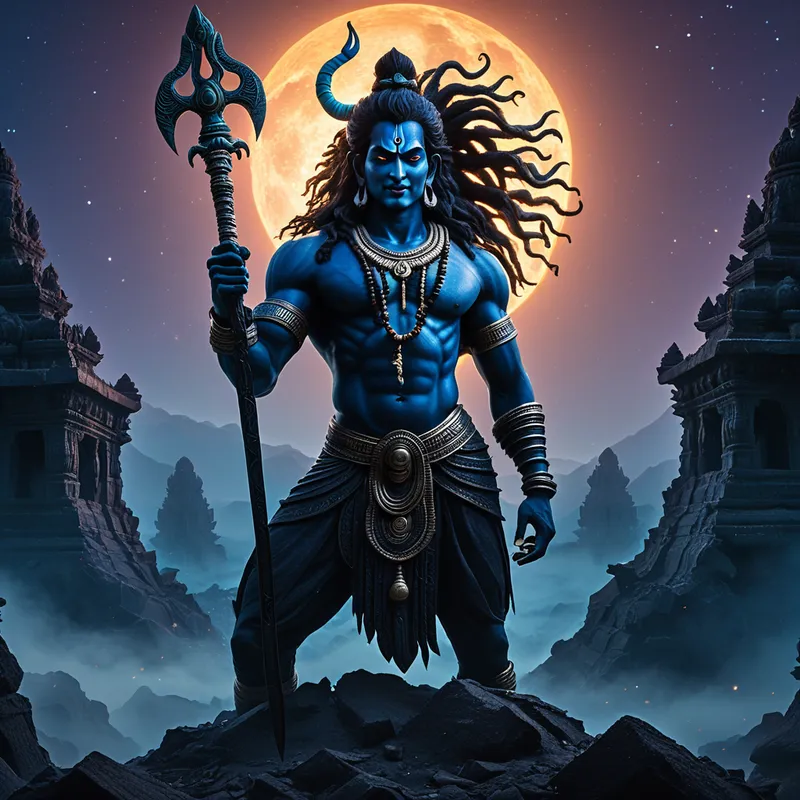
Into this slanting light stepped Kali. He is not a demon of fire and fury, but a sovereign of decay. Dark-skinned, with eyes that reflect a barren sky, he took the form of a king. But this king carried no scepter of justice. In his hands were a dice set, loaded with deceit, and a rusted sword, not for protection, but for petty theft. He did not conquer cities with armies; he infiltrated hearts with whispers. "What is yours is mine," he murmured into the ear of the merchant, who then short-changed the farmer. "Appearance is everything," he sighed to the priest, who began to chant for coin, not for grace.
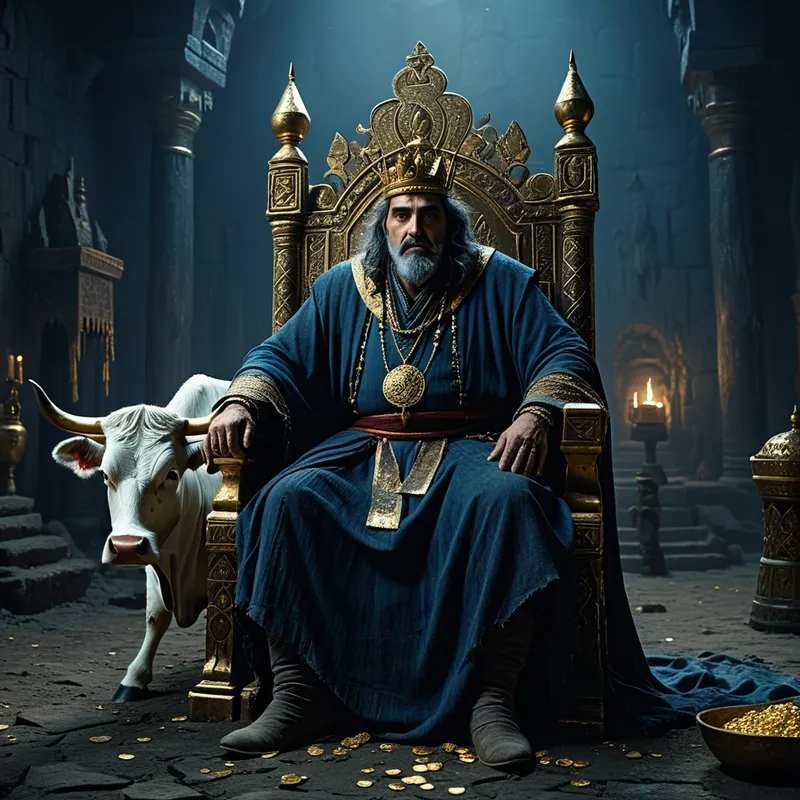
The sacred cow of plenty, Kamadhenu, was found bleeding in the street, not from a tiger's claw, but from the knife of a neighbor arguing over a property line. The earth herself grew weary, her soils yielding less, her rivers running shallow and bitter. Truth, Satya, put on a cloak and hid in the deepest forests, speaking only in riddles to those who dared seek her. Lies wore crowns and sat in halls of power, their voices amplified by a thousand tongues.
Families turned to strangers, and strangers turned to enemies. The wise man was mocked in the marketplace; the loudest fool was called a leader. The bond between teacher and student frayed into a transaction. This is the rising action—not a battle, but a sinking. A sinking of standards, of trust, of the very sap of life. The world grows old, its bones creak, and its memory fades. It forgets it was ever young, ever pure, ever whole.
And the resolution? It is not an end, but a promise written in the seed of the ending itself. For when the weight of Kali's foot presses Dharma down to but a single, fragile point, when the last candle of conscience gutters in the universal storm… then, it is said, the tenth avatar, Kalki, will come. Riding a white horse, blazing like a comet of dawn, he will not reform, but cleanse. He will close the ledger of this long, dark accounting. The story pauses here, on the knife-edge between the deepest night and the impossible first light of a new cycle, waiting for the dawn that is both an ending and a beginning.
Cultural Origins & Context
The myth of the Yugas is not a singular story from one text, but a cosmological framework woven throughout the epic and Puranic literature of India. Its most detailed expositions are found in texts like the Mahabharata and the Puranas, particularly the Vishnu Purana and the Bhagavata Purana.
This was not a myth told to children at bedtime, but a sophisticated theological and philosophical concept used by sages and scholars to explain the nature of historical time, moral entropy, and the cyclical nature of existence. It functioned as a societal mirror and a moral compass. By describing the symptoms of the Kali Yuga—the corruption of leaders, the breakdown of social bonds, the disrespect for knowledge—the myth provided a diagnostic tool for the culture’s own ills. It was a story that said, "This decay is not random; it is part of a vast, predictable cycle. Your suffering has a context within the cosmos." This offered not despair, but a strange kind of solace and a call to personal, interior fortitude, as the societal structures meant to uphold Dharma were seen as inevitably weakening.
Symbolic Architecture
The Kali Yuga is perhaps the most profound psychological myth of decay and shadow-integration ever conceived. It is not about an external apocalypse, but an internal one. Kali, the personified age, is the ultimate symbol of the shadow made king. He represents the collective acceptance of our basest instincts—greed as commerce, deceit as strategy, selfishness as survival.
The Kali Yuga is the psyche's long winter, where the leaves of virtue fall so the roots of consciousness can be forced to seek deeper, unseen waters.
The decaying Dharma is not merely social justice, but the internal alignment of the self. The "shortening of lifespans" symbolizes the shortening of attention, patience, and spiritual memory. The "disappearance of the sacred" marks the repression of the numinous, the transcendental, in favor of the purely material and immediate. The entire myth is a grand metaphor for the process of enantiodromia—where any prevailing conscious principle, when pushed to its extreme, inevitably generates its unconscious opposite. The golden age of pure truth (Satya Yuga) contains the seed of its neglect, which grows into the iron age of pervasive falsehood.
The Dreamer's Resonance
When this myth stirs in the modern dreamer, it rarely appears as a dark-skinned king. It manifests as the somatic and emotional texture of the age itself. One dreams of being lost in a vast, bureaucratic building where all the doors are identical and none lead outside—the labyrinth of meaningless process. One dreams of trying to shout a vital warning, but the voice is silent, or the words come out as gibberish—the failure of true communication. One dreams of watching a beloved, ancient tree being slowly poisoned, feeling profound grief but a paralyzing inability to stop it.
These dreams signal a profound psychological process: the conscious confrontation with inner and outer decay. The dreamer is feeling the weight of the collective shadow, the "Kali" within and without. It is a process of disillusionment, where the gilded surfaces of life—career, status, certain relationships—reveal their hollow core. The body may respond with chronic low-grade fatigue, a sense of heaviness, or anxiety that has no single source. This is the soul experiencing the "thinning of the air" in the Kali Yuga, recognizing the pervasive malnutrition of the spirit in a world obsessed with the quantifiable.
Alchemical Translation
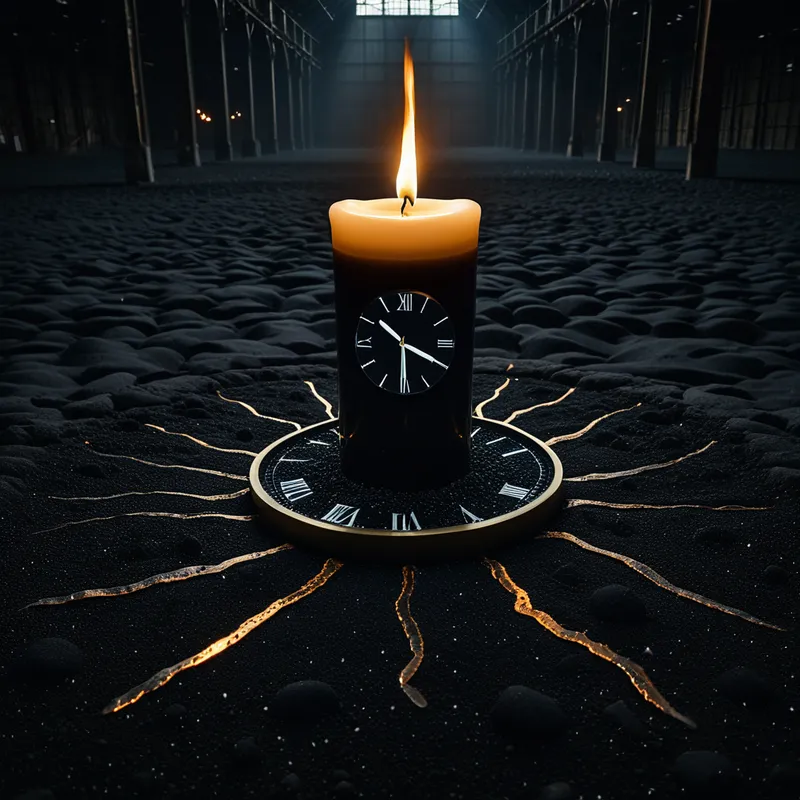
The alchemical journey modeled by the Kali Yuga is the most arduous of all: the nigredo. It is the conscious descent into the darkest phase, not to glorify it, but to transmute it. The myth tells us that enlightenment in this age is not found by building a brighter light atop the mountain, but by becoming the single, unwavering candle in the heart of the warehouse of decay.
The triumph of the Kali Yuga is not to escape the age, but to become the secret, unshakable axis of Dharma within it. The rebel archetype is not one who fights the outer darkness with sword and shield, but who guards the inner light with relentless, quiet integrity.
The first step is recognition—seeing the Kali in our own rationalized greed, our cultivated cynicism, our participation in systems of decay. The second is endurance—the "holding of the posture" like the last pillar of Dharma. This is the practice of maintaining compassion when met with cruelty, speaking truth when surrounded by lies, and valuing wisdom over information. This endurance is the alchemical fire.
Finally, the myth points to the seed of Kalki within. This is not a passive waiting for a savior, but the active cultivation of the inner avatar—the part of the self that can, with clear-eyed ruthlessness, cut away the petrified structures of a dead personality to make way for the new. The promised "end" of the Yuga is not a historical event we await, but the psychological moment when the individual consciousness, having fully integrated the lessons of the shadow (Kali), undergoes a radical, purifying renewal, birthing its own new cycle of being from the ashes of the old. The white horse of Kalki is the purified will, charging through the ruins of illusion.
Associated Symbols
Explore related symbols from the CaleaDream lexicon: