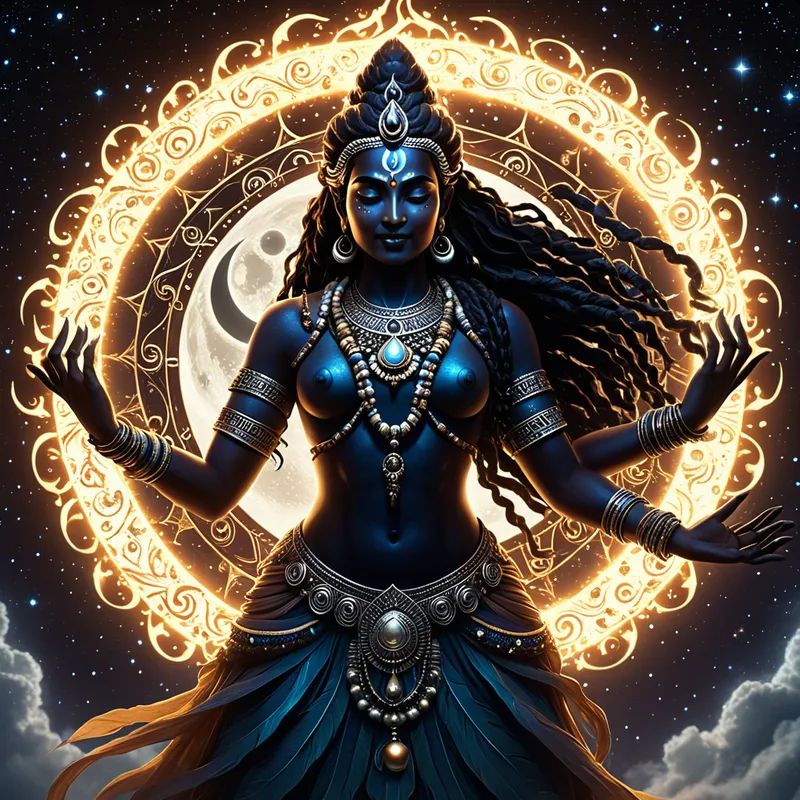
Kala Myth Meaning & Symbolism
The story of the god Shiva, as Kala, confronting the arrogance of death itself, revealing time as the ultimate, all-devouring truth.
The Tale of Kala
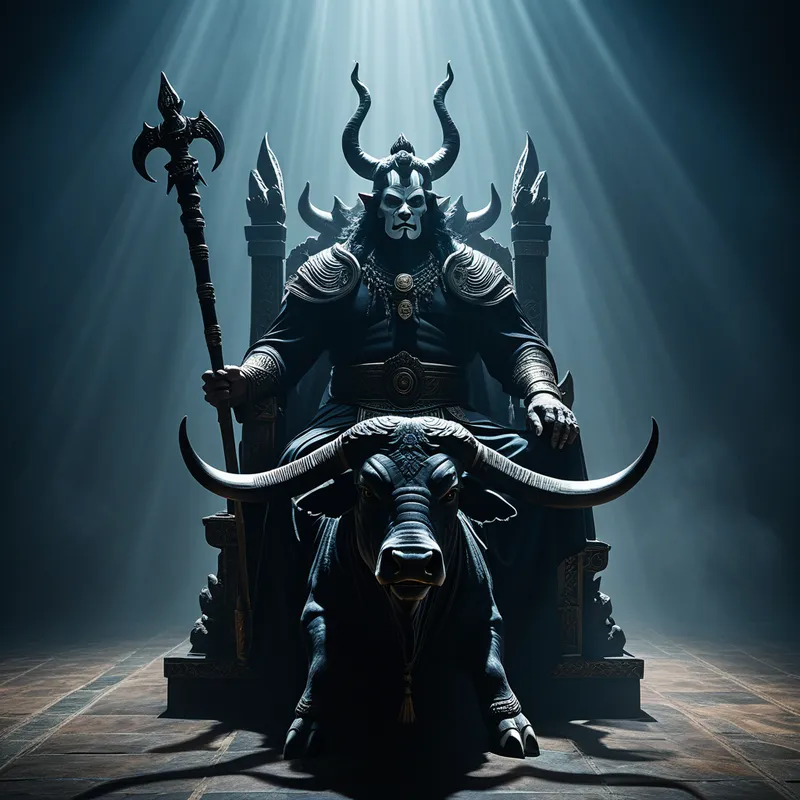
Listen. In the hall of Yama, where the air is still with final judgment, a shadow grew where no shadow should be cast. Yama, the stern lord, the first mortal to die and thus the king of the departed, sat upon his throne of iron law. His eyes, like polished coal, saw the end of all things. His noose, the pasha, was coiled at his side, cold and patient. He was the ultimate authority, the final accountant of karma.
But on this day, a petitioner arrived who did not bow. He was a sage named Markandeya, a youth destined to die at sixteen, yet who clung to life through fierce devotion. When Yama’s messengers came, they found the boy wrapped around the Shiva Linga, his heart a drumbeat of prayer. The noose fell, encircling both boy and stone. And from that stone, a sound emerged—not a roar, but the silence at the end of a universe. A form erupted, terrible and beautiful.
It was He, but not as the serene ascetic. This was Kala. His skin was the darkness between stars, his throat held the poison of existence, and his eyes held the birth and death of galaxies. He wore a garland of skulls that were not trophies, but moments—each a life, an age, a cosmos, consumed. “You dare,” the form thundered without sound, its voice the grinding of tectonic plates, “to cast your noose around that which is beyond your domain?”
Yama, the lord of death, felt a chill that was not of his realm. His authority, which had seemed absolute, was as a child’s decree before the ocean tide. Kala raised a foot. It was not a step, but an unfolding. The hall of judgment cracked. The ledgers of karma ignited into ash. Yama’s mighty buffalo, his vahana, lowed in primal fear. The noose, the pasha, meant to bind souls, shriveled and fell useless. In that moment, Yama did not see a rival god. He saw the canvas upon which he himself was painted. He saw the devourer who would, at the end of all cycles, consume even Shiva. He saw Time itself, for which death is but a servant.
And in seeing, he understood. He prostrated, not in defeat, but in realization. The arrogance of ruling death melted before the truth of being an agent of Time. Kala’s fury softened into the inevitable. He blessed Markandeya with eternal youth, a bubble outside the stream he governed. And Yama was restored, but forever changed—his lordship now a conscious duty within a greater, terrifying order.
Cultural Origins & Context
The myth of Kala emerges from the deep philosophical strata of Hindu thought, particularly within the Shaiva tradition. It is most famously recounted in the Shiva Purana and the Mahabharata. These texts were not mere scriptures but living narratives performed by storytellers and priests, designed to convey complex dharmic and metaphysical principles to both royalty and commoner.
The story functions as a theological cornerstone, establishing the hierarchy of cosmic principles. It addresses a fundamental human question: if Yama is death, what is greater than death? The answer, woven into this dramatic narrative, is Time (Kala). This myth served to contextualize the role of death (Yama) within the broader, cyclical Hindu cosmology of creation, preservation, and dissolution (srishti, sthiti, samhara). It taught that even divine administrators are subject to the supreme law of impermanence.
Symbolic Architecture
At its core, the myth is a map of consciousness confronting its own boundaries. Yama represents the psychological principle of limit, judgment, and the ego’s attempt to impose final order. He is the part of the psyche that says, “This is the end. This is your due. Your story stops here.” He is necessary, for without limit and consequence, there is no form, no individual identity.
Kala is the realization that all forms, even the form of the ego and its judgments, are temporary expressions within a boundless, transformative flow.
Kala symbolizes the unconscious psyche in its ultimate aspect—not personal, but transpersonal. It is the Self (in the Jungian sense) as the timeless ground of being that paradoxically manifests as all-devouring time. Markandeya represents the individual soul (jiva) whose sincere devotion (a focused connection to the transcendent) temporarily exempts it from the laws of the limiting principle, allowing a direct encounter with the ultimate reality. The Shiva Linga is the axis mundi, the point where the infinite pierces the finite, the conduit to the source.
The crushing of Yama’s pride is not a destruction of order, but its subordination to a higher truth. It is the ego’s shocking, humbling, and ultimately liberating discovery that it serves a master it can never fully comprehend.

The Dreamer's Resonance
When this myth stirs in the modern unconscious, it often manifests in dreams of overwhelming, impersonal forces. One may dream of tidal waves swallowing cities, of vast black holes, of entire landscapes being erased, or of a faceless, authoritative figure (a boss, a judge, a parent) being rendered powerless by a silent, expanding darkness.
Somatically, this can correlate with feelings of profound exhaustion, the collapse of carefully maintained structures, or anxiety around deadlines and aging—not as fear of specific events, but of the erosion of self by time. Psychologically, the dreamer is at a point where a long-held identity, a self-concept (the “Yama” within that says “I am this, and this is my limit”), is being confronted by a deeper truth from the Self. It is the psyche’s process of initiating a necessary dissolution. The terror in the dream is the ego’s terror of its own relativization, its reduction from absolute ruler to a passing phenomenon.

Alchemical Translation
The alchemical journey modeled here is the nigredo—the blackening, the dissolution of all fixed elements. In individuation, we must all have our “Yama moment.” We build personas, careers, beliefs, and self-images, and for a time, we rule our inner kingdom with their logic. Then, life—through loss, crisis, or the simple accumulation of years—sends Kala. Our certainties are proven temporary. Our judgments are shown to be partial. Our throne of identity cracks.
The triumph is not in defeating time, but in surrendering to its truth, thereby transforming mortality from a sentence into a sacrament of the eternal.
This is the alchemical gold: the realization that our true identity is not the form that is dissolved, but the awareness that witnesses the dissolution. Markandeya’s eternal youth is not literal immortality, but the birth of the “witness consciousness” (Sakshi) that is untouched by the play of time. The process demands we let our inner Yama be humbled—to release our rigid control, our final judgments on ourselves and our lives. We integrate Kala by accepting impermanence not as a threat, but as the very nature of reality, which liberates us to participate fully in the fleeting, beautiful drama of existence, knowing we are, at essence, the boundless stage upon which it plays.
Associated Symbols
Explore related symbols from the CaleaDream lexicon: