Kairos Myth Meaning & Symbolism
The myth of the winged god Kairos, who represents the critical, fleeting moment of opportunity that must be seized by the forelock before it passes forever.
The Tale of Kairos
Listen. There is a moment that is not like the others. It does not march with the steady, plodding beat of Chronos. It arrives on silent, feathered heels. It is the god Kairos.
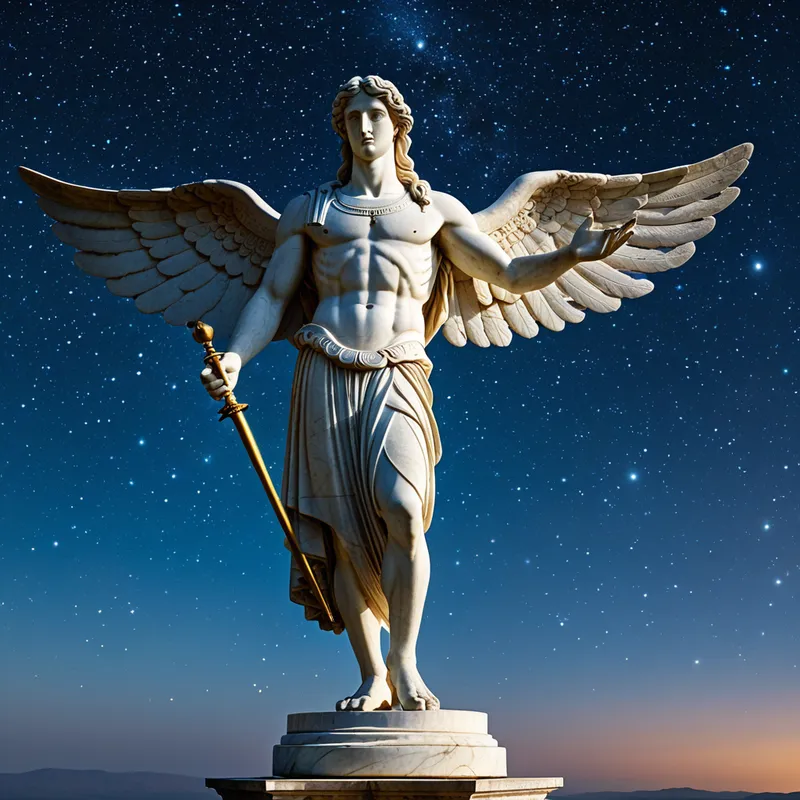
Picture him not as an old king, but as a youth in the very prime of possibility. His body is taut with potential, his gaze sharp and forward-looking. Upon his feet are wings, not for lofty flight, but for the swift, decisive dart—the arrival that is also already a departure. He stands, impossibly, upon the edge of a razor, a blade so fine it divides what is from what could be. In one hand, he holds the scales of destiny, perfectly balanced for an instant.
But look at his hair. This is the secret. From the back of his head, he is bald. Smooth as a polished stone, offering nothing to grasp. But from his brow flows a long, thick forelock, falling over his face and streaming out before him.
He does not announce himself with thunder. He comes on a whisper of changed air, a sudden alignment of shadow and light. You feel him in the prickling of your skin, the quickening of your pulse—the undeniable sense that now. The door, which was forever shut or not yet formed, is open. The path, which was tangled and obscure, is clear. But it is a clarity that flickers.
He is passing you. If you hesitate, if you ponder, if you wait for a better sign, you will see only the back of his smooth, unholdable head. Your hand will close on empty air. The moment, the god himself, will be gone. But if you are awake, if your spirit is poised like his feet upon that blade, you will leap. You will reach out not for the god, but for what he offers: that single lock of hair streaming forward. Seize it, and the momentum carries you with him. The scales tip. The path is taken. The deed is done.
He does not look back. There is no second passing. The razor’s edge is behind you, and the wings are already beating toward the next crossroads, the next waiting soul. You are left, breathless, in the new world your courage has purchased.
Cultural Origins & Context
The figure of Kairos emerges from the rich soil of ancient Greek thought, a culture deeply concerned with fate, excellence, and the nature of time. While Chronos was quantified and measured—the time of sundials, seasons, and lifespans—Kairos was qualitative. He was the "right time," the critical juncture.
He was not a major Olympian with sprawling temples, but a daimon, a personified spiritual force. His most famous physical representation was a lost bronze statue by the sculptor Lysippos in the 4th century BCE, described by poets and historians. This statue was a philosophical and rhetorical teaching tool. Orators were taught to recognize the "kairotic moment" in a speech—the precise instant to introduce a decisive argument. Athletes knew it as the split-second opening for a winning move. Physicians saw it as the crisis point in an illness, turning toward death or recovery.
The myth was passed down not in epic poems of war, but in the teachings of philosophers, the manuals of rhetoricians, and the proverbs of common wisdom. Its societal function was pedagogical and psychological: to train the citizen, the artist, the leader, to cultivate a state of readiness. It taught that destiny (Moira) was not a blind, pre-written script, but a tapestry whose threads included one's own capacity to recognize and act at the fulcrum of events.
Symbolic Architecture
Kairos is the archetypal symbol of qualitative time, the puncture in linear causality where free will and fate perform their delicate dance.
Kairos is the universe offering a handshake; to clasp it requires that your own hand is already extended.
The winged feet symbolize the transient, fleeting nature of opportunity. It cannot be chased down; it arrives and must be met. The razor's edge represents the supreme precision of the moment—the line between success and failure, action and inaction, which is infinitely fine. The scales speak to the moment of perfect balance, where forces are equipoised and the slightest action can tip the outcome.
But the central, profound symbol is the hair. The bald back of the head signifies that once the moment has passed, it is gone irrevocably. You cannot grab it from behind. The long forelock, however, is the handle presented to the one who is facing the future. To seize it, you must be in front of the moment, poised for what is coming, not clinging to what is receding. It is an emblem of proactive engagement with destiny.
Psychologically, Kairos represents the ego's encounter with the Self's timing. It is the eruption of synchronicity—a meaningful coincidence—into ordinary consciousness. It is the call to individuation that does not come on a schedule.

The Dreamer's Resonance
When the pattern of Kairos stirs in the modern dreamscape, it often manifests as dreams of urgent, elusive passage. The dreamer is at a station, and a train is leaving. They are in an exam hall, and time is almost up. They see a door closing, a phone ringing unanswered, a figure turning a corner. There is a somatic quality of tension, of breath held, of muscles coiled.
These dreams signal that the dreamer is at a kairotic juncture in their psychic life. The unconscious is highlighting a developmental threshold. The "train" is a complex ready to be integrated; the "closing door" is an old adaptation that must be left behind; the "unanswered call" is a new aspect of the personality seeking expression.
The anxiety in these dreams is the friction between the soul's readiness and the ego's hesitation. The ego, comfortable with Chronos, wants more time to prepare, to analyze, to secure guarantees. The Self, operating on Kairos' time, says the preparation is the readiness, and the guarantee is only found in the commitment. The dream is a final nudge, a last rehearsal before the moment presents itself in waking life.

Alchemical Translation
The alchemical process mirrored in the myth of Kairos is the Coniunctio, the sacred marriage, but here it is the marriage of inner readiness with outer circumstance. It is the moment of transmutation itself, which cannot be slow-cooked but must be struck like a match.
Individuation is not a marathon; it is a series of decisive leaps across gaps in the path, taken at the only possible instant.
The first stage, Nigredo, is the long, slow time of Chronos—the grinding preparation, the suffering of confusion, the dissolution of old forms. This is necessary, but it is not the transformation. The transformation happens in the Albedo, the flash of Kairos. It is the instant of insight, the courageous confession, the life-altering decision, the acceptance of a painful truth. This is the seizing of the forelock.
For the modern individual, the alchemical translation is the practice of kairotic awareness. It is cultivating a soulful vigilance, a stilled center within the flux, so one can discern the texture of the opportune moment. It means understanding that growth occurs in punctuated equilibrium: long plateaus of integration punctuated by brief, critical windows of rapid change. To hesitate at that window from fear, perfectionism, or nostalgia (trying to grab the bald back of the head) is to refuse the Self's invitation. To seize it is to consent to the next stage of your own becoming, carried forward on the momentum of a courage that recognized its name when it was whispered.
Associated Symbols
Explore related symbols from the CaleaDream lexicon: