Kahoali'i God of Death Myth Meaning & Symbolism
A myth of the god who consumes the eyes of the dead, embodying the sacred, transformative power of death and the renewal of life.
The Tale of Kahoali'i God of Death
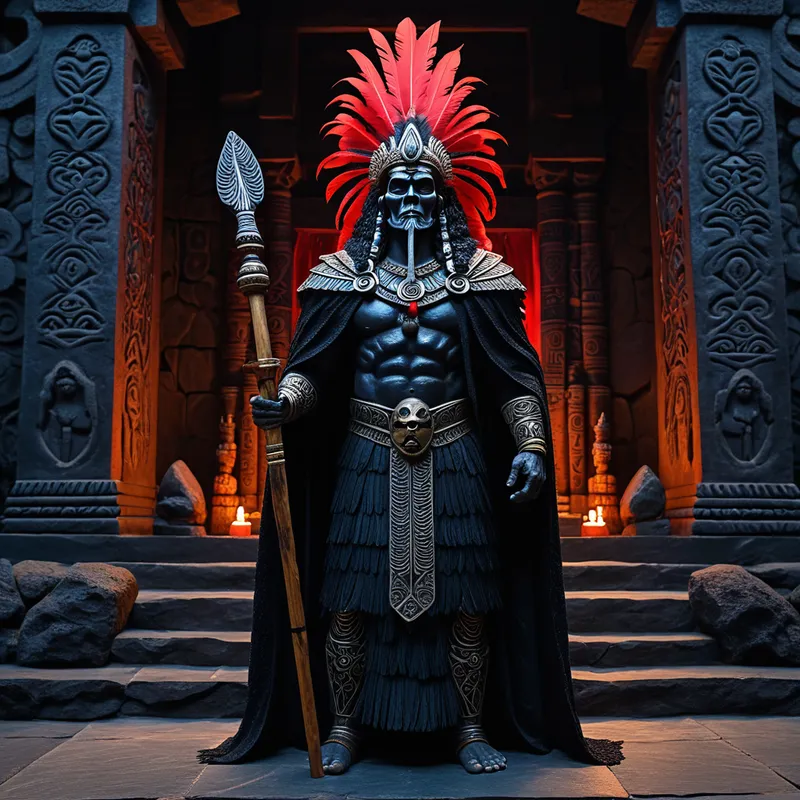
Listen. In the time when the world was young and the breath of the gods still stirred the leaves of the first kukui trees, there was a silence that walked. It was not the silence of emptiness, but the deep, humming quiet of the kapu. This silence had a name: Kahoali'i.
He was the eater of eyes.
When a great ali'i died, his body was prepared with chants and fragrant pikake. The people would wail, their voices a storm upon the shore. But in the sacred house, the heiau, a different ritual unfolded. As night fell, swallowing the last light of Lā, Kahoali'i would come. He was not a skeleton of bone, but a figure of dark, polished stone, his form shifting like a shadow cast by a guttering flame. His approach was not heard, but felt—a sudden chill in the thick, perfumed air.
He would bend over the body of the chief, laid upon the high altar of rough pāhoehoe. With fingers that were both terribly gentle and utterly final, he would touch the closed eyelids. And then, he would consume. He would take the eyes of the dead into himself. This was not an act of desecration, but of terrible, sacred necessity. For the eyes were the windows, the last anchors of the spirit to the world of form. By taking them, Kahoali'i severed the final tie. He closed the door so that another could open.
The spirit, now freed, could begin its long journey to Pō, the night, the source. And Kahoali'i, having performed his duty, would withdraw back into the silence from which he came, carrying those consumed eyes within him—a constellation of departed visions held in eternal darkness. He was the great separator, the necessary shadow without which the light of life had no meaning, the sacred consumer who made the journey of the soul possible.
Cultural Origins & Context
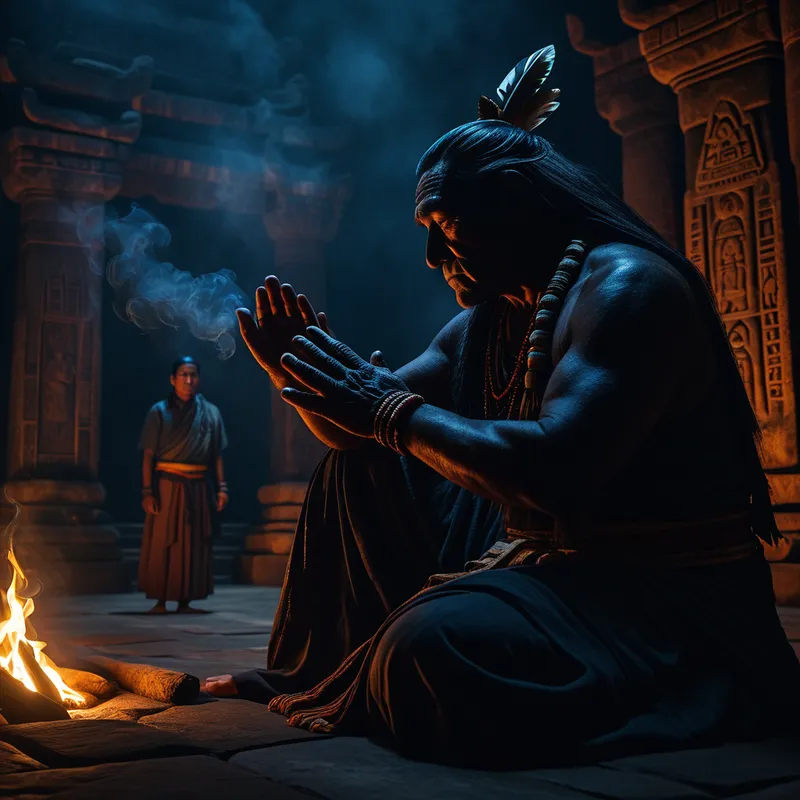
The figure of Kahoali'i is rooted in the complex kapu system and the ancestor-centric spirituality of pre-contact Hawaii. These narratives were not mere stories but lived cosmology, transmitted through the kumu hula and kahuna during sacred ceremonies and in the training of chiefs. The myth functioned on multiple societal levels.
Firstly, it explained and sanctified the mortuary practices for the highest-ranking ali'i, differentiating them from common death rites. It reinforced the sacred nature of the chief's body and the dangerous, potent spiritual transition it underwent. Secondly, it personified the concept of kapu as it applied to death—death was not a chaotic end, but a ritually managed, orderly transition overseen by a specific deity. Kahoali'i was the embodiment of this divine order in the realm of endings. His act ensured the proper flow of mana from the deceased back to the ancestral realm and, ultimately, to the living lineage, maintaining the cosmic and social equilibrium.
Symbolic Architecture
At its core, the myth of Kahoali'i is a profound allegory for the psychology of transformation. Death here is not annihilation, but a sacred, catalytic process administered by a divine principle.
The eye that sees the world must be swallowed by the night so that the spirit can learn to see by its own inner light.
Kahoali'i represents the archetypal function that facilitates profound change. He is the limen itself—the sacred threshold guardian. His consumption of the eyes symbolizes the necessary "de-identification" that must occur for any true metamorphosis. We are identified with what we see, with our perspective, our worldly attachments and roles (symbolized by the chief). For the psyche to move to a new state of being, that old identity must be ritually taken, consumed, and integrated into a larger, transpersonal order (Kahoali'i himself).
The eyes are the organs of ego-consciousness, of separation and objectification. Their removal is the end of one mode of perception. Kahoali'i does not destroy them; he incorporates them. This suggests that our former conscious perspectives are not lost but become part of the unseen, guiding wisdom of the deeper Self—the dark, inner god who oversees all transitions.
The Dreamer's Resonance
When this mythic pattern stirs in the modern dreaming mind, it often signals a profound, non-negotiable ending presided over by an impersonal, sacred force within the psyche. One might dream of a faceless, authoritative figure performing a precise, ritualistic action on the dreamer's body, or of willingly surrendering a treasured possession (like jewels or lights) that symbolize one's vision or understanding of oneself.
Somatically, this can feel like a deep, centering calm amidst external chaos, or a strange detachment as a life structure falls away. Psychologically, it is the process of the ego surrendering its central, identifying perspective. The "death" is not of the Self, but of the ego's claim to sovereignty. The dreamer is undergoing an initiation where the personal will is being realigned with a transpersonal pattern. There is often an accompanying sense of awe and fear—the holy dread of the numinous—rather than simple terror. It is the psyche's way of enacting the line, "Not my will, but Thine be done."

Alchemical Translation
The alchemical journey mirrored in Kahoali'i's ritual is the nigredo, the blackening, but a sacred nigredo. It is the stage of separatio performed not by the conscious ego, but by the inner, archetypal Magician.
The psychic transmutation begins when we consent to the removal of our own eyes—to stop seeing through the lens of who we thought we were.
For the modern individual, this translates to those pivotal moments when a core identity—the successful professional, the devoted caregiver, the certain believer—is ritually "consumed" by life circumstances. A job loss, the end of a relationship, a failure, or a spiritual crisis becomes the altar. The god of death is the pattern of meaning that emerges from within, insisting this ending is not meaningless destruction but a sacred dissolution required for the soul's journey.
The alchemical goal is not to avoid Kahoali'i, but to recognize him as an agent of the Self. The triumph is in the sacred consent to the ritual. By understanding the "consumption" of our old ways of seeing as a necessary step, we participate in our own psychic transmutation. The ego's vision is surrendered so that the vision of the Self can begin to form. We move from being the ali'i on the altar to becoming, in our deepest essence, participants in the sacred function of Kahoali'i himself—the ones who can hold the darkness of endings as the womb of new beginnings.
Associated Symbols
Explore related symbols from the CaleaDream lexicon:
- Death — The central theme, not as an end but as a sacred, transformative ritual administered by a divine principle to facilitate the soul's journey.
- Sacrifice — The voluntary surrender of the ego's vision and identity, a necessary offering for spiritual transition and renewal.
- Ritual — The precise, sacred action performed by Kahoali'i, representing the structured, meaningful process inherent in deep psychological change.
- Door — Kahoali'i himself as the threshold guardian, the entity that closes the door on one state of being so the spirit can pass to another.
- Eye — The symbol of conscious perception, identity, and worldly attachment that must be surrendered for transformation to occur.
- Shadow — Kahoali'i as the personification of the sacred, necessary shadow that completes the self, the aspect that handles endings and integration.
- Altar — The place of transformation where the old self is laid to rest and the sacred, transpersonal ritual is enacted.
- Journey — The spirit's passage to Pō, representing the soul's movement into deeper, unseen realms of the psyche after a major dissolution.
- God — The impersonal, archetypal force of order and transition that oversees fundamental changes beyond personal control.
- Spirit — The essential self that is liberated by the ritual, freed from its physical and egoistic anchors to continue its evolution.
- Darkness — The realm of Pō and the nature of Kahoali'i, not as evil, but as the fertile, unknown ground from which new life and understanding emerge.
- Light — The conscious vision that is consumed, which must be relinquished so that a new, inner illumination can eventually be kindled.