Kagura Myth Meaning & Symbolism
The myth of the divine dance that lured the sun goddess from her cave, restoring light and order to a world plunged into darkness.
The Tale of Kagura
Listen, and hear the tale of the time the world went dark.
It began not with a roar, but with a retreat. The radiant Amaterasu-Ōmikami, she who fills the sky with light, was wounded to her very soul. Her brother, the storm god Susanoo-no-Mikoto, had ravaged her sacred rice fields, defiled her weaving hall, and in a final act of terror, flung the flayed corpse of a heavenly pony through the roof. The violence was not just an offense; it was a shattering of cosmic order, a tear in the fabric of harmony.
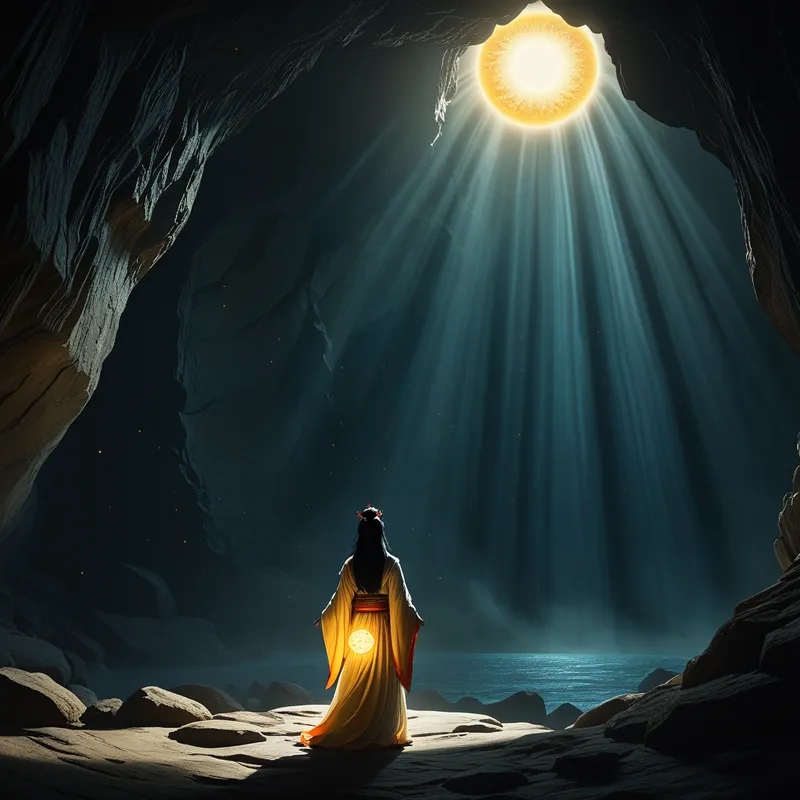
In her profound grief and rage, Amaterasu turned away from all creation. She retreated into the Ama-no-Iwato, a celestial cave of stone, and sealed the entrance with a mighty rock. The universe held its breath. Without her gaze, without her spirit, light fled the world. The plains of the high plain of heaven, Takamagahara, grew cold and grey. The middle world of reed plains, Ashihara-no-Nakatsukuni, was plunged into an unending, starless night. Chaos reigned; malevolent spirits crawled from the shadows, and the eight million kami wept in despair.
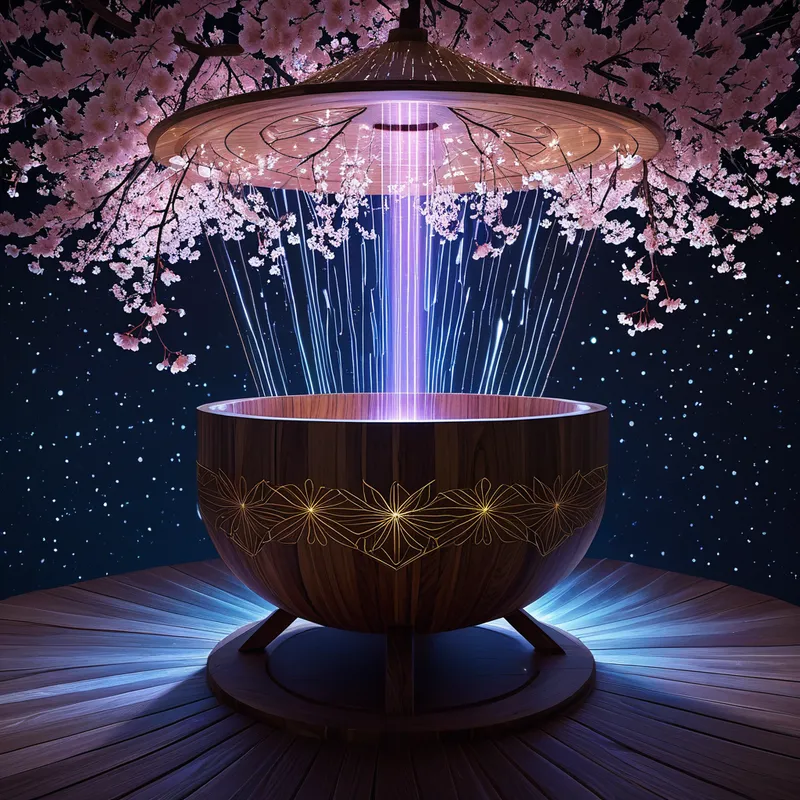
The celestial assembly gathered before the sealed cave, their faces pale in the gloom. Plans were whispered and discarded. Then, the Ame-no-Uzume-no-Mikoto stepped forward. A smile played on her lips, not of mirth, but of fierce determination. She did not call for force or pleas. She called for a mirror, a sacred tree, and an upturned wooden tub.
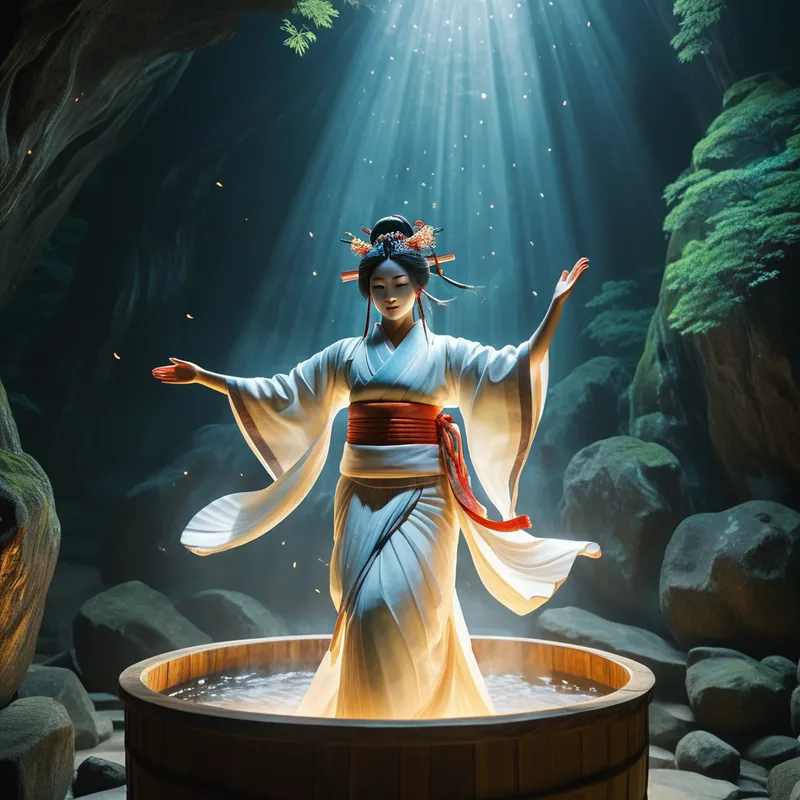
Before the cave's impenetrable door, she began. She placed the mirror, the Yata-no-Kagami, so it faced the darkness within. She adorned the Sakaki with jewels, streamers, and mirrors. Then, she mounted the hollow tub. And she danced.
It was not a gentle dance. It was a performance of raw, ecstatic life. She stamped her feet on the resonating tub, a rhythm that pulsed through the very bones of the world. She let her garments loosen, her hair fly wild. Her body became a whirlwind of abandon, a celebration so utterly genuine, so shamelessly vibrant, that it defied the surrounding despair. The assembled kami, caught in the spell, began to laugh—a great, roaring wave of laughter that shook the foundations of heaven.
Inside her stony womb, Amaterasu heard the strange commotion. The thunderous stomping, the riotous laughter… curiosity pricked her sorrow. A sliver of light appeared as she cracked the rock door. “Why do you laugh,” her voice echoed, “when the world is draped in darkness?”
From the other side, a voice replied, “We rejoice because there is a deity greater and more splendid than you!” And as Amaterasu peered out, she saw her own radiant reflection—magnified, eternal, and breathtaking—in the mirror held before her. Transfixed by this divine image, she leaned further out.
In that moment of captivated wonder, the god of strength, Ame-no-Tajikarao-no-Kami, seized the rock door and flung it aside forever. Another deity stretched a sacred rope, the Shimenawa, behind her, barring her return. Light, glorious and warm, flooded back into the universe. Order was restored. And the dance that brought it forth was given a name: Kagura.
Cultural Origins & Context
The myth of Kagura is enshrined in Japan’s oldest chronicles, the Kojiki and the Nihon Shoki. It is not merely a story but the foundational etiology for one of Shinto’s most vital ritual practices. Kagura is the prototype for all sacred dance and theatrical performance intended to invite, entertain, and pacify the kami.
Historically, Kagura was performed by shrine maidens (Miko) and ritual specialists at imperial courts and major shrines, particularly during the crucial Niiname-sai and other seasonal celebrations. Its societal function was profound: it was a technology of cosmic maintenance. By re-enacting the primal drama of Ame-no-Uzume, the community participated in the ongoing restoration of order (kami no michi, the way of the kami) over chaos. The dance was a conduit, a means of aligning the human realm with the divine, ensuring the sun’s return, the harvest’s bounty, and the community’s vitality. It was passed down not just as lore, but as embodied knowledge—a sacred choreography that held the memory of how to call light back from the brink.
Symbolic Architecture
At its heart, Kagura is a myth about revelation through radical authenticity and enacted joy. Each element is a profound symbol.
The cave represents the wounded psyche in retreat—a state of depression, trauma, or profound alienation where the inner light (consciousness, vitality, the Self) withdraws. The eternal night is the psychic stagnation and the reign of shadow contents that follows.
The mirror does not create light; it reveals the light that has been forgotten. The first step in healing is often to behold one's own hidden radiance.
Ame-no-Uzume is the archetype of the sacred fool, the ecstatic, and the therapist. She does not argue with the darkness; she dances at its door. Her tools are not weapons but instruments of reflection (the mirror), connection (the adorned tree linking heaven and earth), and resonance (the stamping tub). Her disrobing symbolizes the stripping away of social persona and shame, revealing the raw, authentic life-force beneath. The laughter of the gods is not mockery but the contagious, healing sound of collective catharsis, breaking the spell of isolated grief.
The final, crucial act is the physical prevention of a return to darkness (the Shimenawa). This symbolizes the commitment required after an insight or healing—the active work to integrate the returned light so the psyche does not slip back into its familiar cave.
The Dreamer's Resonance
When this myth pattern stirs in the modern dreamer, it often signals a profound somatic and psychological process: the call to lure a vital but hidden part of the Self back into the light of consciousness.
One might dream of being in a dark, enclosed space (a basement, a sealed room) while hearing compelling music or laughter outside. Or, one might dream of witnessing or performing an irresistible, uninhibited dance, feeling a powerful release of energy. The dreamer could be the one in the cave, or they could be Ame-no-Uzume, tasked with drawing something out.
Somatically, this process can feel like a buildup of restless, almost frustrated energy—a knowing that something must move. Psychologically, it is the recognition that intellectual analysis or passive waiting has failed. The hidden “sun”—perhaps one’s creativity, joy, assertiveness, or spiritual connection—will not respond to logic or pleading. It requires an offering of authentic, embodied life. The dream is the unconscious staging the conditions for a Kagura: presenting the mirror (self-reflection), setting the scene, and urging the dreamer to find the dance within their own body and circumstance.
Alchemical Translation
The Kagura myth is a perfect model for the alchemical process of individuation—the Jungian journey toward psychic wholeness. It maps the transmutation of leaden despair into golden consciousness.
The initial nigredo, the blackening, is Amaterasu’s retreat: a necessary, if painful, dissolution of the old conscious attitude. The world goes dark. The work of the albedo, the whitening, begins with Ame-no-Uzume’s dance. This is not an intellectual analysis but an opus contra naturam—a work against the prevailing nature of gloom. It is the ego, in service to the Self, engaging in a symbolic, ritual act to invite the transcendent function.
The sacred dance is the ego’s willingness to become foolish, to risk authenticity, to create a vibration so true it resonates with the deepest layers of the Self.
The mirror represents the stage of solutio and coagulatio—the dissolving of identification with the shadowed self and the coagulation of a new, more complete self-image. Seeing one’s own radiance reflected is the moment of illumination, the rubedo or reddening. Finally, the placement of the Shimenawa is the citrinitas, the yellowing or integration, where the insight is made permanent within the psychic structure.
For the modern individual, the Kagura process asks: What part of your inner sun has retreated into a cave of grief, shame, or overwhelm? What old storm (a conflict, a betrayal, an exhaustion) caused it to hide? And most crucially, what is your dance? What is the utterly genuine, life-affirming, perhaps even “shameless” expression—be it art, movement, creation, or connection—that you can perform before that inner darkness? It is through that enacted authenticity, that ritual of the soul, that we bar the door to the old cave and let the light flood back in, restoring order to our inner universe.
Associated Symbols
Explore related symbols from the CaleaDream lexicon: