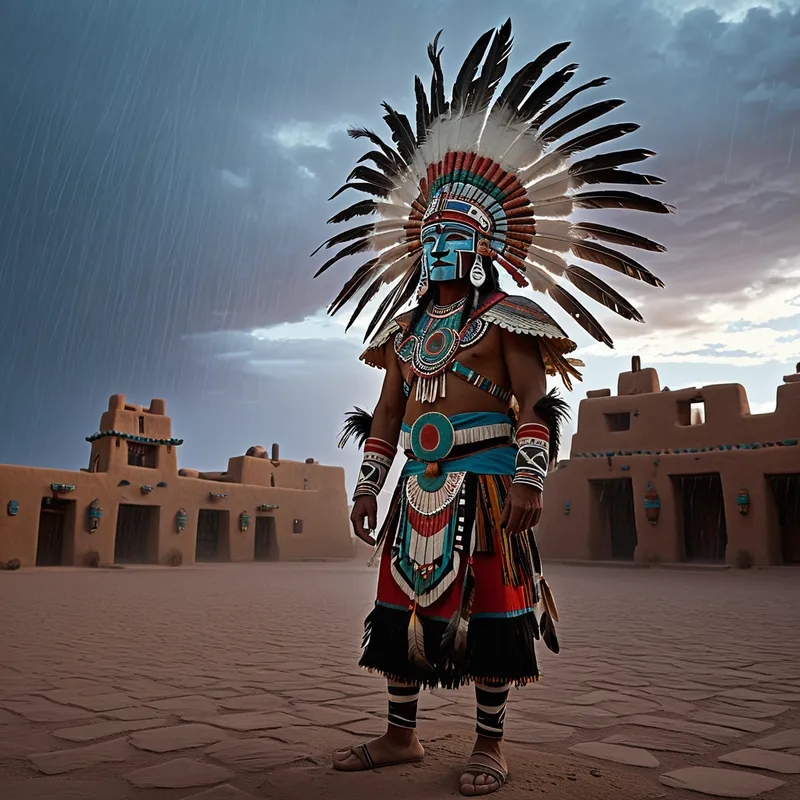
Kachina Dancers Myth Meaning & Symbolism
Sacred spirit-beings descend from misty peaks to dance rain into being, teaching humanity the sacred reciprocity between the visible and invisible worlds.
The Tale of Kachina Dancers
Listen. In the time before time, when the world was dry bone and breath was dust, the people of the high mesas waited. They watched the sky, a vast and empty turquoise bowl. Their prayers for rain were whispers lost on the wind, their corn seeds tiny, hopeful stones in the parched earth. The world was a line drawn too sharply between the seen and the unseen, and the connection was severed.
Then, from the Nuvatukya'ovi, the cloud-veiled peaks to the west, a sound began. Not thunder, but the soft, rhythmic beat of many feet upon the earth. A mist descended, not of water, but of presence. And through it, they came.
They were the Kachinas. They were not gods to be worshipped from afar, but visitors, relatives from the other side of the veil. Some wore masks that held the storm's fury, their heads crowned with towering clouds of painted wood and eagle down. Others bore the gentle face of the sprouting bean, their bodies draped in green. There were hunters with the eyes of hawks, and grandmothers with cheeks of falling snow. They did not speak with human tongues. They spoke with their bodies, in the sacred language of the dance.
For six moons they stayed, dwelling among the people in the heart of the pueblo. They taught not with words, but with being. In the plaza, as the sun bled into the horizon, the dance would begin. The beat of the drum was the heartbeat of the world itself. The dancers’ feet, wrapped in soft hide, struck the earth in perfect unison—a prayer pressed directly into the soil. Their rattles sang the sound of rushing streams. Their movements were the bending of corn stalks in the wind, the gathering of clouds, the patient arc of the sun.
The people watched, and in watching, they remembered. They remembered they were not separate from the sky or the soil. The dancers showed them the hidden connections: how a lifted arm could pull moisture from the air, how a stomping foot could awaken seeds deep below. The children, wide-eyed, learned the names and natures of these spirit-kin—which one brought the gentle rain, which one ensured the hunt, which one taught the art of healing.
And then, as mysteriously as they arrived, their work complete, the Kachinas prepared to depart. On the final day, a great dance was held. It was a crescendo of color, sound, and devotion. As the last drumbeat faded, the Kachinas did not walk back into the mist. Instead, they gifted their masks—the very vessels of their presence—to the people. "We are returning to our home in the mountains," their leader seemed to say without words. "But now, you know the dance. You hold our face. When you put it on and move with a true heart, you do not pretend to be us. You become the bridge. You call, and we will answer."
With that, they were gone. But the pueblo was no longer silent. The air was thick with the promise of rain, and in the kivas, the gifted masks waited. The people were no longer merely hopeful. They were participants in a sacred, unending conversation.
Cultural Origins & Context
This is not a myth of a singular, forgotten past, but a living, breathing reality for the Pueblo peoples, most notably the Hopi and Zuni. The story of the Kachinas' arrival is the foundational narrative for a complex ceremonial cycle that structures the agricultural and spiritual year. It is a myth enacted, not just recounted.
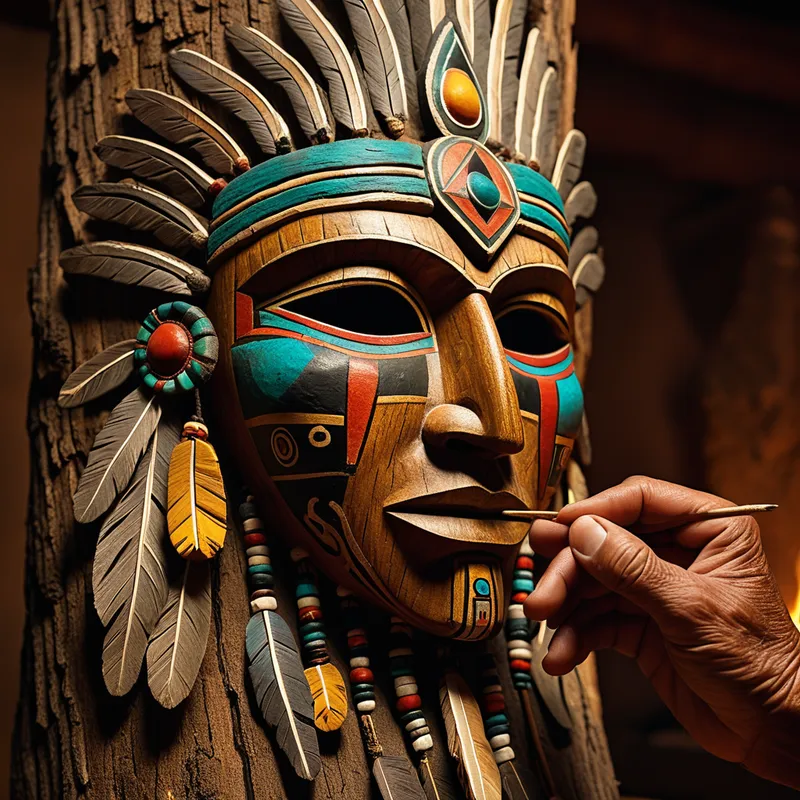
The knowledge is passed down not through written texts, but through immersive participation. From a young age, children are given miniature Kachina dolls to learn their attributes. As they grow, they witness the ceremonies, and eventually, initiated men take on the profound responsibility of donning the masks and regalia to become the Kachina dancers during the half-year cycle from winter solstice to mid-summer. This is not performance art; it is a sacred obligation, a ritual technology for maintaining cosmic and community balance. The storytellers are the entire community—the carvers who shape the masks from cottonwood root, the elders who supervise the preparations, the dancers who embody the spirits, and the families who receive their blessings. Its societal function is holistic: it ensures rain and fertility, teaches moral and practical lessons, reinforces social cohesion, and provides a direct, experiential link to the spirit world.
Symbolic Architecture
At its core, the Kachina myth is a profound teaching on the nature of reality as relationship. The Kachinas themselves are not distant deities but personified intermediaries. They symbolize the animating spirit within all natural forces and moral principles—the spirit of the rain cloud, of the growing corn, of the wise ancestor, of laughter itself.
The mask does not conceal the individual; it reveals the archetype. In wearing it, the dancer surrenders his personal identity to become a conduit for a transpersonal force, demonstrating that the self is a vessel for something greater.
The central conflict of the myth—the drought and disconnection—symbolizes a state of psychic and spiritual aridity. The resolution is not a battle won, but a relationship restored. The dance is the symbolic act of reciprocal invocation. The human community, through disciplined ritual (the dance), calls upon the spirit world (the Kachinas). In response, the spirit world bestows its blessing (rain, fertility, order). This creates a sacred feedback loop. The gifted mask is the ultimate symbol of this empowered responsibility. It says: the divine is not "out there." You have been given the tools to participate in its manifestation. The power now resides within the community's disciplined practice.
The Dreamer's Resonance
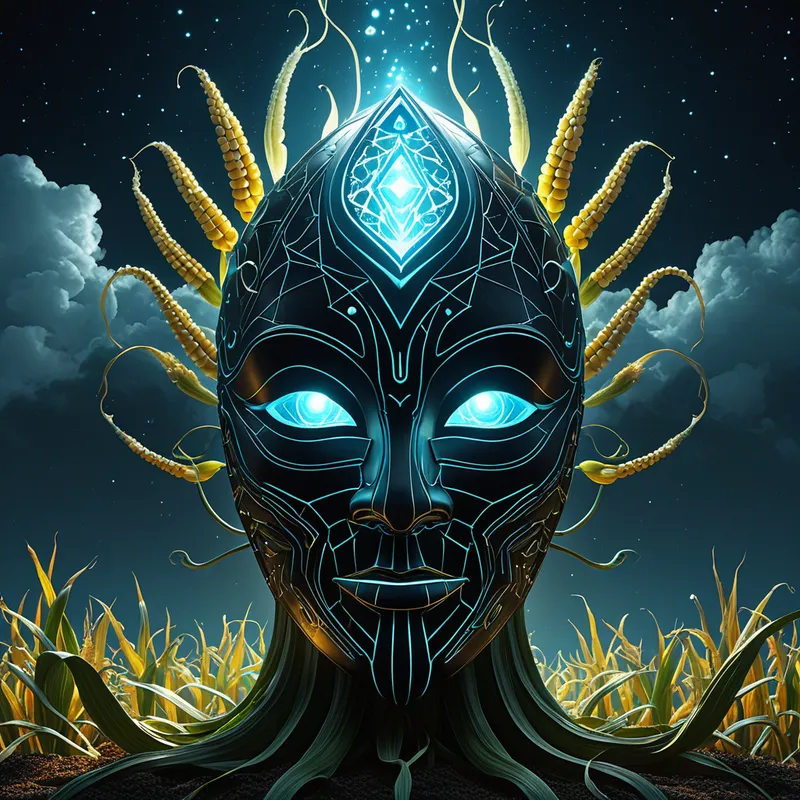
When this mythic pattern stirs in the modern dreamer, it often signals a profound somatic and psychological process: the longing for authentic enactment and the healing of a perceived split. To dream of masked dancers, especially in a context of personal "drought" (creative sterility, emotional dryness, spiritual emptiness), points to a deep need to reconnect with the animating spirits of one's own life.
Somatically, one might feel a stiffness, a sense of being "uprooted" or disconnected from the body's wisdom—the opposite of the fluid, grounded dance. Psychologically, the dreamer is confronting the gap between their inner reality (their feelings, intuitions, ancestral wisdom) and their outer expression (their daily persona, their social mask). The Kachina dream asks: What vital force are you not "dancing" into being? What ritual or disciplined practice have you abandoned that once connected you to your own source of rain? The masked figures may represent disowned parts of the self—the inner healer, the fierce protector, the joyful creator—waiting to be reintegrated not through thought, but through embodied, respectful action.
Alchemical Translation
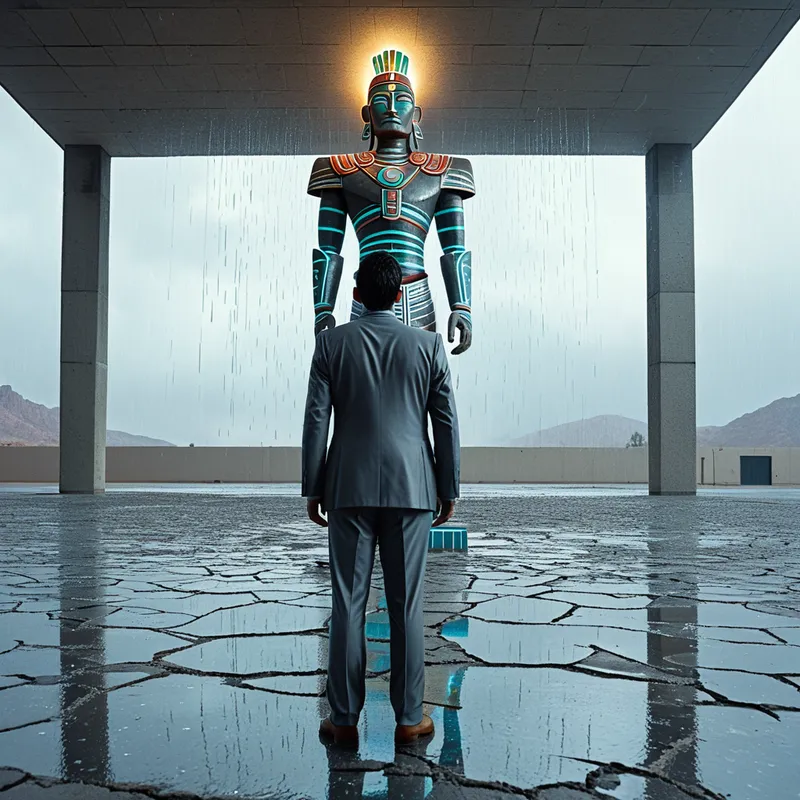
The Kachina myth provides a stunning model for the Jungian process of individuation—the psychic transmutation of the individual into an integrated whole. The journey begins in the "drought" of the ego-centric state, where the individual feels separate from the nourishing waters of the unconscious (the spirit world).
Individuation is not about becoming a perfect, isolated self. It is about becoming a skilled and respectful dancer in the great ceremony between consciousness and the unconscious, learning to wear the many masks of the psyche without being possessed by any single one.
The "descent" of the Kachinas represents the eruption of archetypal contents from the unconscious into conscious life. This can be overwhelming, even terrifying. The myth’s wisdom is in its structured container: the kiva (the ceremonial underground chamber) symbolizes the vessel of the disciplined ego and the safe, sacred space needed for this work. The "dance" is the alchemical operation itself—the conscious, ritualized engagement with these powerful forces. One does not just have an insight (see a Kachina); one must learn its steps, its rhythms, its nature (dance with it).
The ultimate alchemical goal is symbolized by the gifted mask. This is the lapis philosophorum, the philosopher's stone of this process. It represents the achieved ability to consciously mediate between the inner and outer worlds. The integrated individual no longer just suffers the whims of the unconscious or is rigidly identified with the persona. Instead, they can consciously "don the mask"—access the power of the nurturer, the warrior, the sage—as needed, in service to life, and then respectfully set it aside. They become the bridge, the dancer who, through their own disciplined practice, can call forth rain in their own desert and for their community. The self becomes a ceremony, and life becomes a sacred, reciprocal dance.
Associated Symbols
Explore related symbols from the CaleaDream lexicon: