
Kaʻahupahau Myth Meaning & Symbolism
A myth of a shark goddess who transforms from a feared predator into a sacred guardian of the people and the life-giving waters of Puʻuloa.
The Tale of Kaʻahupahau
Listen, and let the salt air fill your lungs. Let your feet feel the warm black sand of Puʻuloa. In the time before time, when the world was woven from chant and breath, these waters were not a harbor for ships of iron, but a vast, intricate larder of the sea. And in its deepest channels, a shadow moved. It was the shadow of a great shark, feared by all. Her name was Kaʻahupahau.
She was born of the deep, a creature of tooth and instinct, a sovereign of the blue realm. Fishermen would see her dorsal fin cut the surface like a dark blade and paddle swiftly for shore, their hearts drumming against their ribs. She was the unseen danger, the reason mothers warned their children not to venture too far. But within Kaʻahupahau, a strange alchemy was at work. Perhaps it was the constant, gentle prayers of the people who lived on her shores. Perhaps it was the very spirit of Puʻuloa itself, whispering of a different destiny.
A transformation began, slow as the growth of coral. The fierce hunger for human flesh receded, replaced by a profound, watchful awareness. She began to know the people—their canoes, their fishing grounds, their children playing in the shallows. She became their unseen sentinel. Her brother, Kahiʻuki, joined her in this sacred charge. Together, they patrolled the channels, not as hunters of man, but as protectors from the true monsters of the deep.
And a monster came. His name was Kahiʻuka, a shark of immense size and relentless appetite, drawn to the rich waters and the people within them. Fear, cold and sharp, returned to Puʻuloa. The people despaired. But Kaʻahupahau had changed. She was no longer just a shark; she was a guardian with the cunning of a deity.
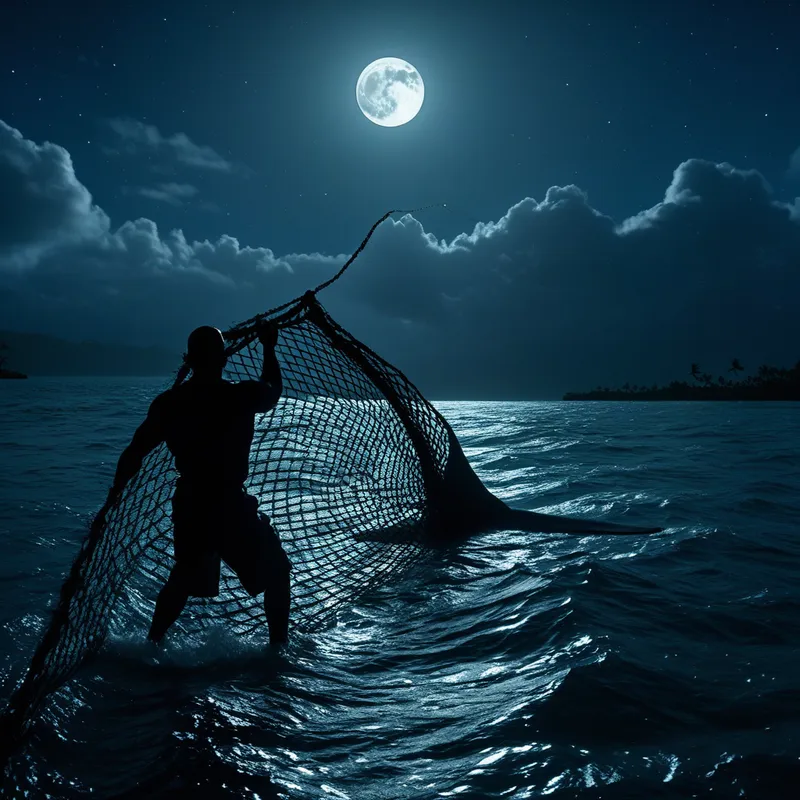
She devised a plan. The people, under her guidance, wove a mighty net from the strongest olonā cord. They laid their trap at the channel’s narrow mouth. When Kahiʻuka, driven by his bottomless hunger, surged into the entrance, the net ensnared him. He thrashed, a tempest of scale and fury, but the bonds held. And there, in the churning water, the protectors of Puʻuloa fulfilled their duty. Kaʻahupahau and her kin ended the threat, their teeth serving justice, not random violence.
From that day, the waters were truly safe. Kaʻahupahau and Kahiʻuki were called ʻaumakua. The people left offerings of kalo and ʻuala on special stones at the water’s edge. Fishermen would whisper prayers of thanks, knowing the sleek shadows beneath their canoes were not a threat, but an escort. The feared predator had become the sacred protector, her myth written not on paper, but in the safe passage of every canoe and the grateful hearts of her people.
Cultural Origins & Context
The story of Kaʻahupahau is rooted deeply in the specific landscape of Puʻuloa on the island of Oʻahu. This was not a pan-Polynesian myth, but a moʻolelo kuʻuna (traditional story) of place, explaining the unique character and safety of those particular waters. It was passed down orally through generations by kūpuna (elders) and kahuna, serving multiple vital societal functions.
Primarily, it was an ecological and behavioral charter. The myth codified the kapu against harming the sharks of Puʻuloa, ensuring the balance of the marine ecosystem. It taught respect for a powerful animal by transforming it from a random danger into a rational, placable entity with whom one could have a relationship. The story also reinforced the Hawaiian concept of ʻaumakua, where the boundary between human and nature, ancestor and animal, was fluid and reciprocal. Kaʻahupahau’s tale was a narrative anchor for a complex web of environmental stewardship, familial identity (for those who claimed her as their ʻaumakua), and spiritual practice centered on profound reciprocity with the natural world.
Symbolic Architecture
At its core, the myth of Kaʻahupahau is a profound allegory for the transformation of raw, unconscious power into conscious, protective authority. She begins as a pure expression of the instinctual, predatory realm—the shadow in the deep that the conscious ego fears.
The greatest strength is not born from the eradication of one's nature, but from its conscious integration and redirection.
Her evolution mirrors the psychological movement from being possessed by an archetype (the Destroyer) to inhabiting it with purpose (the Protector). The shark is a perfect symbol of this potent, amoral life force—efficient, ancient, and terrifying. Kaʻahupahau’s transformation suggests that these formidable energies within the psyche—our aggression, our territoriality, our primal survival instincts—need not be denied or vanquished. They can be educated by relationship, by the call of a responsibility larger than the self.
The defeat of Kahiʻuka is crucial. He represents the untransformed, devouring aspect of the same archetype—chaotic hunger that consumes without purpose. Kaʻahupahau does not battle him as an external enemy alone; she confronts the lingering echo of what she herself could have remained. Her victory is the triumph of the integrated self over the chaotic, self-serving id. The net, a product of human craft and divine strategy, symbolizes the conscious structure—culture, ritual, ethics—necessary to bind and transmute raw, destructive power.

The Dreamer's Resonance
When the pattern of Kaʻahupahau stirs in the modern dreamer, it often signals a profound somatic and psychological process of reclaiming personal power from the shadow. To dream of a feared creature—a shark, a wolf, a serpent—that then reveals itself as an ally or guide is a classic encounter with this myth.
The somatic experience might be one of initial terror freezing the dream-body, followed by a gradual thawing into awe and a strange sense of recognition. The dreamer isn't just observing a helpful animal; they are in relationship with an intelligence that was once perceived as purely threatening. This mirrors the process of integrating a rejected part of the self: perhaps one's own assertiveness, anger, or fierce independence that has been labeled "dangerous" and suppressed. The dream is an invitation from the deep psyche to stop fleeing from this inner "shark" and to turn, face it, and discover its potential as a guardian. The process is one of moving from a victim relationship to one's own power (being hunted by it) to a sovereign relationship (commanding it for protection).

Alchemical Translation
For the modern individual navigating the process of individuation, Kaʻahupahau’s journey is a masterclass in psychic alchemy. The prima materia, the base substance, is the raw, undifferentiated force of instinct and emotion that often frightens us—our rage, our ambition, our sensual appetites. The initial stage is nigredo, the blackening: the recognition and fear of this "monster" within our own depths.
The alchemical fire is the heat of conscious attention and the willingness to engage. Kaʻahupahau does not cease to be a shark; she becomes a conscious shark. This is the albedo, the whitening: the purification and integration. We do not eliminate our nature; we refine its expression. We take the teeth of our criticism and use them to defend our boundaries, not indiscriminately attack. We take the relentless drive of our hunger and focus it on nourishing our true calling.
Individuation is the process of building a net of consciousness strong enough to hold our most terrifying potentials, so they may be transformed into guardians of the soul's harbor.
The final stage, the rubedo or reddening, is the embodiment of the integrated self as a protective, life-giving force. The individual is no longer at war with their own depth. Instead, like Kaʻahupahau, they become a guardian of their own inner landscape and, by extension, can offer genuine protection and stability in their outer world. The myth teaches that our wholeness requires us to befriend the deepest, most powerful creatures in our psychic oceans, not to sail in fear of them. The harbor of the self can only be truly safe when its native guardians are honored and awake.
Associated Symbols
Explore related symbols from the CaleaDream lexicon: