Jurupari Myth Meaning & Symbolism
A foundational myth of sacred law and masculine initiation, where a divine being establishes order through a brutal, transformative ritual of exclusion.
The Tale of Jurupari
Listen, and hear the story that is not for all ears. In the time before time, when the world was soft and lawless, the people lived without separation. Women knew the secrets of the forest, and men knew the rhythms of the hunt, and all was shared beneath the great green canopy. But the world was young, and its spine was not yet strong.
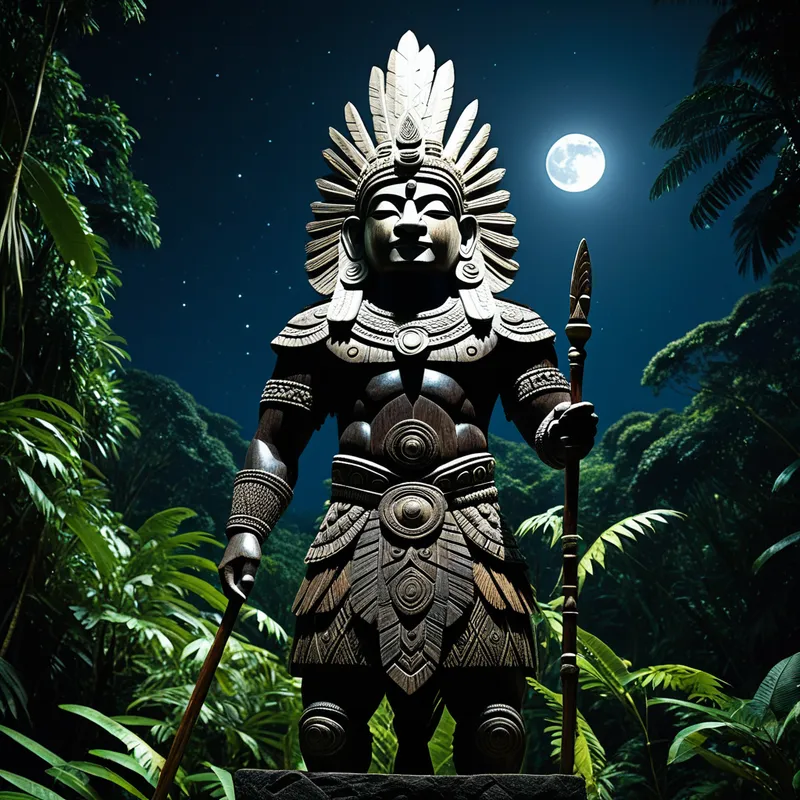
From the dark, fecund womb of the river, where the Boiúna sleeps, a seed was planted. Not in the earth, but in the belly of a woman, a woman who had eaten the fruit of the Urucuri palm. From her, a child was born not of flesh, but of purpose. He was Jurupari, and he came into the world full-formed, his skin like polished night, his eyes holding the cold fire of distant stars. He did not cry; he observed.
He grew not as a child grows, but as a law takes root. The people were in awe and in fear. Jurupari walked the forest and saw the tangled ways, the laughter that had no discipline, the sharing that had no hierarchy. He saw that the old ways, the ways of the women and the uninitiated, held power but lacked order. A great melancholy settled upon him, a divine dissatisfaction. The world needed a backbone, a sacred structure to bear the weight of becoming.
So, he gathered the first substances of power: the hard wood of the forest, the breath of the river, the silence of the jaguar’s path. From these, he fashioned the sacred flutes and trumpets—the Yurupary instruments. Their sound was not music as the people knew it. It was the sound of the forest’s bones groaning into alignment, the sound of a boundary being drawn. It was severe, beautiful, and utterly terrifying.
He summoned the men. "Hear the voice of order," he intoned. "This sound is the foundation of the world to come. It is the breath of sacred law. But this knowledge, this sound, has a price. It is not for all. The old matriarchal mysteries must recede. The women, the children—they must not see, they must not hear. This is the first law: separation is the price of power."
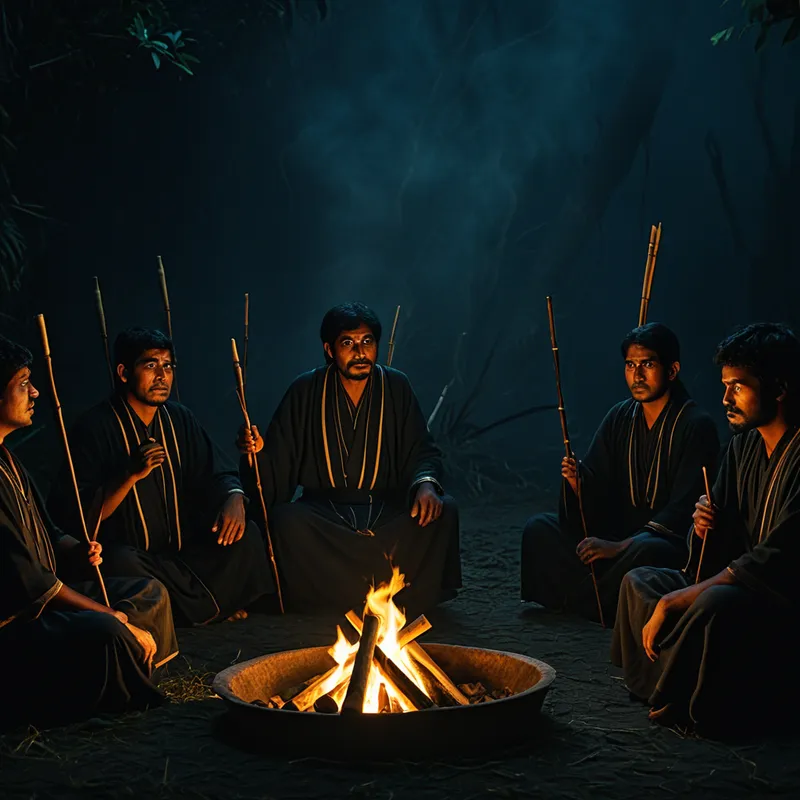
And so, the first ritual was born in shadow and firelight. The men, hearts pounding with a mixture of terror and exhilaration, took up the instruments. The first notes cut through the communal night, a sonic blade dividing the world. The women, who had once held all secrets, were now excluded, confined to the huts. Jurupari watched, his expression unchanging. The law was established. But a law born of exclusion is a hungry spirit.
The myth whispers of his end, not with a battle, but with a consequence. Some say the women, in their wisdom and wounded pride, discovered the secret. They broke the taboo, looked upon the sacred instruments, and in that act of seeing, the spell was fractured. Jurupari, the personification of this rigid order, could not exist in a world where the law was broken. He was transformed, departing to become the very principle he embodied—an eternal, demanding presence in the ritual house, in the sound of the flutes, in the stern face of initiation. He did not die; he became the rule itself.
Cultural Origins & Context
The myth of Jurupari is foundational to the cosmologies of numerous Indigenous peoples of the Upper Amazon region, particularly among the Tukanoan, Arawakan, and other linguistic groups in the Northwest Amazon basin. It is not a simple folktale but a living, sacred narrative intricately tied to the most vital social and religious institution: male initiation.
Traditionally, the myth was and is transmitted orally within the strict confines of the men’s house, the maloca. It is not a story for public entertainment but a sacred charter, recited during the elaborate and often arduous initiation rituals where boys are separated from the world of women and childhood to be introduced to the sacred laws, responsibilities, and secrets of adult men. The custodians of the myth are the elders and shamans, who use its narrative to justify and explain the severe social structure, the exclusion of women from certain rituals, and the absolute authority of the sacred wind instruments that embody Jurupari’s voice. Its societal function is paramount: it creates and maintains social order, defines gender roles with cosmic sanction, and provides a traumatic yet transformative roadmap for masculine identity.
Symbolic Architecture
Jurupari is not a "hero" in the classical sense, but a personified principle of necessary, painful order. He represents the psychic moment when undifferentiated consciousness must be broken apart for structured identity to form.
He is the archetypal shock of the Law—the voice that says "thou shalt not" to the blissful unity of childhood, instituting the complex burden of cultural adulthood.
The myth is a profound allegory of cultural psychic inflation. The pre-Jurupari world symbolizes a primal, matriarchal-consciousness state—unbounded, creative, but potentially chaotic and lacking in enduring form. Jurupari’s arrival is the eruption of the patriarchal principle, the logos that imposes narrative, hierarchy, and distinction. The sacred flutes are the symbols of this imposed order: their sound is the vibration that structures chaos. The brutal exclusion of women symbolizes the necessary, yet tragic, repression of the feminine (the Eros principle, the connective, nurturing unconscious) to establish a masculine-identified cultural ego (the Logos principle). Jurupari’s demise upon the breaking of the taboo reveals the inherent instability of an order based purely on repression; the excluded element always returns, demanding integration.

The Dreamer's Resonance
When this myth stirs in the modern dreamer, it signals a profound interior crisis of structure. To dream of a severe, authoritative figure establishing unbendable rules, or of being initiated into a secret, demanding group that requires you to abandon a part of your old self, is to feel the Jurupari process activating.
Somatically, this may feel like a tightening in the spine, a rigidity in the jaw—the body preparing to bear a new weight of responsibility. Psychologically, it is the process of individuation through severance. The dreamer may be at a life threshold—leaving home, starting a career, committing to a relationship—where the soft, undifferentiated patterns of the past must be deliberately cut away to make room for a chosen, adult identity. The shadow side of this dream is the feeling of cold isolation, of having sacrificed warmth and connection for the sake of a sterile, if powerful, order. The dream asks: What sacred law are you being called to embody, and what innocent part of your soul must you temporarily exile to do so?

Alchemical Translation
The alchemical journey modeled by Jurupari is that of Coagulatio—the process of condensation, hardening, and formation. It is the antithesis of the dissolving Solutio. The modern individual, swimming in a sea of possibilities, infinite connections, and blurred boundaries (a digital echo of the primal matriarchal forest), often feels a deep, Jurupari-like call to erect internal structure.
The first stage of the Work is not expansion, but contraction. The creation of a vessel, a discipline, a rule, is an act of self-sacrifice that makes future transformation possible.
The myth teaches that psychic transmutation requires a ruthless separation. One must enter the "men’s house" of one’s own discipline—whether in art, analysis, or spiritual practice—and exclude the "noise" of distraction, the pull of old comforts, and the uninitiated parts of the psyche that do not understand the work. The sacred "flutes" are our unique talents and tools, which only gain their powerful, world-structuring voice when dedicated to a strict, often isolating, practice. The danger, as the myth warns, is inflation—becoming identified with the law itself, becoming rigid, cold, and ultimately unable to integrate the warmth of relationship, emotion, and the feminine principle. The ultimate goal is not to remain Jurupari, but to use the structure he provides as a vessel strong enough to later contain a reunited, more complex wholeness.
Associated Symbols
Explore related symbols from the CaleaDream lexicon:
- Forest — The primal, undifferentiated state of consciousness and the womb of creation from which Jurupari's law emerges to impose structure.
- River — The dark, feminine source from which Jurupari is born, representing the deep, unconscious flow of life that his masculine order seeks to channel and direct.
- Ritual — The enacted form of Jurupari's law, the strict ceremonial process that transforms boys into men and chaos into sacred order.
- Sacrifice — The core transaction of the myth: the sacrifice of communal unity and feminine knowledge to gain structured power and masculine identity.
- Order — The ultimate principle Jurupari embodies, the cosmic and social structure necessary for a culture to cohere and endure.
- Shadow — Jurupari himself represents the shadow side of creation—the stern, excluding, and often cruel force required to establish form, a necessary but difficult aspect of the psyche.
- Mask — The sacred flutes and the ritual secrecy act as a mask, hiding the mystery of transformation and creating a boundary between the profane and the sacred worlds.
- Separation — The fundamental action of the myth, the painful but essential dividing of the world into categories (male/female, initiated/uninitiated) that enables cultural complexity.
- Law — The divine mandate Jurupari brings, which is not merely a rule but the foundational vibration that gives shape and meaning to human society.
- Sound — The medium of Jurupari's power, as the sacred flute sound is the literal vibration that institutes order and carries the weight of tradition.