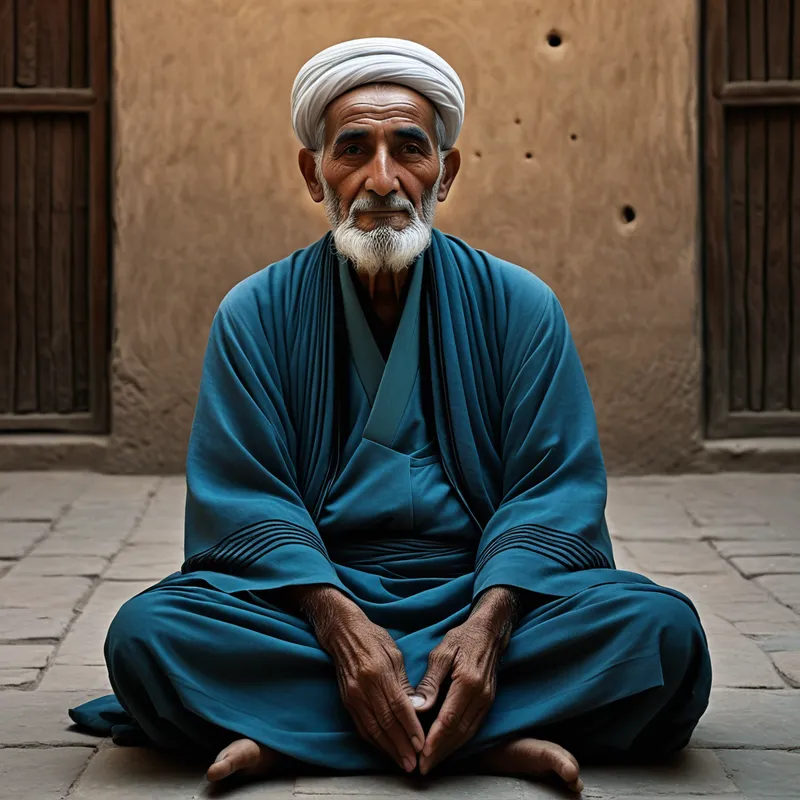
Junayd of Baghdad Myth Meaning & Symbolism
The tale of the Sufi master Junayd, who teaches that the ultimate spiritual state is not the annihilation of the self, but its return to the world in service.
The Tale of Junayd of Baghdad
In the heart of Baghdad, where the Tigris whispers ancient secrets and the dust of the marketplace carries the scent of a thousand spices, there lived a man named Junayd. He was a master, a sheikh, around whom a stillness gathered like dew. His students were seekers of the Haqq, drunk on the wine of divine love, yearning to lose themselves in the ocean of the Beloved.
One day, a cry pierced the quiet of the teaching circle. A disciple, his face alight with unearthly joy, burst through the door. “I have found it! I am gone! The ‘I’ is annihilated! I am nothing in the All!” He danced, a leaf in the hurricane of fana. The other students stirred, a mixture of awe and envy in their eyes. Was this not the ultimate goal? To be extinguished like a candle in the sun?
Junayd watched, his gaze deep as a well. He did not smile. He did not condemn. He simply observed the flame of ecstasy consuming the young man’s form.
Days turned. The disciple remained in this state, wandering the streets in rapture, heedless of the world. He no longer prayed the prescribed prayers; why should a dead man pray? He no longer attended to his duties; why should a drop separated from the ocean act? He lived in the sublime homelessness of intoxication.
Then, a change. The fierce joy began to fray at the edges. A confusion entered his eyes. The ecstasy, once a boundless sea, now felt like a prison of light. He was lost in the annihilation, with no path back to shore. He returned to Junayd’s courtyard, not dancing, but stumbling. The light on his face had dimmed to a desperate glare.
He fell before the master. “Help me,” he whispered, his voice raw. “I am lost in the desert of union. I have become nothing, and in this nothing, I am perishing.”
Junayd placed a hand on the disciple’s head. His touch was cool, like a stone in a stream. “My son,” he said, his voice the sound of the earth itself, “you have drunk the wine. But you have not learned to carry the cup.”
The master sent him away with a simple, impossible command: “Go to the market. Buy a cluster of grapes. Bring them to me.”
The disciple stared, bewildered. The market? Grapes? These were concerns of the world, of the self he believed he had destroyed. Yet, in his desolation, the command was a rope thrown into the abyss. He obeyed.
The journey to the market was an agony. Every sight, every sound—the haggling merchants, the crying children, the smell of bread and dung—assaulted him. He was a ghost trying to grasp solid matter. He purchased the grapes, the weight of them strange and terrible in his hand, a confirmation of his separate existence.
He returned and offered the fruit to Junayd. The master took a single grape, placed it in his mouth, and ate. “Now,” Junayd said, “the work begins. You have tasted annihilation. Now you must learn baqa. The journey is not from sobriety to intoxication. It is from intoxication, back through sobriety, and into a sacred presence within the world. The grape is as divine as the ecstasy. Go, and pray your prayers.”
And so, the disciple began again. Not as a man seeking to escape himself, but as a man returning from the abyss, tasked with bearing its secret into the marketplace. He learned that the greatest miracle was not to disappear, but to appear fully—as a servant, a neighbor, a human being—while holding the infinite within the vessel of a finite life.

Cultural Origins & Context
The stories of Junayd are not myths of a distant, fictional past, but sacred anecdotes (manaqib*) preserved within the oral and written traditions of early Sufism. They emerged from the vibrant, intellectually rigorous milieu of 9th and 10th century Baghdad, a crossroads of philosophy, theology, and mystical yearning. Junayd himself was a pivotal figure, often called the “Sayyid al-Ta'ifa” (The Master of the Group), who helped articulate a mystical theology that could coexist with orthodox Islamic law.
These tales were passed down by his disciples and later collected in classic works of Sufi hagiography like Tabaqat al-Sufiyya. Their function was multifaceted: they preserved the wisdom of a master, provided paradigmatic models for the spiritual path, and served as corrective lenses. In a time when ecstatic utterances and radical acts of some mystics risked alienation and persecution, Junayd’s story of the grapes acted as a crucial social and psychological container. It defined the Sufi ideal not as permanent otherworldly rapture, but as a responsible, integrated holiness that returns to and serves the community.
Symbolic Architecture
The myth is a perfect map of the soul’s alchemy. The disciple’s initial ecstasy represents the irresistible pull toward fana. It is a necessary death, a dissolution of the petty, constructed self. Yet, Junayd reveals this as an intermediate, not final, station.
The cup is not meant to be shattered in the fountain; it is meant to be filled, so it may offer drink to others.
The marketplace and the grapes are symbols of the created world, of al-dunya. The command to engage with them is the call to baqa. This is the critical return. The ego is not destroyed permanently; it is transmuted. It becomes a willing vessel, a conscious servant. The ecstasy is distilled into a stable, abiding presence. The disciple’s agony in the market is the birth pangs of this new, integrated consciousness—one that can hold both transcendence and immanence without contradiction.

The Dreamer's Resonance
When this myth pattern appears in modern dreams, it speaks to a profound psychological process: the crisis following a peak experience or a radical disintegration. The dreamer may have experienced a transformative insight, a spiritual awakening, a creative breakthrough, or a psychological collapse that shattered their old identity (the ecstatic fana). The initial dream imagery might be of flying, dissolving into light, or overwhelming bliss.
The Junayd pattern emerges in the next phase. The dreamer now finds themselves lost, disoriented, and unable to function in ordinary life. They dream of being a ghost in their own home, of understanding a sublime truth but being unable to speak it, of trying to perform simple tasks like the dream-grapes with paralyzing difficulty. This is the somatic signature of the unintegrated transformation. The psyche is signaling that the ecstatic state must be grounded. The dream calls for a “return to the market”—a re-engagement with the body, relationships, and daily responsibilities, not as a regression, but as the necessary field for embodying the change.

Alchemical Translation
The myth models the complete arc of individuation. The first stage is the nigredo: the burning away of the persona in the fire of the unconscious (the ecstatic annihilation). This is often mistaken for the goal itself. Junayd’s wisdom guides us through the albedo and rubedo.
The gold is not found in fleeing the lead of the world, but in learning to transmute the lead while standing firmly within it.
The command to buy grapes is the work of integration. The inflated, spiritually “special” self (which can be a subtle ego trap even in annihilation) is humbled. The individual must gather the scattered fragments of their experience and bring them to the seat of consciousness (the master/Junayd within). The eating of the grape is the conjunction, the sacred marriage where the divine insight is metabolized into human substance. The final stage is not a static perfection, but a dynamic, ongoing service—the prayers performed not out of obligation, but as the natural expression of a soul now in harmonious dialogue with both the Absolute and the relative. The Self is realized not beyond the world, but as the conscious, serving axis around which the world turns.
Associated Symbols
Explore related symbols from the CaleaDream lexicon:
- Cup — The human heart and consciousness as a vessel, which must be strong and clear to contain the intoxicating wine of divine experience without shattering.
- Water — The flowing, adaptable essence of life and spirit; Junayd’s sobriety is the still, clear water that reflects the whole sky, contrasted with the chaotic wine of intoxication.
- Journey — The essential Sufi path (tariqa), which is not a linear flight from the world but a circular return, moving from separation to union and back to a transformed engagement.
- Sacrifice — The sacrifice of the ego’s sense of specialness and permanent transcendence, willingly offered up to re-enter the mundane world as a servant.
- Mirror — The polished heart in the state of baqa, which reflects the divine attributes clearly into the world, without the distortions of ego or the fog of ecstasy.
- Market — The realm of ordinary life, relationships, and duty, which is the true testing ground and final destination of all spiritual realization.
- Sobriety — The conscious, integrated state (sahw) that follows spiritual intoxication, representing stability, responsibility, and clarity of presence.
- Wine — The intoxicating experience of divine love and unity (fana) that dissolves boundaries, a necessary but incomplete stage of the spiritual process.
- Return — The critical movement of baqa, the hero’s journey back to the community with the elixir, which completes the cycle and makes the transformation meaningful.
- Service — The ultimate expression of the integrated self, where spiritual realization is translated into compassionate action within the human world.