
Julius Caesar's Purple Toga Myth Meaning & Symbolism
A myth of ambition and divine favor, where a purple toga marks a man for greatness and seals his fate, exploring the cost of touching the numinous.
The Tale of Julius Caesar's Purple Toga
Let the forum’s murmur fade. Listen now to the stones of the Curia, for they remember a whisper that became a thunderclap. The air in Rome was thick that day, not with summer heat, but with the scent of destiny, sharp as a drawn blade. Gaius Julius Caesar, his brow already bearing the invisible crown of colossal ambition, stood before the Senate not as a supplicant, but as a force of nature contained within mortal flesh.
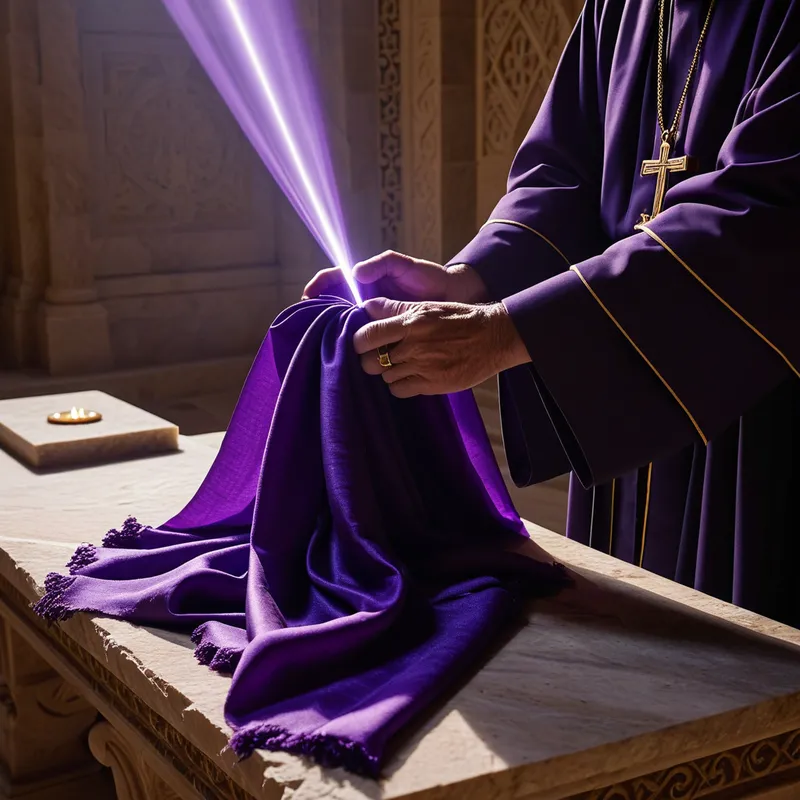
The priests of the temple, their faces pale masks of awe and dread, approached. In their hands they bore not a scroll of law, nor a general’s standard, but a folded cloth. A hush, colder than the Tiber in winter, fell. As they unfolded it, a gasp rippled through the ranks of toga-clad men like a wave breaking on a shore of fear. It was a toga. But no ordinary white, the color of citizen virtue. This was purpura.
This was the purple of kings, of Jupiter Optimus Maximus himself, the color squeezed from ten thousand sea-snails, worth more than its weight in gold. It was the color of the eastern sun at its bloody birth, of the deep ocean where monsters dwelled, of the vein that carries life—and spills it. They placed it upon Caesar’s shoulders. The weight was more than wool; it was the weight of a world’s expectation, the gaze of the gods, and the jealous fury of men.
From that moment, Caesar did not merely wear the purple; he was trailed by it. In the Senate, it was a silent, blazing argument. In the streets, it drew the eyes of the people, who saw in its hue not just power, but a terrible, beautiful otherness. His enemies saw only the insult, the flag of tyranny unfurled before their very eyes. The toga became his second skin, a luminous target. Whispers turned to plots. The Ides of March drew near, and the purple seemed to deepen, to darken, as if drinking the shadow of the coming betrayal.
On that final day, as he walked toward the Theatre of Pompey, the purple toga was his banner. It flowed around him, a river of royal dye. When the daggers struck, first from Casca, then from the multitude of "friends," it was not the white of his tunic they first stained, but that magnificent purple. The divine color drank the mortal red, the sacred and the profane mingling in a final, violent sacrament. As he fell, wrapping the toga around his face in a last gesture of dignity, the myth was sealed. The garment that marked him for divine favor became his shroud, the symbol of his ascent the map of his demise.
Cultural Origins & Context
This story, while orbiting the historical figure of Julius Caesar, belongs to the realm of political mythology. It was not a tale told by bards of old Rome, but a narrative woven in the aftermath of one of history’s most consequential assassinations. The sources are threads in later historians like Plutarch and Suetonius, who recorded the omens and portents surrounding Caesar’s death.
In the rigid hierarchy of the Republic, sumptuary laws strictly regulated the use of purple. The latus clavus, the broad purple stripe on the senatorial tunic, was a badge of rank. Solid purple was reserved for triumphing generals and, in its fullest expression, was seen as the prerogative of kings—a concept anathema to the Republican ethos. Therefore, the story of Caesar accepting, or being granted, a full purple toga functioned as potent political propaganda post-mortem. For his supporters and deifiers, it was proof of his exceptional, near-divine status, a visual sign that he transcended the laws of men. For his assassins and their sympathizers, it was the ultimate proof of his regal ambitions, justifying their tyrannicidal act.
The myth served a societal function of moral and political reasoning. It provided a simple, powerful symbol to explain a complex event: the end of the Republic. The purple toga became the objective correlative for the charge of regnum (kingly power). It translated political conflict into a mythic language of sacred violation and cosmic punishment, allowing Romans to process the trauma of civil war and autocracy through a story of symbolic transgression and fate.
Symbolic Architecture
The myth’s power lies in its stark, alchemical symbolism. The purple toga is not merely a garment; it is a threshold, a membrane between the human and the divine, the individual and the archetype.
The purple is the color where ambition becomes destiny, and where destiny reveals its price. It is the visible aura of the numinous, both a blessing and a curse.
Psychologically, Caesar represents the Self in its most inflated, heroic form—the ego that has successfully identified with a powerful archetypal force (the Ruler). The purple toga symbolizes this inflation. It is the projection of inner, psychic grandiosity onto the outer world, where it becomes a tangible, wearable reality. The act of wearing it is the act of fully stepping into one’s assumed archetypal role, shedding the persona of the ordinary citizen for the mantle of the extraordinary.
The fatal turn is inherent in the symbol. Purple, drawn from the sea (the unconscious) and costing countless lives (the sacrificed elements of the psyche), is inherently unstable. It represents a power that is not fully integrated. The ego, wearing the archetype, mistakes itself for the archetype. This is the peril of inflation: the psyche’s self-regulating principle, the enantiodromia, must act. The conspirators, in this reading, are not just historical figures but manifestations of the neglected, shadowy parts of the Republic—and of Caesar’s own psyche—that rise up to dismantle the overgrown edifice of the ego. The staining of the purple with blood is the inevitable return of the repressed, the reminder that all identification with the divine must ultimately be paid for in mortal coin.

The Dreamer's Resonance
When this mythic pattern stirs in the modern dreamer, it seldom appears as a literal Roman senator. Instead, one might dream of receiving a prestigious award that feels terrifying, of being forced to wear a uniform of immense authority that isolates them, or of being publicly crowned while a crowd’s cheers slowly morph into hostile murmurs.
The somatic experience is key: a feeling of simultaneous elevation and exposure. There is the thrilling, expansive sensation of recognition and power (the weight and splendor of the purple), immediately coupled with a visceral dread, a tightening in the chest, a knowledge of being a target. This dreams speaks to a critical juncture in the dreamer’s life—a promotion, a public commitment, the acceptance of a leadership role or a defining identity.
The psychological process is one of confronting the burden of one’s own potential. The dream signals that the dreamer is touching an archetypal power (the Ruler, the Hero). The conflict arises from the tension between the inner call to greatness and the fear of the consequences: envy (the conspirators), isolation (the singular purple), and the ultimate sacrifice of a simpler, more anonymous life (the white toga). It is the psyche working through the anxiety of stepping onto a larger stage, warning of inflation while also acknowledging the call to a significant destiny.

Alchemical Translation
The myth of the purple toga is a brutal but precise map of the individuation process, specifically its most perilous phase: the confrontation with the archetypal realm and the necessary correction of ego inflation.
The initial state is the albedo, the whitening: Caesar as the brilliant, conscious strategist and reformer, the persona of the successful leader. The granting of the purple represents the rubedo, the reddening—the influx of the archetypal, libidinal energy of the Self. This is the moment of profound empowerment and connection to a transpersonal force.
The alchemical work is not in receiving the purple, but in surviving it. The goal is not to wear the archetype, but to let it wear you, to become its vessel without being consumed by its fire.
Caesar’s tragedy is that he fails the next stage: citrinitas, the yellowing or solar wisdom, which would require the integration of this inflation. He does not metabolize the purple; he is simply clothed by it. The conscious ego remains identified with the gift, lacking the reflective capacity to see itself as separate from the divine favor.
Thus, the process completes in a nigredo-like collapse—the blackening of the Ides. The assassination is the psyche’s violent, enantiodromatic self-correction. For the modern individual on the path of individuation, the myth instructs: when you are granted your "purple toga"—a surge of creative power, a mantle of authority, a moment of profound recognition—you must immediately engage in the humbling work of integration. You must ask, "Who am I, beyond this radiant garment?" You must acknowledge the shadow it casts and the envy it provokes, both in the outer world and in the neglected parts of yourself.
The true alchemical triumph is not dying in the purple, but learning to fold it away, to know it is a power you can access but not a skin you must permanently wear. It is to achieve a consciousness that can contain both the brilliance of the king and the mortality of the man, allowing the purple to illuminate the soul without becoming its funeral shroud.
Associated Symbols
Explore related symbols from the CaleaDream lexicon: