Jötnar Myth Meaning & Symbolism
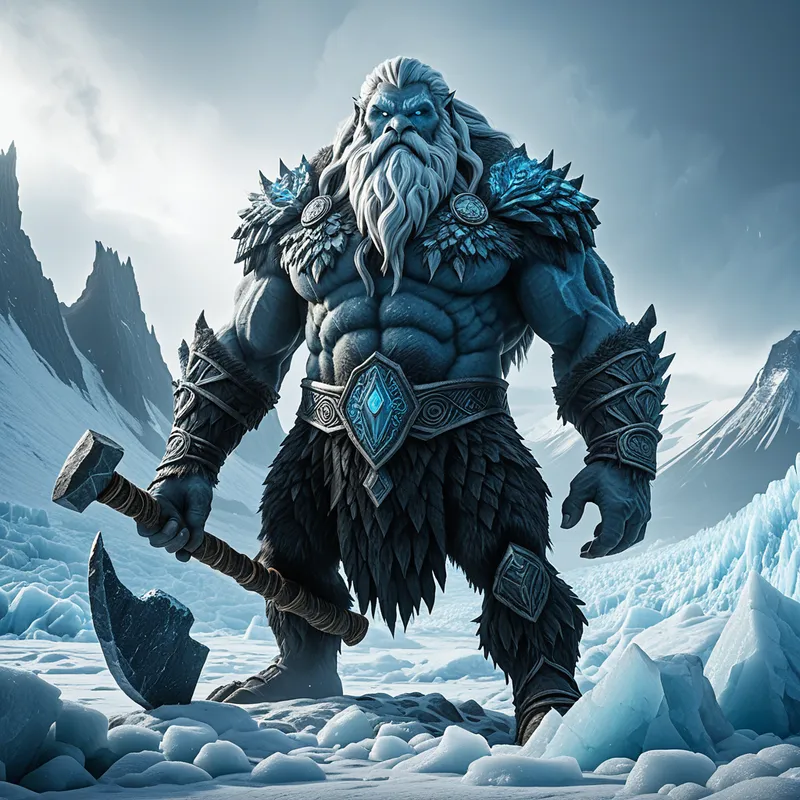
The Jötnar are the primordial giants of chaos and creation, representing the untamed forces of nature and the unconscious that the gods must engage to build the world.
The Tale of Jötnar
Listen. Before the sun knew its path and the moon its hiding place, there was only the Ginnungagap—the yawning void, a breath held between two realms. To the north, Niflheim, a place of rime and silence. To the south, Muspelheim, a land of flame and fury. Where their breaths met in the great emptiness, the ice of Niflheim dripped and steamed. From that weeping, that first moisture, life stirred. It coalesced, grew heavy, and took a form: Ymir, the first of the Jötnar, a being of frost and earth, asleep in the chaos.
From the sweat of Ymir’s armpit, a male and female Jötunn were born. From his legs, another son. The race of giants swelled from his sleeping form. And from the melting ice, a cow, Audhumbla, emerged. Her licks upon the salty ice-blocks freed another shape: Buri, the first of the gods. His lineage would lead to Odin and his brothers, Vili and Vé.
But the world was cramped, filled with the snoring bulk of Ymir and his clamorous offspring. The young gods looked upon the primal giant, not as a grandfather, but as the embodiment of the formless, consuming chaos from which they wished to carve order. So they did what new orders must do to the old: they rose up and slew Ymir. His blood became a deluge, drowning all but two of the Jötnar, who fled to the edges of the world. From his flesh, they molded Midgard, the middle-yard. From his bones, the mountains; from his teeth, the stones; from his skull, the dome of the sky, held aloft by four dwarves. From sparks of Muspelheim, they fashioned the stars.
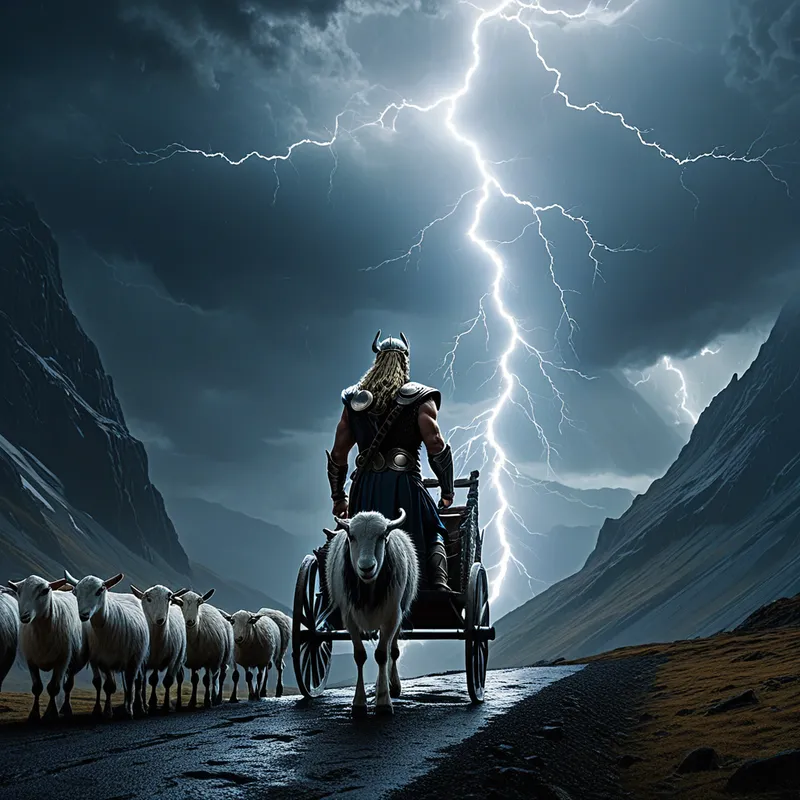
Yet the Jötnar were not gone. They retreated to Jötunheimr, a land of harsh beauty and raw power, forever separate from the ordered realms of gods and men. They became the eternal "other," the constant pressure on the walls of the world. Thor would ride out in his goat-drawn chariot, his hammer Mjölnir cracking the sky, to break giant skulls and keep the chaos at bay. Loki, himself born of Jötunn blood, would weave between the realms, a catalyst of both creation and destruction. The gods would seek out giantesses for wisdom, for magic, and for brides, forever bound to the very force they sought to master. For the world was built from the body of a giant, and its end, Ragnarök, would be heralded by their final, furious return.
Cultural Origins & Context
These stories were not scripture, but living breath in the longhouses of Scandinavia and Iceland. They were the province of skalds—poets and storytellers who held the lineage of the world in their verses. Passed down orally for centuries, these myths were codified mainly in 13th-century Iceland, most famously in the Poetic Edda and the Prose Edda by Snorri Sturluson, a Christian scholar trying to preserve a fading pagan worldview.
In a culture intimately acquainted with a harsh, untamable environment—where winter was a giant that had to be fought each year, where the sea was a hungry monster, and where the wilderness beyond the farmstead was vast and unknown—the Jötnar made profound sense. They personified the existential threats of famine, storm, cold, and the chaotic forces of nature that could erase human order in an instant. The mythic cycle of the gods battling giants was not just entertainment; it was a cosmological model for the Norse understanding of reality: a fragile, hard-won order (Asgard and Midgard) perpetually defended against an encircling, primordial chaos (Jötunheimr).
Symbolic Architecture
Psychologically, the Jötnar represent the raw, undifferentiated contents of the unconscious. They are the primal matter of the psyche—the instincts, the passions, the chaotic swirl of potential and memory that exists before the light of consciousness (the gods) brings form and distinction.
The ego, like Asgard, is built from the material of the unconscious. We slay the formless giant of pure potential to build a coherent self, yet we forever dwell in a world made of its substance.
They are not simply "evil." They are antecedent. They are creativity in its raw, volcanic state; wisdom that is ancient and non-rational; desire that is boundless and consuming. The gods’ constant struggle with them symbolizes the ego's necessary but endless task of engaging with the unconscious: to fight it when it threatens to overwhelm (Thor’s battles), to trick it for gain (Loki’s deceptions), or to marry it to bring new qualities into the conscious realm (the many unions between gods and giantesses). The Jötnar are the shadow, not merely as personal failings, but as the vast, impersonal, and fecund ground of being from which individual consciousness springs.
The Dreamer's Resonance
When the imagery of the Jötnar stirs in modern dreams, it signals an encounter with these foundational, often frightening, layers of the self. To dream of vast, slow-moving figures of earth or ice, of being in a crushing, primordial landscape, or of a looming, ancient presence at the edge of one’s psychic territory is to feel the pressure of the unconscious asserting itself.
This is not a nightmare of persecution, but a somatic experience of psychic gravity. The dreamer may be undergoing a process where old structures of identity (the ordered "Asgard" of their personality) are being challenged by a surge of unlived life, repressed emotion, or creative potential (the rising Jötnar). The feeling is often one of awe mixed with dread—the recognition of something vastly older and more powerful than the daily self. It is the psyche’s way of announcing that negotiation with these deeper forces can no longer be avoided; integration, not annihilation, is the required task.
Alchemical Translation
The alchemical work modeled by the Jötnar myth is the opus contra naturam—the work against nature, which is really a work of transmuting raw nature into conscious spirit. The process begins with the nigredo, the blackening: the confrontation with the chaotic, "giant" material of the unconscious (the slaying of Ymir). This is a necessary, violent separation of consciousness from its undifferentiated source.
Individuation is not about building walls against chaos, but about learning to build with its stones.
The next stage is the albedo, the whitening: the fashioning of a world from this material (creating Midgard from Ymir’s body). Here, the ego constructs a stable reality. But the work is never done. The final, mature stage is the conscious, ongoing relationship. This is the rubedo, the reddening or maturation: the god seeking out the giantess for her wisdom, the acknowledgment of kinship with Loki, the acceptance that one’s strength and creativity are forever fed by the very chaos one contains. The triumph is not in the final victory over the giants—for Ragnarök tells us that is an illusion—but in the courage to ride out, again and again, to meet them, to know them, and to bring something of their raw, ancient power back into the service of a more conscious, more whole, and more resilient self. The goal is not a world without giants, but a self strong enough to dwell in a world made of them.
Associated Symbols
Explore related symbols from the CaleaDream lexicon: