Jörmungandr Myth Meaning & Symbolism
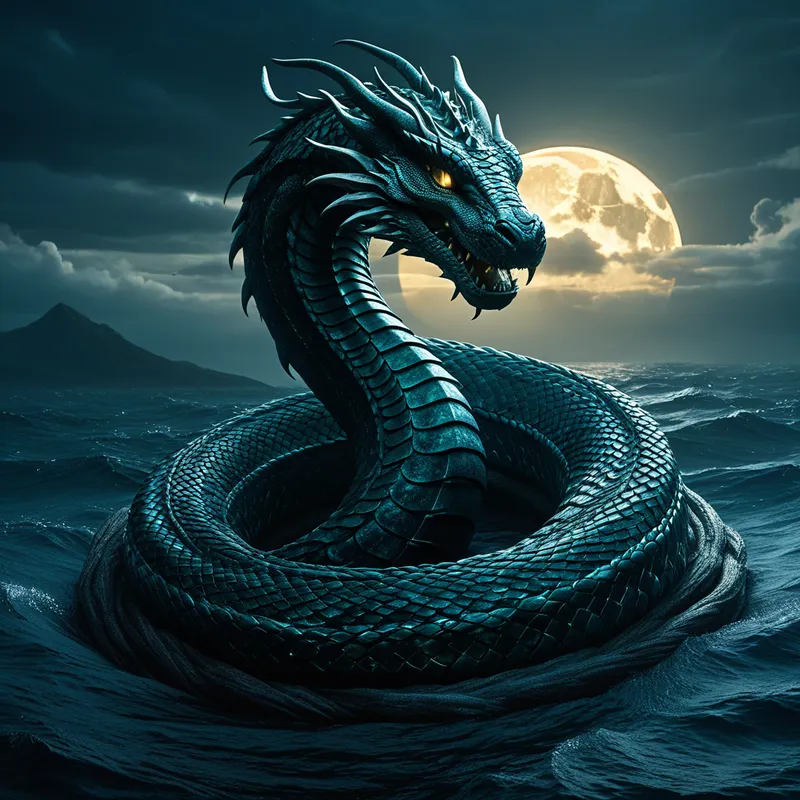
The immense serpent cast into the sea by Odin, destined to encircle the world and battle Thor at Ragnarok, embodying chaos, containment, and cyclical fate.
The Tale of Jörmungandr
Hear now of the great shaping, when the bones of the world were still soft. In the high halls of Asgard, Odin looked into the well of wisdom and saw a writhing shadow in the deep. It was one of the monstrous children of Loki, born of the giantess Angrboða—a serpent of such vile and boundless growth that its very existence threatened the order of the nine worlds.
Odin’s one eye saw not just the beast, but the pattern of its fate. With a voice that shook the roots of Yggdrasil, he commanded it be taken from Jötunheimr. The Aesir seized the coiling, hissing creature, its scales still slick from the womb of chaos. They carried it not to a prison of stone, but to the vast, grey expanse that encircled the lands of men: the great ocean. With a heave born of dread and necessity, they cast the serpent into the salty deep.
And there, in the cold and crushing dark, the miracle of containment occurred. The ocean was vast, but the serpent’s growth was vaster. It grew and grew, feeding on the leviathans of the deep and the detritus of all worlds, until its length spanned the horizon. Its tail sought its own mouth, and finding it, it bit down. Jörmungandr became the Ouroboros of Midgard, a living belt of scale and muscle around the girdle of the world. The very thing meant to destroy order had become its defining boundary. The sea was its body, the land its heart.
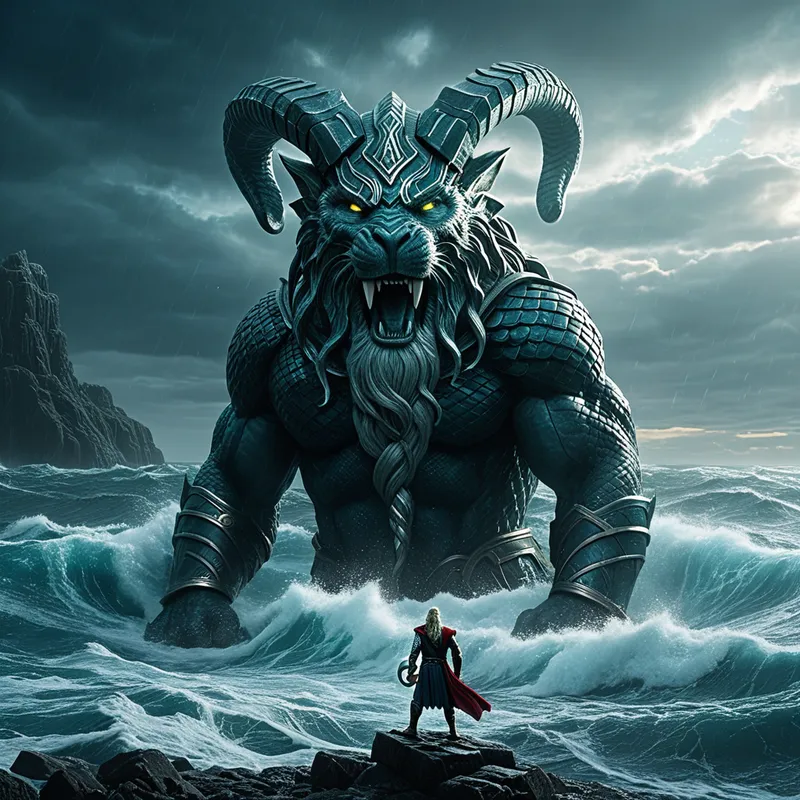
Yet fate is a knot that tightens. The thunderer, Thor, whose rage is the storm, would twice meet the serpent he loathed. Once, in the hall of the giant Útgarða-Loki, he strained to lift a cat that was the serpent in disguise, moving the very world. And once, on a fishing trip with the giant Hymir, he hooked the beast itself. The sea boiled, the sky cracked with lightning, and Thor raised the monstrous head, venom dripping like rain, his hammer poised for the blow that would end the age. But Hymir, in terror, cut the line, and the serpent sank back into the abyss with a sound like continents shifting.
This was but a rehearsal. The final act is written in the runes of doom. When the stars fall and Ragnarok begins, Jörmungandr will writhe in final fury, spewing poison across land and sea. Thor will come for his ancient foe. They will meet in the last battle, a dance of thunder and venom. The god will slay the serpent, and stagger nine paces, to fall dead from its poison. World-ender and world-defender, locked in an embrace of mutual annihilation, making way for the green world to rise again from the sea.
Cultural Origins & Context
This myth was not penned in a book, but breathed into the smoky air of the longhouse. It was part of the vast, interconnected tapestry of Norse lore, preserved and transmitted orally by skalds and poets for centuries before being recorded in the 13th-century texts of the Prose Edda and the poetic fragments of the Elder Edda. These stories were not mere entertainment; they were a cognitive map of a harsh and magnificent universe.
In a culture intimately familiar with the capricious, encircling sea, Jörmungandr was a profound cosmological explanation. The ocean was the ultimate unknown, a source of sustenance and a bringer of death. The myth gave that formless terror a form: a tangible, if monstrous, entity. It explained why the world was habitable—because chaos was literally held at bay, contained in a defined ring. The serpent modeled the Norse understanding of fate (ørlög): an inescapable, pre-written pattern where even the gods’ actions to avert doom only ensure its arrival. The story of Thor’s fishing trip and their final duel at Ragnarok served as a powerful narrative engine, reinforcing values of courage, fatalism, and the acceptance of necessary, cyclical destruction.
Symbolic Architecture
Jörmungandr is the archetypal symbol of contained chaos. It represents the vast, unconscious, and potentially annihilating forces that exist both outside and within the individual and the collective.
The serpent does not destroy the world from without; it defines the world by encircling it. The greatest threat, when fully faced, becomes the necessary boundary.
Psychologically, it is the embodiment of the Shadow in its most colossal, impersonal form. It is not a personal flaw, but the raw, amoral, instinctual force of nature itself—the churning id of the world. Odin’s act of casting it into the sea is the primordial act of consciousness: the ego attempting to separate itself from, and impose order upon, the formless deep of the unconscious. The serpent’s position, biting its own tail to form the Ouroboros, symbolizes a paradox: the system of order (the world of Midgard) is only possible because it is surrounded by, and therefore defined against, the very chaos it fears. The boundary is not a wall, but the chaos itself, forced into a circular shape.
The repeated clashes with Thor represent the ego’s (Thor) necessary but ultimately futile attempts to permanently defeat this unconscious force. Each encounter is a temporary victory of order, a holding back of the tide, but the serpent always returns to the deep. The myth acknowledges that the shadow cannot be eradicated; it can only be engaged with, managed, and ultimately, accepted as part of the total structure of reality.
The Dreamer's Resonance
When the World Serpent surfaces in modern dreams, it rarely appears as a literal monster. Its presence is more atmospheric, more somatic. One may dream of vast, circular structures—a highway with no exit, a moat around a castle, a ring of towering waves. There is a feeling of being encircled, contained, or of confronting something too large to comprehend. The dreamer might feel the ground tremble with a subterranean movement or see a dark, sinuous shape distorting the landscape beneath a thin surface.
This dream signals a profound encounter with a systemic or archetypal shadow. It is not about a personal anger or repressed memory, but about confronting the immense, impersonal forces that shape one’s life: the cyclical patterns of family destiny, the overwhelming pressure of societal systems, or the raw, biological realities of mortality and decay. The psyche is sensing the "Jörmungandr" of its own existence—the vast, unconscious complex that defines the limits of the dreamer’s current world. The somatic feeling of being encircled is key; it speaks to a recognition that one’s identity and life are constructed in relation to, and in tension with, a powerful, encircling "other."
Alchemical Translation
The individuation process, the journey toward psychic wholeness, is mirrored perfectly in the myth’s arc. It begins with the recognition and containment of the shadow (Odin casting the serpent into the sea). The individual must first acknowledge the existence of these vast, chaotic forces within the personal and collective unconscious, and consciously choose to "contain" them—not by repression, but by giving them a defined place in one’s psychic geography.
The middle stage is the repeated engagement (Thor’s battles). The conscious ego must test its strength against these forces. These are life’s great crises, the "fishing trips" where we accidentally hook something far bigger than we intended. We may lift the serpent’s head briefly—gaining insight, experiencing a breakthrough—only to have it slip back, teaching us that this is not a war to be won once, but a relationship to be maintained.
The alchemical goal is not to kill the serpent, but to understand that you and the serpent are two poles of the same circle. The poison and the thunder are one substance.
The culmination is the Ragnarok integration. In the alchemy of the soul, this is not literal death, but the death of the old, rigid ego-structure that sees itself as separate from the serpent. The final battle represents the ultimate confrontation where the conscious principle (Thor) and the unconscious principle (Jörmungandr) meet with full force. The "death" of both is the dissolution of their opposition. From this mutual annihilation arises the potential for a new, more integrated consciousness—the "green world" that rises after Ragnarok. The individual learns that their wholeness includes the serpent. The chaos is not outside; it is the very circle that contains and defines the totality of the Self. One becomes, in a sense, both the contained world and the serpent that encircles it.
Associated Symbols
Explore related symbols from the CaleaDream lexicon:
- Snake Slither
- Giant Footprint
- Sliding Ice
- Ice Blue
- Centipede Movement
- Viper
- Snake Slithering
- Reticulated Python
- Scaled Guardian
- Fiery Gopher Snake
- Venomous Bite
- Elder Serpent
- Turbulent Storm at Sea
- Kraken
- Sea Serpent
- Serpent's Fang
- Jotunn Storm
- Toy Snake
- Serpent-Headed Graffiti
- Serpent Statue
- Torus
- Serpent Wisdom
- Infinity
- Torsion
- Rust
- Limit
- Snake
- Daring Tarpon