
Jörð Myth Meaning & Symbolism
The story of Jörð, the living Earth, whose union with Odin births Thor, modeling the sacred marriage of consciousness and the grounded, instinctual world.
The Tale of Jörð
Listen, and hear the tale that is not sung in halls of mead, but whispered by the roots of the great Yggdrasil. Before the gods walked, she was. She was the deep hum of stone, the sigh of loam, the patient dreaming of the mountain’s bones. They named her Jörð, and she was the land itself—vast, silent, and fecund.
The sky was a realm of thought and storm, ruled by the All-Father, Odin, he of the single eye that sees all patterns, all fates written in the well’s dark water. He wandered, a cloak of shadows about his shoulders, his mind a tempest of seeking. He knew the runes, he knew the price of wisdom paid in pain, but he knew not stillness. His spirit was an eagle, forever circling the heights, and in its soaring, a great loneliness grew.
One twilight, as the last light bled into the Ginnungagap, Odin’s wanderings brought him to a place of profound quiet. It was not a hall, not a forest, but a wide, rolling expanse where the wind spoke only to the grass. Here, the ceaseless churn of his thoughts met a deep, resonant silence. He felt it not with his eye, but with his being—a presence immense and patient. It was the presence of the land, of Jörð. She did not speak in words, but in the scent of damp soil after rain, in the cool solidity underfoot, in the slow, green pulse of life waiting beneath the surface.
The conflict was not of clashing swords, but of opposing essences. The sky-god, all intellect and furious will, stood before the earth-goddess, all body and instinctual becoming. His was the realm of being; hers was the realm of becoming. He saw in her not an object, but a consciousness—a deep, knowing slumber that held all potential. Drawn by a need he could not name, a need to anchor his soaring vision, Odin reached out. Not with a hand, but with his spirit.
And the Earth responded.
The rising action was not a battle, but a merging. The storm of Odin’s consciousness descended into the fertile darkness of Jörð. Sky touched soil. Lightning, the sharp flash of divine awareness, seared into the rich, receptive clay. It was a union of the highest and the lowest, the thinker and the felt, the father of æsir and the mother of all that grows. In that sacred collision, a new potency was forged—not in the heavens, but deep within the womb of the world itself.
From this union, a resolution was born in thunder. Jörð brought forth a son, a child of both realms. He was strength incarnate, with hair like storm-lit wheat and a voice that shook the foundations of mountains. They named him Thor. In him, the sky’s righteous fury was given the solid fist of the earth; the abstract power of the god was made manifest, tangible, protectively physical. He was the bridge, the living testament to the moment the wanderer found his home, not in a hall, but in the very ground of being.

Cultural Origins & Context
The myth of Jörð survives not as a single, elaborated epic, but as fragments—a name in a skáldic kenning, a lineage recited in the Prose Edda. She is called "daughter of Night" and "mother of Thor," placing her at the very core of the cosmic family. This was not a tale for grand performance, but a foundational truth woven into the understanding of the world itself.
For the Norse, the land was not passive scenery; it was a living, responsive entity. Every farm, forest, and fjord had its landvættir. Jörð was the totality of this spirit—the animating soul of the physical world upon which life, survival, and fate depended. Her myth functioned as a sacred map of reality: consciousness (Odin) is barren and adrift without the grounding, nourishing matrix of the physical and instinctual (Jörð). The myth sanctified the relationship between the people and their environment. It explained why the thunder god, protector of Midgard, was born from the soil—he was literally the defender of his mother’s body.
Symbolic Architecture
Psychologically, Jörð represents the archetypal Ground of Being. She is the unconscious not as a dark cellar of repressed trauma, but as the fertile, creative, and instinctual foundation of the psyche. She is the body’s wisdom, the somatic intelligence, the "felt sense" that exists before and beneath language.
The marriage of sky and earth is the primordial act of consciousness realizing it is not separate from the ground from which it sprang.
Odin symbolizes the differentiated consciousness—the ego, the seeker, the intellect that risks inflation and isolation in its lofty pursuits. His union with Jörð is the necessary coniunctio oppositorum (union of opposites) that prevents the psyche from spinning into dissociation. Thor, the resulting "child," symbolizes the ego grounded in instinct—a consciousness that is powerful, effective, and protective because it is in right relationship with its own foundational, earthy nature. He is willpower informed by vitality, action rooted in substance.
The Dreamer's Resonance
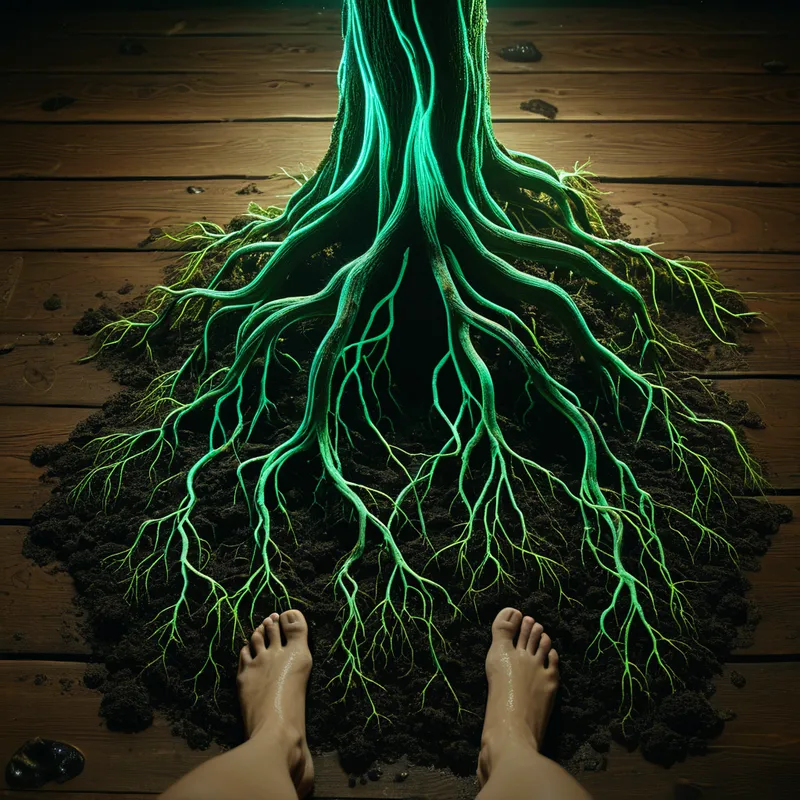
When this myth stirs in the modern dreamer, it often manifests as a profound somatic call. One may dream of roots breaking through floors, of lying down and merging with the soil, of an overwhelming urge to touch bare earth, or of a vast, feminine presence in a landscape that feels deeply familiar and nurturing.
These dreams signal a psychological process of grounding. The dreamer’s consciousness may have become too identified with the "Odinic" aspects—overthinking, planning, living in abstract futures or pasts, disconnected from the physical present. The psyche, through the image of Jörð, is initiating a corrective. It is a call to descend from the head into the body, to feel the feet on the ground, to attend to physical needs, to honor rhythms of rest and digestion. It is an invitation to heal the mind-body split by recognizing the body not as a vehicle, but as the very temple and substance of the soul.
Alchemical Translation
The alchemical journey modeled here is the transmutation of spirit into embodied soul. The prima materia is the unintegrated psyche: a brilliant but wandering spirit (Odin) alienated from its base matter (Jörð).
The nigredo, or blackening, is the moment of confrontation—the loneliness of the sky-god, the felt absence of substance. The albedo, or whitening, is the recognition and courtship—the turning of attention toward the somatic, the earthy, the instinctual. The sacred marriage itself is the coniunctio, the red stage where opposites unite.
Individuation is not about ascending to pure spirit, but about bringing spirit fully into the vessel of earthly existence.
The resulting "child," Thor, is the lapis philosophorum—the philosopher’s stone—for the modern individual. It is the achieved state where one’s highest values, intellect, and aspirations (Odin) are nourished and made potent through a loving, respectful relationship with one’s physical being, emotional depths, and ecological context (Jörð). The triumph is not transcendence of the earth, but the realization that true power, creativity, and protection are born from this sacred union. We do not escape nature; we become conscious participants in it, defending its sanctity within and without, as Thor defends Midgard. The work is to stop wandering, and to finally, fully, come home to the ground of our own being.
Associated Symbols
Explore related symbols from the CaleaDream lexicon: