Journey to the West Myth Meaning & Symbolism
A rebellious monkey-god escorts a monk on a perilous pilgrimage to fetch sacred scriptures, battling demons and his own nature to achieve enlightenment.
The Tale of Journey to the West
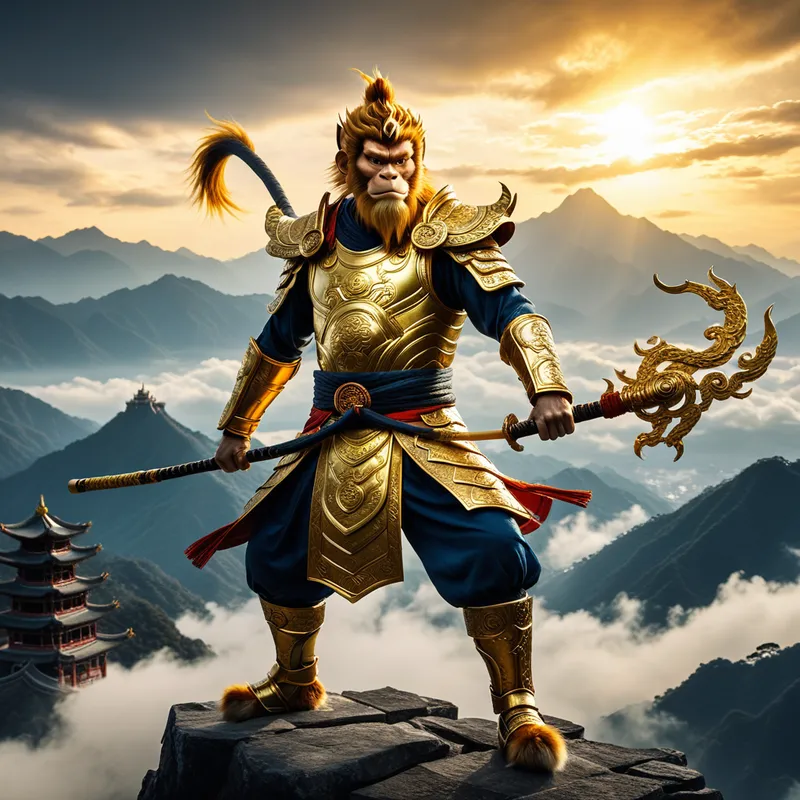
Hear now the tale of a pilgrimage that shook the heavens and tamed the earth. In the celestial court of Jade Emperor, chaos was born from a stone. A monkey, hatched from a rock nourished by the cosmos, crowned himself Great Sage Equal to Heaven. His name was Sun Wukong, and with his Ruyi Jingu Bang, a staff that could span the skies or hide behind an ear, he defied the gods. He drank the elixir of immortality, ate the peaches of longevity, and scrawled his name in the ledgers of the dead. The heavens trembled at his laughter.
No cage could hold him, no army defeat him. In the end, it was not force but wisdom that subdued him. The Buddha himself pressed a mountain upon the rebellious sage, pinning him for five hundred years under the weight of his own boundless pride. There he waited, in the silence of crushed ambition, until a sound broke through the stone: the footsteps of a pilgrim.
The pilgrim was the monk Xuanzang, chosen by Guanyin, the Goddess of Mercy, for a sacred task. He was to travel west, to the thunderous peaks of Vulture Peak, to retrieve the true scriptures and bring enlightenment to the Eastern lands. His path was a ribbon of peril through a world thick with hunger—hunger for flesh, for power, for the monk’s pure heart that promised immortality to any demon who consumed it.
To protect him, Guanyin sought disciples bound by fate. From his mountain prison, Sun Wukong was offered freedom, sealed by a golden fillet placed upon his brow—a circlet that tightened with a whispered sutra, a constant reminder of the discipline he lacked. He was joined by two other fallen spirits: Zhu Bajie, whose piggish form mirrored his insatiable appetites, and Sha Wujing, a silent, burdened ogre seeking redemption.
So the fellowship walked. They crossed rivers where dragons lurked, scaled mountains where bone-white winds howled, and passed through kingdoms ruled by illusion. Eighty-one tribulations, each a test. The Monkey King’s brilliance and wrath saved them time and again, yet his greatest enemy was often his own impetuous heart, punished by the tightening fillet. The pig longed for his wife and a warm bed, the ogre simply bore the load, and the monk, in his endless compassion, often mistook deception for virtue, nearly leading them all to the cooking pot.
After years of dust and wonder, they stood before the Buddha. The scriptures were granted, but not before a final, sly test—they received blank scrolls, only to return for the true, inscribed ones. The lesson was etched not just on paper, but in their souls. As they flew back east on a cloud, their earthly forms fell away. The rebellious monkey, the lustful pig, the burdened ogre—all were transformed. They ascended to their true, enlightened stations, Victorious Fighting Buddha among them. The journey was the scripture. The path was the prize.
Cultural Origins & Context
The epic is a magnificent tapestry woven from many threads. Its core is the historical 7th-century pilgrimage of the Buddhist monk Xuanzang, who traveled to India to study and bring back sacred texts. This real-life odyssey of faith and scholarship was first embellished in popular folktales and dramatic performances during the Tang and Song dynasties. It was in the Ming dynasty, however, that the story crystallized into its definitive form through the literary genius—likely of Wu Cheng’en—who compiled and authored the 100-chapter novel Journey to the West.
This was not a text confined to scholars. It was a story for the people, told in teahouses, performed in operas, and passed down through generations. It served a dual societal function: as a thrilling adventure full of magic and humor, and as a vehicle for syncretic spiritual teaching, blending Buddhist ideals with Daoist magic and Chinese folk religion. It presented a cosmology where heaven was a bureaucracy, demons were everywhere, and enlightenment was a hard road best traveled with a trickster’s wit. It affirmed the possibility of redemption for all, no matter how flawed, if they committed to the arduous path of discipline and service.
Symbolic Architecture
At its heart, Journey to the West is a grand allegory for the soul’s progression toward enlightenment. Each main character represents a facet of the human psyche undertaking this journey.
Sun Wukong is the untamed, brilliant, and rebellious ego. Born from the primordial stone (the unformed Self), he possesses limitless potential—the 72 transformations, the cloud somersaults. Yet, this potential is chaotic, selfish, and destructive. His imprisonment under the mountain is the crushing weight of existential crisis, where raw power meets its limit. The golden fillet is the necessary constraint, the discipline of mindfulness and moral code that directs his mighty energy toward a higher purpose.
The ego must not be destroyed, but enlisted. The Monkey King’s fury, once turned against heaven, becomes the very force that protects the pilgrimage.
Xuanzang represents the spirit, the pure but naive intention toward enlightenment. He is compassion without discernment, constantly endangered by his own virtue. He needs the Monkey King’s discernment and force to survive, just as the spirit needs the disciplined ego to navigate the world. Zhu Bajie embodies raw appetite and sensual desire, while Sha Wujing is the burden of karma, the quiet, persevering weight of our past actions. The white horse is the vehicle of the body, carrying the spirit forward. The 81 tribulations are the inevitable trials of life, each an opportunity to shed an illusion, conquer a fear, or integrate a shadow.
The Dreamer's Resonance
When this myth stirs in the modern dreamer, it signals a profound psychological process is underway. To dream of being pursued by shape-shifting demons may reflect feeling assailed by chaotic, unrecognized aspects of the self—anxieties, desires, or past traumas that “feed” on one’s vital energy. Dreaming of a powerful, rebellious animal (like a monkey) breaking free could signify the ego’s healthy rebellion against oppressive structures, internal or external, that have kept one’s true potential imprisoned.
A dream of a long, arduous journey with mismatched companions often mirrors the somatic feeling of life’s current path—a sense of being burdened, pulled by base desires (the pig), yet guided by a flickering, higher intention (the monk). The tightening of a band around the head in a dream can be a direct somatic metaphor for the pressure of a new discipline, a moral dilemma, or the painful but necessary containment of a wild impulse to serve a greater goal. These dreams ask: What part of you is the untamed Monkey King needing direction? What is the sacred task you are avoiding?
Alchemical Translation
The myth models the alchemical process of individuation—the Jungian journey toward psychic wholeness. The initial state is one of inflation: the monolithic, stone-born ego (Sun Wukong) believes it is the center of the cosmos. The crisis (imprisonment) forces a dissolution of this inflated identity. The call to the pilgrimage is the emergence of the Self, the organizing principle of the psyche (represented by the combined mission of the group).
Individuation is not a solitary ascent but a fellowship of the fragments. The pig, the ogre, the horse—they must all make the journey. Wholeness requires redeeming what we would rather leave behind.
The long road west is the transformation stage. Each demon battled is a complex or shadow aspect integrated. The ego (Monkey King) learns to serve the spirit (monk), not dominate it. The spirit learns to accept the protection and discernment of the ego. Base instincts (Zhu Bajie) and karmic burdens (Sha Wujing) are not eliminated but given a role in the quest. The final arrival and reception of the true scriptures—after being tricked with blank ones—symbolizes the integration and realization that enlightenment is not an external reward, but the embodied wisdom gained from the process itself. The Monkey King becomes a Buddha, not by ceasing to be a fighter, but by fully becoming the Victorious Fighting Buddha—his essential nature perfected and redirected. For the modern individual, the alchemy lies in recognizing one’s own pilgrimage: identifying the “scriptures” (wholeness, purpose) one seeks, accepting the necessary disciplines (the fillet), and embracing the entire troupe of one’s personality on the long road home.
Associated Symbols
Explore related symbols from the CaleaDream lexicon: