
Jotunn Footprints Myth Meaning & Symbolism
A myth of immense, ancient tracks left in the land, telling of a time when the world was raw, and the gods walked with their primordial kin.
The Tale of Jotunn Footprints
Listen, and let [the hearth](/myths/the-hearth “Myth from Norse culture.”/)-fire grow low. I will tell you of the marks left not by gods or men, but by the First Ones, the ones who were here when [the world](/myths/the-world “Myth from Tarot culture.”/) was still soft clay beneath [the sky](/myths/the-sky “Myth from Persian culture.”/)’s forge.
In the days when Odin was still young in his one-eyed seeing, and Thor’s hammer-song was a new sound in the air, the lands of [Midgard](/myths/midgard “Myth from Norse culture.”/) bore a different weight. The mountains were still settling their bones; the rivers were cutting their first, hesitant paths. And across this nascent skin of [the earth](/myths/the-earth “Myth from Hindu culture.”/) walked the [Jötnar](/myths/jtnar “Myth from Norse culture.”/). Their shadows were like moving valleys, their breath [the mist](/myths/the-mist “Myth from Celtic culture.”/) that cloaked the northern peaks.
There is a place, a high fjord where the stone is grey and sheer. The skalds whisper that Loki, in one of his restless wanderings, once trailed a [Jotunn](/myths/jotunn “Myth from Norse culture.”/) named [Mimir](/myths/mimir “Myth from Norse culture.”/) to this very spot. They spoke of things older than speech—of the cow Audhumla licking the salt from the stones, of the great corpse of Ymir becoming the world itself. As they spoke, the [Jotunn](/myths/jotunn “Myth from Norse culture.”/) shifted his weight, his foot pressing into the living rock of the mountainside. It was not a blow of anger, but a simple act of being, as a man might lean against a tree.
The stone yielded like wet clay. When the Jotunn moved on, following the path of a glacier yet unborn, he left behind a print. It was not a claw-mark of a beast, but the clear, profound impression of a heel, an arch, and five toes—a shape terrifyingly familiar, yet scaled to a logic that made mortal hearts clench. It filled with the first rain, then the first snow. Centuries later, a band of men, ancestors of the folk you know, found it. They saw it not as a scar, but as a sign. They called it Jötunnafótspor—the Giant’s Footfall—and they knew they walked in a world that remembered its makers. The footprint became a place of offering, a reminder that the ground beneath them was once the flesh of a dreaming giant, and that those who shaped the world still walked its edges, leaving their stories etched in stone and ice.

Cultural Origins & Context
This mythic motif, less a single story than a pervasive cultural perception, is woven into the Norse understanding of landscape. It belongs to the genre of fornaldarsögur—“stories of ancient times”—and landnám narratives that explain the origins of place names and geological features. The tales were not merely fireside entertainment; they were a cognitive map. A peculiar rock formation, an unusually shaped valley, or a deep, isolated depression in a plateau was often interpreted as the footprint of a Jotunn.
These stories were told by farmers, hunters, and sailors—people intimately connected to the land. A skald might formalize it, but the myth was born from direct, somatic experience of the environment. Its societal function was profound: it sacralized the landscape, turning wilderness into a narrative text. It explained the awe-inspiring and often terrifying scale of the Nordic world—the deep fjords, the massive boulders—not as random acts of geology, but as the lingering traces of conscious, primordial beings. It served as a constant, humbling reminder that humanity (Midgard) exists in a middle realm, built from the body of the old giants and constantly under the gaze (and potential threat) of the new gods. The footprint was a tangible anchor to that cosmic history.
Symbolic Architecture
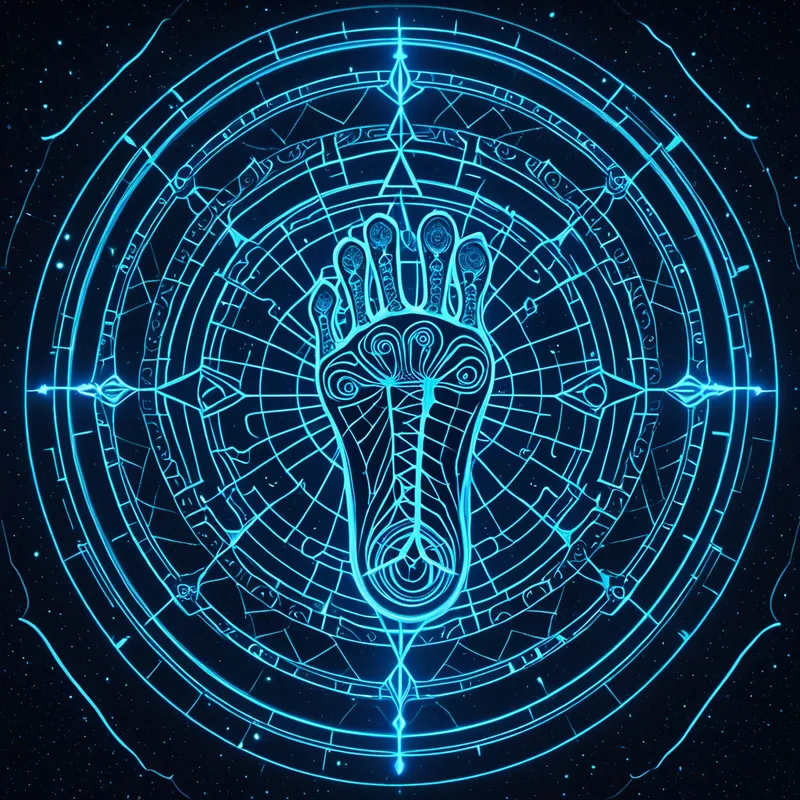
The Jotunn [footprint](/symbols/footprint “Symbol: A footprint symbolizes a journey, the impact of one’s actions, and the legacy left behind.”/) is a master [symbol](/symbols/symbol “Symbol: A symbol can represent an idea, concept, or belief, serving as a powerful tool for communication and understanding.”/) of liminality and [memory](/symbols/memory “Symbol: Memory symbolizes the past, lessons learned, and the narratives we construct about our identities.”/). It is not the giant itself, but its [absence](/symbols/absence “Symbol: The state of something missing, void, or not present. Often signifies loss, potential, or existential questioning.”/) impressed upon [presence](/symbols/presence “Symbol: Presence in dreams often signifies awareness or acknowledgment of something significant in one’s life.”/). It represents the interface between the primordial, chaotic past (the Jötnar) and the structured, conscious present (the world of gods and humans). The [footprint](/symbols/footprint “Symbol: A footprint symbolizes a journey, the impact of one’s actions, and the legacy left behind.”/) is a [boundary](/symbols/boundary “Symbol: A conceptual or physical limit defining separation, protection, or identity between entities, spaces, or states of being.”/) marker.
The impression in the stone is the world’s first memory, a fossil of a time when consciousness itself took its first step.
Psychologically, the Jotunn symbolizes the raw, untamed, and immense contents of the unconscious—the archaic layers of the [psyche](/myths/psyche “Myth from Greek culture.”/) that predate individual [identity](/symbols/identity “Symbol: Identity represents the sense of self, encompassing personal beliefs, cultural background, and social roles.”/). The footprint, then, is the [trace](/symbols/trace “Symbol: A faint remnant or subtle indication of something that was present, suggesting memory, evidence, or a path to follow.”/) this unconscious leaves upon the conscious “[landscape](/symbols/landscape “Symbol: Landscapes in dreams are powerful symbols representing the dreamer’s emotional state, personal journey, and the broader context of life situations.”/)” of [the ego](/myths/the-ego “Myth from Jungian culture.”/). It is the sudden, inexplicable depression in one’s [mood](/symbols/mood “Symbol: Mood in dreams often represents the emotional landscape of the dreamer, reflecting subconscious feelings that may not be acknowledged in waking life.”/), the archaic [pattern](/symbols/pattern “Symbol: A ‘Pattern’ in dreams often signifies the underlying structure of experiences and thoughts, representing both order and the repetitiveness of life’s situations.”/) that repeats in relationships, the foundational [trauma](/symbols/trauma “Symbol: A deeply distressing or disturbing experience that overwhelms the psyche, often manifesting in dreams as unresolved emotional wounds or psychological injury.”/) or gift that shapes one’s inner geography without being fully seen or understood. It is [evidence](/symbols/evidence “Symbol: Proof or material that establishes truth, often related to justice, guilt, or validation of beliefs.”/) that something vast and formative has passed through the territory of [the self](/myths/the-self “Myth from Jungian culture.”/), leaving an indelible [mark](/symbols/mark “Symbol: A ‘mark’ often symbolizes identity, achievement, or a defining characteristic in dreams.”/) that structures everything built upon it.
The Dreamer’s Resonance
When this mythic pattern stirs in the modern unconscious, it often manifests in dreams of discovering immense, ancient tracks. One might dream of finding a colossal footprint in their backyard, under their house’s foundation, or at the heart of a familiar city. The somatic feeling is one of profound disorientation mixed with awe—the ground of being is revealed to be inscribed by something Other.
This dream signals a process of psychic archaeology. The dream-ego is being confronted with the foundational “footprints” of its own psyche—the early, pre-verbal imprints left by parental figures, cultural conditioning, or innate archetypal structures. The emotion—whether fear, wonder, or solemn respect—indicates the dreamer’s relationship to these deep structures. To dream of measuring the footprint, of trying to fill it, or of watching it slowly fill with [water](/myths/water “Myth from Chinese culture.”/) or light, suggests an active engagement with integrating these profound, shaping forces. The dream is an invitation to acknowledge that the very ground upon which one has built a life is not neutral, but imprinted with ancient, powerful histories.
Alchemical Translation
The alchemical process modeled here is [solutio](/myths/solutio “Myth from Alchemical culture.”/) followed by coagulatio—dissolution and re-coagulation—but of the earth itself, of one’s foundational ground. The myth presents the initial state: the solid, seemingly permanent stone (the conscious attitude, the [persona](/myths/persona “Myth from Greek culture.”/)) is revealed to be malleable, impressed upon by a force of nature (the unconscious). The first step in individuation is this shocking realization: the bedrock of the self is not immutable.
The alchemical work begins not in rejecting the footprint, but in learning to dwell respectfully within its hollow, to study its contours as the first map of one’s own interior world.
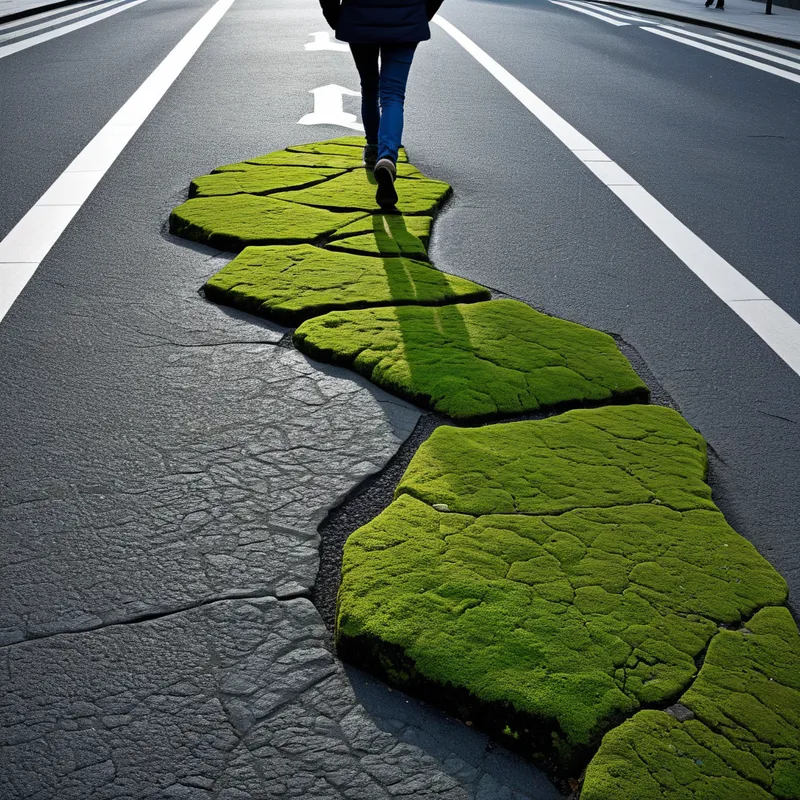
The psychic transmutation involves “filling the footprint.” Will one fill it with [the shadow](/myths/the-shadow “Myth from Jungian culture.”/)‘s fear, making it a pit of dread? Or, like the ancients, will one fill it with an offering—with conscious attention, with the waters of emotion, with the slow growth of understanding (the moss and ice in the hero image)? To do the latter is to perform a sacred act: one acknowledges the primordial source, accepts its shaping power, and then consciously contributes to what that imprint becomes. The footprint ceases to be a wound in the landscape and becomes a vessel, a sacred basin that holds the rain and reflects the stars. The individual no longer builds their identity in denial of the giant’s passage, but upon a conscious, reverent relationship to it, transforming a mark of overwhelming otherness into [the cornerstone](/myths/the-cornerstone “Myth from Biblical culture.”/) of a more authentic, grounded self.
Associated Symbols
Explore related symbols from the CaleaDream lexicon: